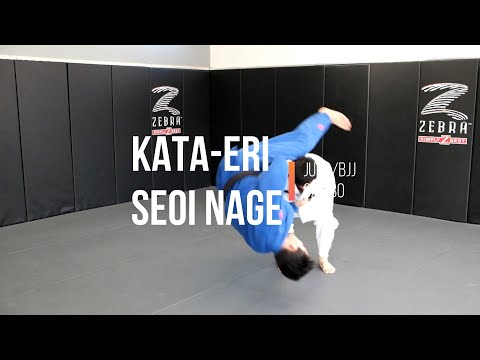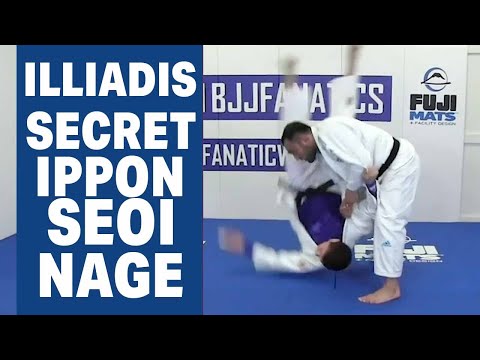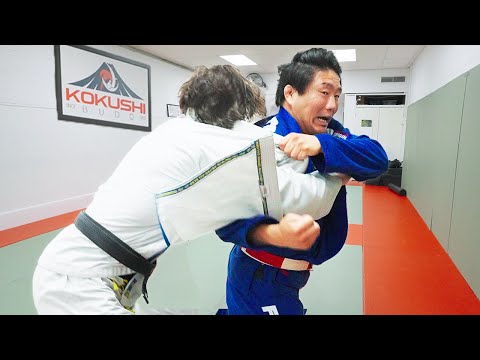
Impress Your Judo Friends With Standing Seoi Nage
0
Eri Seoi Nage·Shintaro Higashi
De Ashi instructional about to drop - get your download below of the popular soto makikomi instructional NEW Soto Makik…
Перевод: shoulder throw
Eri Seoi Nage (collar back-carrying throw) is a seoi-nage variant in which the thrower grips the opponent's collar or lapel deeply with the throwing hand, turns in, and throws the opponent over the shoulder using the collar grip as the primary control. [1] The deep collar grip provides a high control point near the opponent's neck, allowing the thrower to control posture and direction throughout the entry and throw. [1],[2] Eri seoi-nage is particularly effective against taller opponents, as the high collar grip can be used to break their posture downward during the turn-in. [2],[3]
Eri seoi nage was recognised by the Kodokan as a distinct seoi-nage variant, differentiated by the collar grip that gives the technique its name. [1] The variant has been particularly popular in heavier weight categories where the deep collar grip provides the leverage needed to turn in larger opponents. [2],[3]
Eri seoi nage (lapel seoi nage) is effective because the thrower maintains their grip on the opponent's lapel throughout the throw, providing continuous control and making it difficult for the opponent to create separation. [1] It is particularly useful in modern competition where grip-fighting makes it hard to establish the cross-body arm control needed for ippon seoi nage. [2]
Eri seoi nage is a competition adaptation recognised by the IJF as a variant of seoi nage where the lapel grip is maintained rather than switching to an under-arm grip. [1]
Eri seoi nage (lapel shoulder throw) is a high-frequency scoring variant in IJF competition, particularly among lighter weight categories. [1]
Изображений для этой техники пока нет.
Войдите, чтобы предложить изображение.
De Ashi instructional about to drop - get your download below of the popular soto makikomi instructional NEW Soto Makik…
If you like the video, please hit a like button and a subscribe button! And also, please let me know what techniques you…
I hope you found this technique useful. If you're looking for more details on how you can improve your judo, check out m…
Eri seoi nage, a collar-grip shoulder throw, is executed with both hands gripping the opponent's collar on the same side, with fingers positioned on the outside of the lapel rather than inside to avoid hand injuries (Travis Stevens/Ilias Iliadis). The grip itself remains constant throughout the technique and should originate from a position where the thrower's shoulder remains free and mobile. Stevens/Iliadis emphasizes maintaining precise distance—close enough to prevent the opponent's counter-attack but far enough to execute the throw—achieved through a half-step with the legs working in coordination with the hand placement. The throwing arm must keep the elbow tight to the armpit (both the thrower's and opponent's), with the hand elevated rather than dropping, and execution should be explosive and fast to prevent defensive posting. Shintaro Higashi focuses on standing eri seoi nage specifically, highlighting that collar protection is critical when the opponent attempts to grab the near lapel, and that feinting with grip variations (overhand setup) creates openings. Higashi demonstrates multiple setups to disguise the throw's timing, including head control, leg attacks, and sequential threat combinations that prevent the opponent from anticipating the actual seoi nage entry. Both instructors stress that the technique requires coordinated leg and hand movement executed with speed and proper distance management to succeed against a resisting opponent.
Сформировано на основе 3 инструкторов
Учебных курсов по этой технике пока нет.
Войдите, чтобы предложить курс.
Риск травмы для человека, к которому применяется техника
Seoi-Nage family; high amplitude with rotation over tori's shoulder (Kano 1986)
Уровень мастерства, необходимый для надёжного выполнения техники
Разрешена ли техника по основным соревновательным правилам
Kodokan Judo — Official Nage-waza Classification
Traditional Judo throwing technique terminology (Kodokan Institute)
Official Kodokan ground technique classification system
Standard Japanese martial arts terminology (kanji/hiragana)
Established Japanese martial arts naming convention — native Japanese term (和語/漢語)
Traditional Judo throwing technique terminology (Kodokan Institute)
explosive turning speed, arm pulling power, deep level change
shorter stature for getting under the opponent, strong back
deltoids, trapezius, quadriceps, core
Keep the same grip throughout—never change it. Travis Stevens emphasizes that the grip remains constant from setup through execution.
Keep both fingers on the outside of the grip and position your elbow inside toward the opponent's armpit, rather than starting from an elevated position. This positioning maintains freedom in your shoulder and prevents the opponent from detecting the throw early.
Use minimal, efficient movement—just enough to get in position. Travis Stevens stresses using controlled, compact steps rather than exaggerated footwork.
Eri Seoi Nage (collar back-carrying throw) is a seoi-nage variant in which the thrower grips the opponent's collar or lapel deeply with the throwing hand, turns in, and throws the opponent over the shoulder using the collar grip as the primary control. The deep collar grip provides a high control point near the opponent's neck, allowing the thrower to control posture and direction throughout the entry and throw.
Eri seoi nage was recognised by the Kodokan as a distinct seoi-nage variant, differentiated by the collar grip that gives the technique its name. The variant has been particularly popular in heavier weight categories where the deep collar grip provides the leverage needed to turn in larger opponents.
IJF: разрешён — Legal throwing technique; IBJJF: разрешён — Legal at all belt levels; UWW: разрешён — Legal in both freestyle and Greco-Roman; Unified MMA: разрешён — Legal throwing technique; ADCC: разрешён — Legal; FIAS Sport Sambo: разрешён — Legal; FIAS Combat Sambo: разрешён — Legal
Оценка опасности 6/10. High — Seoi-Nage family; high amplitude with rotation over tori's shoulder (Kano 1986)
Стандартная цепочка подготовки: Grip Setup (Kumi-kata) → Off-Balance (Kuzushi) → Entry (Tsukuri) → Execution (Kake).
Стандартные контрприёмы: Lower Centre of Gravity — bend knees and drop hips to make the throw harder to execute / Grip Break — deny the thrower their preferred gripping configuration / Stiff-Arm — maintain distance with straight arms to prevent the entry.
Распространённые варианты: Morote seoi nage (two-handed shoulder throw with both hands gripping); Ippon seoi nage (one-arm shoulder throw loading the arm over the shoulder); Drop seoi nage (dropping to the knees for a lower entry point); Korean-style shoulder throw (modified entry with deeper level change).
Eri seoi nage (lapel shoulder throw) is a high-frequency scoring variant in IJF competition, particularly among lighter weight categories.
Основные ошибки, на которые стоит обратить внимание: Gripping too shallow on the lapel — the deep grip is what makes this variant effective / Not turning the body fully — the deep grip requires a complete 180-degree rotation to generate the throw / Letting the opponent strip the deep lapel grip before you enter — secure it firmly before committing / Entering without kuzushi — the deep grip tempts you to skip the forward pull, but kuzushi is still essential.
Eri Seoi Nage также известен как Seoi Nage, Lapel Shoulder Throw, Collar Seoi Nage, Eri Seoi Nage.