Yama Arashi
0
Yama Arashi·Seiryoku Zenyo
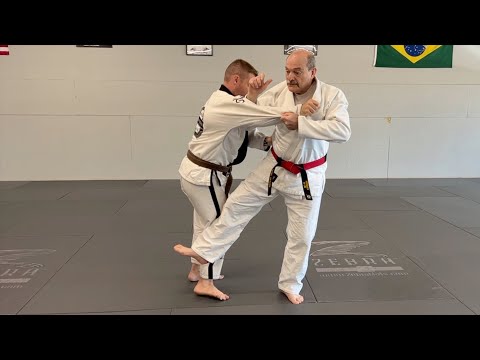
Mark Gilston, 4th degree judo black belt and 2nd degree BJJ black belt demonstrates and discusses uses for an unusual ve…
Перевод: mountain storm
Yama Arashi (mountain storm) is a powerful te-waza technique in which the thrower secures a deep lapel grip, often gripping over the shoulder or at the neck, turns in, and drives the opponent forward and over while dropping the body to amplify the throwing force. [1] The technique generates tremendous rotational force through the combination of the deep grip, explosive turning action, and the thrower's body-weight commitment. [1],[2] Yama-arashi is classified as a te-waza despite its sacrifice-like body drop because the primary throwing mechanism is the arm and grip action rather than the body fall itself. [2],[3]
Yama arashi is one of judo's most historically significant techniques, closely associated with Shiro Saigo, who reportedly used it to defeat much larger opponents in the famous 1886 Tokyo Metropolitan Police tournament that established the Kodokan's supremacy. [1] The technique's dramatic name ('mountain storm') reflects the overwhelming power of its execution. [2],[3] Modern historians debate whether Saigo's technique was truly yama-arashi or another throw, but the technique's legendary status in judo lore is firmly established. [3]
Yama arashi is rarely seen in modern IJF competition but holds historical significance in judo's development. [1]
Изображений для этой техники пока нет.
Войдите, чтобы предложить изображение.
Mark Gilston, 4th degree judo black belt and 2nd degree BJJ black belt demonstrates and discusses uses for an unusual ve…
Учебных курсов по этой технике пока нет.
Войдите, чтобы предложить курс.
Риск травмы для человека, к которому применяется техника
Sacrifice version adds tori's falling body weight to arm throw mechanics
Уровень мастерства, необходимый для надёжного выполнения техники
Разрешена ли техника по основным соревновательным правилам
Kodokan Judo — Official Nage-waza Classification
Traditional Judo throwing technique terminology (Kodokan Institute)
Official Kodokan ground technique classification system
Standard Japanese martial arts terminology (kanji/hiragana)
Established Japanese martial arts naming convention — native Japanese term (和語/漢語)
Traditional Judo throwing technique terminology (Kodokan Institute)
explosive turning speed, arm pulling power, deep level change
shorter stature for getting under the opponent, strong back
deltoids, trapezius, quadriceps, core
Каждое движение в любом боевом искусстве обладает рядом универсальных свойств. Комбинируйте параметры ниже, чтобы найти нужный инструмент или сравнить аналоги из разных стилей.
According to Seiryoku Zenyo's approach, use a sleeve grip and come in with just above your elbow, between your elbow and your wrist, pushing away and then down rather than using a one-sided grip.
Keep your leg strong with your toe pointed up to the ceiling rather than pointed forward, and pivot when you throw to generate power.
Seiryoku Zenyo teaches a more subtle, 'old man style' version of the throw that differs from the usually seen classic technique, emphasizing the sleeve grip and elbow placement over the standard method.
Yama Arashi (mountain storm) is a powerful te-waza technique in which the thrower secures a deep lapel grip, often gripping over the shoulder or at the neck, turns in, and drives the opponent forward and over while dropping the body to amplify the throwing force. The technique generates tremendous rotational force through the combination of the deep grip, explosive turning action, and the thrower's body-weight commitment.
Yama arashi is one of judo's most historically significant techniques, closely associated with Shiro Saigo, who reportedly used it to defeat much larger opponents in the famous 1886 Tokyo Metropolitan Police tournament that established the Kodokan's supremacy. The technique's dramatic name ('mountain storm') reflects the overwhelming power of its execution.
IJF: разрешён — Legal throwing technique; IBJJF: разрешён — Legal at all belt levels; UWW: ограничен — Legal in freestyle, banned in Greco-Roman (no leg attacks below waist); Unified MMA: разрешён — Legal throwing technique; ADCC: разрешён — Legal; FIAS Sport Sambo: разрешён — Legal; FIAS Combat Sambo: разрешён — Legal
Оценка опасности 6/10. High — sacrifice version adds tori's falling body weight to arm throw mechanics
Стандартная цепочка подготовки: Grip Setup (Kumi-kata) → Off-Balance (Kuzushi) → Entry (Tsukuri) → Execution (Kake) → Fall (Sutemi).
Стандартные контрприёмы: Lower Centre of Gravity — bend knees and drop hips to make the throw harder to execute / Grip Break — deny the thrower their preferred gripping configuration / Stiff-Arm — maintain distance with straight arms to prevent the entry.
Распространённые варианты: Morote seoi nage (two-handed shoulder throw with both hands gripping); Ippon seoi nage (one-arm shoulder throw loading the arm over the shoulder); Drop seoi nage (dropping to the knees for a lower entry point); Korean-style shoulder throw (modified entry with deeper level change).
Yama arashi is rarely seen in modern IJF competition but holds historical significance in judo's development.
Основные ошибки, на которые стоит обратить внимание: Not committing to the sacrifice fall — yama arashi requires full commitment to the falling entry / Losing the deep lapel grip during the fall — the grip is the anchor of the entire throw / Falling straight down instead of falling while rotating — the rotation is what throws the opponent / Not pulling the opponent over with enough force during the sacrifice.
Yama Arashi также известен как Mountain Storm, Mountain Storm Throw, Yama Arashi.