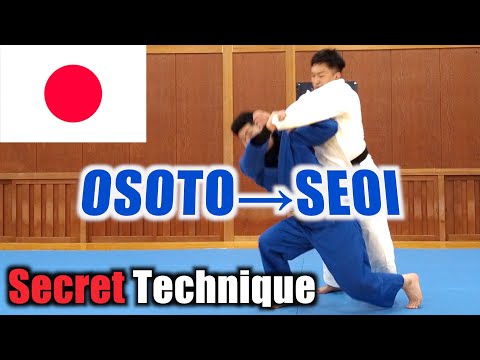
Learn Judo Throw This Basic Combination Technique!
0
Judo Combination Throw·Travis Stevens
Learning judo can be challenging. Try this basic combination to get a better feel for judo! Grab a membership to The A…
Перевод: Combination technique
The Judo Combination Throw family (renraku waza, 連絡技) covers the art of linking two or more throwing techniques together, where the first throw creates the reaction or off-balance needed for the second throw to succeed — the hallmark of advanced judo competition strategy. [1] Combination throwing exploits the opponent's defensive reaction to the initial attack: when they resist one throw by shifting weight in a specific direction, that weight shift becomes the perfect kuzushi (off-balance) for a throw in the opposite or perpendicular direction. [1],[2] Classic judo combinations include o uchi gari → o soto gari (inside reap driving the opponent backward, then outside reap when they step back), seoi nage → ko uchi gari (forward throw feint, then inside reap when they resist forward), and uchi mata → ouchi gari. [2],[3] Mastery of renraku waza is what separates competitive judoka from recreational practitioners — a single-technique thrower is predictable, while a combination thrower is nearly impossible to defend. [3]
Combination throwing is central to advanced judo and was emphasised by the great Kodokan masters. [1] Kyuzo Mifune (10th dan, 'God of Judo') was legendary for his ability to chain throws seamlessly, as documented in his 'Canon of Judo' (1956). [1],[2] Modern competition judo at the international level relies heavily on renraku waza, with champions like Teddy Riner, Shohei Ono, and Ilias Iliadis known for their combination throwing ability. [2],[3]
Combination throwing is what makes judo throwing effective at the highest levels — single-technique throwers are easily defended by experienced opponents, while combination throwers create unsolvable puzzles. [1] At the Olympic and World Championship level, the majority of scoring throws come from combinations rather than single attacks. [2] The same principle (chain attacks) applies across all grappling: chain wrestling, chain submissions, and chain sweeps all use the same action-reaction principle. [3]
Изображений для этой техники пока нет.
Войдите, чтобы предложить изображение.
Learning judo can be challenging. Try this basic combination to get a better feel for judo! Grab a membership to The A…
Learn how to do this advanced combination of OSOTO to SEOI. A beautiful judo throw. OSOTO GARI SEOI NAGE SEOI OTOSHI T…
Учебных курсов по этой технике пока нет.
Войдите, чтобы предложить курс.
Риск травмы для человека, к которому применяется техника
Combination throws carry standard throwing impact risks; the speed of transitions between throws can catch opponents off-guard, increasing the amplitude of the final throw; the recipient must be able to breakfall from unexpected angles
Уровень мастерства, необходимый для надёжного выполнения техники
Разрешена ли техника по основным соревновательным правилам
Best Judo (Inokuma & Sato, 1979)
Description sources — [1] Best Judo (Inokuma & Sato, 1979) on renraku waza [2] Canon of Judo (Mifune, 1956) [3] Olympic/World Championship judo analysis
Official Kodokan ground technique classification system
Description sources — [1] Best Judo (Inokuma & Sato, 1979) on renraku waza [2] Canon of Judo (Mifune, 1956) [3] Olympic/World Championship judo analysis
all individual throwing physical requirements PLUS reaction time, tactical awareness, grip maintenance during transitions
fast transitions between techniques, good balance, ability to read the opponent's weight shifts
same as individual throwing components with emphasis on core (transitioning between throw directions)
Каждое движение в любом боевом искусстве обладает рядом универсальных свойств. Комбинируйте параметры ниже, чтобы найти нужный инструмент или сравнить аналоги из разных стилей.
Judo combination throws (renraku-waza) chain two or more throws together — the first throw creates the reaction that makes the second throw available. The most common: ko-uchi to o-uchi, o-uchi to uchi-mata, seoi-nage to ko-uchi. Combination attacks are considered the mark of advanced judo. (Kano, Kodokan Judo; judo coaching manuals)
Travis Stevens emphasizes that your hands, shoulders, and body must work together as one unit to create the proper reaction and drive power into the technique.
Travis Stevens explains that you should pull yourself in close, change your hand direction, lower your center of gravity, and then execute the follow-up throw by changing direction again.
According to FLUID JUDO JAPAN, step with your right foot first, then land your left foot, immediately rotate it, and point your toes in the direction of the throw.
The Judo Combination Throw family (renraku waza, 連絡技) covers the art of linking two or more throwing techniques together, where the first throw creates the reaction or off-balance needed for the second throw to succeed — the hallmark of advanced judo competition strategy. Combination throwing exploits the opponent's defensive reaction to the initial attack: when they resist one throw by shifting weight in a specific direction, that weight shift becomes the perfect kuzushi (off-balance) for a throw in the opposite or perpendicular direction.
Combination throwing is central to advanced judo and was emphasised by the great Kodokan masters. Kyuzo Mifune (10th dan, 'God of Judo') was legendary for his ability to chain throws seamlessly, as documented in his 'Canon of Judo' (1956).
IJF: разрешён — Legal throwing technique; IBJJF: разрешён — Legal at all belt levels; UWW: разрешён — Legal in both freestyle and Greco-Roman; Unified MMA: разрешён — Legal throwing technique; ADCC: разрешён — Legal; FIAS Sport Sambo: разрешён — Legal; FIAS Combat Sambo: разрешён — Legal
Оценка опасности 6/10. Moderate — combination throws carry standard throwing impact risks; the speed of transitions between throws can catch opponents off-guard, increasing the amplitude of the final throw; the recipient must be able to breakfall from unexpected angles
Стандартная цепочка подготовки: Establish Dominant Grip (Kumi Kata) → Attack with Throw #1 → Read the Reaction → Transition → Execute Throw #2 → Follow Through.
Стандартные контрприёмы: Not reacting predictably — varying defensive responses makes combination throwing harder / Counter-throwing — using throw #1 as a counter opportunity rather than simply defending / Grip breaking between throws — stripping the grip during the transition prevents throw #2 / Movement — circular movement and tai sabaki make combination entries difficult.
Распространённые варианты: Forward-backward combinations (seoi nage → ko uchi gari; tai otoshi → o uchi gari (feint…); Backward-forward combinations (o soto gari → seoi nage; o uchi gari → tai otoshi (drive …); Lateral combinations (harai goshi → o uchi gari (sweep one side, reap the other)); Same-direction chains (de ashi barai → de ashi barai (repeated sweeps in the sam…); Three-throw combinations (elite judoka chain three throws: o uchi gari → ko uchi ga…); Wrestling chain equivalent (single leg → double leg → high crotch (the same principle…).
Combination throws produce the majority of scores at the Olympic and World Championship level in judo. Elite champions are defined by their combination throwing ability.
Основные ошибки, на которые стоит обратить внимание: Only committing to one throw — a half-hearted first throw doesn't create the defensive reaction needed for the combin… / Pausing between throws — the transition must be immediate; any pause allows the opponent to reset their balance / Always using the same combination — predictable combinations are defended; develop multiple combinations in different… / Not reading the opponent's reaction — the second throw must match the opponent's actual defensive reaction; throwing ….
Judo Combination Throw также известен как Renraku Waza, Combination Technique, Throwing Combination.