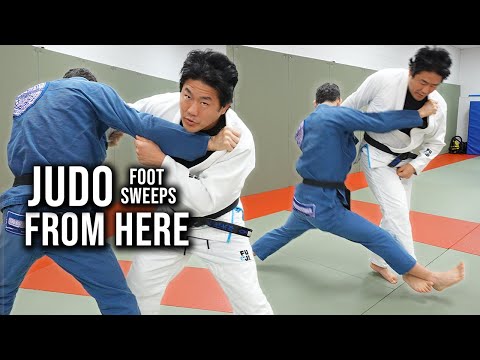
Judo foot sweep drill.
0
Foot Sweep·Coach Scott
Practice you foot work with this simple but effective drill.
Перевод: Foot technique
The Foot Sweep group covers throwing techniques where the thrower uses their foot or leg to sweep, reap, hook, or trip the opponent's supporting leg, causing them to lose balance and fall — the most timing-dependent and technically refined techniques in all of martial arts. [1] Known as ashi waza in judo, foot sweeps are often called the 'gentleman's throw' because a perfectly timed sweep requires no strength at all — only precise timing that catches the opponent mid-step when their weight transfers to one foot. [1],[2] Judo master Kyuzo Mifune demonstrated that foot sweeps can be used by a smaller fighter to throw a much larger opponent, as the technique relies on timing and kuzushi rather than power. [2],[3] This group includes de ashi barai (advancing foot sweep — often considered the single most fundamental throw in judo), o soto gari (major outer reap), ko soto gari (minor outer reap), o uchi gari (major inner reap), ko uchi gari (minor inner reap), and sasae tsurikomi ashi (propping drawing ankle throw). [3]
Foot sweeps have been central to judo since its founding by Jigoro Kano in 1882 — ashi waza was one of the original throw categories in the Kodokan Gokyo. [1] Kano reportedly considered de ashi barai the most important throw for developing proper throwing principles, placing it first in the original Gokyo. [1],[2] Kyuzo Mifune, the 'God of Judo' (10th dan), was legendary for his foot sweep mastery, demonstrating that perfect timing could overcome any size or strength disadvantage. [2],[3] The foot sweep concept appears across multiple martial arts — Muay Thai features the teep sweep and clinch sweeps, wrestling uses foot trips, and many traditional martial arts include sweeping techniques. [3]
Foot sweeps are among the most efficient techniques in judo — when timing is perfect, they require almost zero physical effort while producing dramatic results. [1] In competition judo, o soto gari is consistently one of the top three scoring throws at the international level. [2] The combination of ko uchi gari and o uchi gari as setup throws for major techniques (seoi nage, uchi mata) makes them indispensable in any competitive judoka's arsenal. [3]
Foot sweeps derive from the ashi waza category of Kodokan judo, which synthesised sweeping techniques from multiple koryu jujutsu traditions. [1] Kyuzo Mifune's mastery of ashi waza (documented in Canon of Judo, 1956) elevated foot sweeps to the highest art form in martial arts. [1],[2] Modern judo competition continues to feature ashi waza prominently, with o soto gari being one of the most commonly attempted and scored techniques at Olympic and World Championship level. [2]
O soto gari is one of the top three most-scored throws in international judo competition, frequently producing ippon at the Olympic and World Championship level. [1] Ko uchi gari and o uchi gari, while rarely scoring ippon on their own, are among the most commonly used setup techniques that create openings for other throws. [1],[2]
Изображений для этой техники пока нет.
Войдите, чтобы предложить изображение.
Practice you foot work with this simple but effective drill.
Brian Glick No Gi Foot Sweep Tutorial https://www.youtube.com/watch?v=7OAt8Nntv0c Give him a Follow! 10% off Subscript…
Учебных курсов по этой технике пока нет.
Войдите, чтобы предложить курс.
Риск травмы для человека, к которому применяется техника
Foot sweeps are generally among the safer throws; the lower amplitude means less impact on landing compared to hip throws or sacrifice throws; primary injury risk is to the swept leg (ankle sprains if caught awkwardly) and to the head if the thrown person doesn't breakfall properly
Уровень мастерства, необходимый для надёжного выполнения техники
Разрешена ли техника по основным соревновательным правилам
Kodokan Judo (Jigoro Kano, 1986)
Description sources — [1] Kodokan Judo (Kano, 1986) on ashi waza as fundamental [2] Canon of Judo (Mifune, 1956) on timing principles [3] Best Judo (Inokuma & Sato, 1979) on ashi waza classification
History sources — [1] Kodokan Judo (Kano, 1986) [2] Mifune's legendary sweep demonstrations [3] Cross-martial arts sweep traditions
Effectiveness sources — [1] Canon of Judo (Mifune, 1956) on efficiency [2] IJF competition statistics on o soto gari scoring rate [3] Combination throwing analysis
Official Kodokan ground technique classification system
Description sources — [1] Kodokan Judo (Kano, 1986) on ashi waza as fundamental [2] Canon of Judo (Mifune, 1956) on timing principles [3] Best Judo (Inokuma & Sato, 1979) on ashi waza classification
History sources — [1] Kodokan Judo (Kano, 1986) [2] Mifune's legendary sweep demonstrations [3] Cross-martial arts sweep traditions
Effectiveness sources — [1] Canon of Judo (Mifune, 1956) on efficiency [2] IJF competition statistics on o soto gari scoring rate [3] Combination throwing analysis
timing sensitivity (the primary attribute — foot sweeps are timing techniques above all), balance (sweeping while maintaining own standing position), kuzushi skill (hands must coordinate perfectly with foot contact)
long legs (more reach for sweeps and reaps), good proprioception (feeling the opponent's weight shifts), quick feet
hip abductors/adductors (driving the sweep laterally), calves (controlling foot placement), forearms (pulling power for kuzushi), core (balance during single-leg support phase)
Каждое движение в любом боевом искусстве обладает рядом универсальных свойств. Комбинируйте параметры ниже, чтобы найти нужный инструмент или сравнить аналоги из разных стилей.
Foot sweeps appear in 172 passages across 46 books — extensively documented across judo, karate, and MMA sources. The timing-based takedown family — the attacker sweeps the opponent's foot during weight transfer. Considered the most technically demanding takedowns in judo. (46 books; Kano, Kodokan Judo)
Coach Scott emphasizes that you should engage your hips and use your driving leg—hip engagement is critical to generating power for the sweep.
Shintaro Higashi recommends staying in place rather than shifting your body away when your opponent crowds you for the Ko-soto, then drive over them to finish the sweep effectively.
Shintaro Higashi suggests attacking Ko-sio to put weight off one leg, then immediately attacking the Ko-soto on the other leg to create a devastating combination.
The Foot Sweep group covers throwing techniques where the thrower uses their foot or leg to sweep, reap, hook, or trip the opponent's supporting leg, causing them to lose balance and fall — the most timing-dependent and technically refined techniques in all of martial arts. Known as ashi waza in judo, foot sweeps are often called the 'gentleman's throw' because a perfectly timed sweep requires no strength at all — only precise timing that catches the opponent mid-step when their weight transfers to one foot.
Foot sweeps have been central to judo since its founding by Jigoro Kano in 1882 — ashi waza was one of the original throw categories in the Kodokan Gokyo. Kano reportedly considered de ashi barai the most important throw for developing proper throwing principles, placing it first in the original Gokyo.
IJF: разрешён — Legal throwing technique; IBJJF: разрешён — Legal at all belt levels; UWW: ограничен — Legal in freestyle, banned in Greco-Roman (no leg attacks below waist); Unified MMA: разрешён — Legal throwing technique; ADCC: разрешён — Legal; FIAS Sport Sambo: разрешён — Legal; FIAS Combat Sambo: разрешён — Legal
Оценка опасности 4/10. Moderate — foot sweeps are generally among the safer throws; the lower amplitude means less impact on landing compared to hip throws or sacrifice throws; primary injury risk is to the swept leg (ankle sprains if caught awkwardly) and to the head if the thrown person doesn't breakfall properly
Стандартная цепочка подготовки: Movement → Read the Step → Time the Sweep → Coordinate Hands → Drive Through → Follow Up.
Стандартные контрприёмы: Lift the Foot — when sensing a sweep attempt, lift the targeted foot so the sweep catches air / Counter-sweep — sweeping the opponent's sweeping leg as it comes in / Step Over — stepping over the sweep attempt and continuing forward / Post and Balance — posting the targeted foot firmly and absorbing the sweep with bent knee.
Распространённые варианты: De ashi barai (advancing foot sweep) (sweeping the opponent's lead foot as it advances; the mos…); O soto gari (major outer reap) (reaping the opponent's outside leg while driving them bac…); Ko uchi gari (minor inner reap) (hooking the opponent's inside heel and pulling it; a quic…); O uchi gari (major inner reap) (stepping between the opponent's legs and reaping their in…); Sasae tsurikomi ashi (propping drawing ankle throw) (blocking the opponent's ankle while pulling them over the…); Ko soto gari (minor outer reap) (a quick outside reap against the heel); Harai tsurikomi ashi (sweeping drawing ankle) (sweeping the ankle while pulling the opponent forward and…).
O soto gari is one of the top three most-scored throws in international judo competition, frequently producing ippon at the Olympic and World Championship level. Ko uchi gari and o uchi gari, while rarely scoring ippon on their own, are among the most commonly used setup techniques that create openings for other throws.
Основные ошибки, на которые стоит обратить внимание: Sweeping too early — the foot must be swept at the exact moment of weight transfer; sweeping too early catches an emp… / Sweeping too late — sweeping after the foot has fully planted means trying to move a rooted, weighted foot; this requ… / Neglecting the hand pull (kuzushi) — foot sweeps without proper upper-body kuzushi are merely leg contacts; the hands… / Standing upright during o soto gari — the reaping action requires driving the chest into the opponent while sweeping;….
Foot Sweep также известен как Ashi Waza, Foot Technique, Leg Sweep, Ashi Barai.