Standard Ko Soto Gake

Род

Перевод: minor outer hook

Дистанция и классификация

Категория
Удар и защитаЗамкиБлижний бойБой против нескольких
Дистанция
БлижняяСредняяДальняя
Целевая зона
Верхняя частьСредняя частьНижняя часть

Обзор

Standard Ko Soto Gake executes the classical minor outer hook where the thrower places the sole of the foot behind the opponent's heel from the outside, hooks it to prevent backward stepping, and drives the opponent rearward with chest and hand pressure. [1] The opponent, unable to retreat because the foot is trapped, falls backward over the hooked ankle. [1],[2] The throw requires the thrower to be close to the opponent, with strong forward pressure and precise foot placement behind the target heel. [2],[3]

Также известна как
Classical Minor Outer HookBoxing[1]Standard Small Outside HookBoxing[2]
Используется в

История и происхождение

The standard form of ko soto gake has been part of the Kodokan judo syllabus as a recognised nage-waza technique. [1] It is commonly taught alongside the reaping techniques as an alternative finishing mechanic for close-range standing situations. [2],[3]

Страна происхождения· показано в случайном порядке

  • Япония小外掛け(Ko Soto Gake)Дзюдо, Бразильское джиу-джитсу
  • БразилияБразильское джиу-джитсу, ММА
  • СШАММА
  • КитайШуайцзяо

Эффективность

Ko soto gake is effective at close range where the hooking action traps the opponent's heel and prevents any backward stepping to recover balance. [1] It is particularly useful in clinch situations where the fighters are chest-to-chest and larger sweeping techniques cannot be executed. [2]

Родословная

Ko soto gake is classified in the expanded Kodokan nage-waza list, distinguished from reaping (gari) techniques by its hooking (gake) mechanic. [1]

Соревновательные результаты

The standard ko soto gake is seen in IJF competition. [1]

Изображения

Изображений для этой техники пока нет.

Войдите, чтобы предложить изображение.

Биомеханический механизм

Primary ActionPulling and lifting with the arms to load the opponent over the shoulder or upper back
Joints InvolvedAttacker's shoulders (loading point), elbows (pulling action), hips (turning under the opponent)
Force VectorForward and downward rotation — the pulling arm creates circular momentum while the body turns underneath
Kuzushi (Off-balancing)Forward — breaking the opponent's balance forward over their toes allows the turning entry

Позиция и вход

From judo gripBreak balance forward, turn in and hook the opponent's inner thigh with the throwing leg, continue rotation to sweep them off the ground
From underhookSecure inside position, turn and hook the leg while driving the upper body forward

Варианты

Standard techniqueprimary execution from standard grip and positioning
No-gi adaptationmodified without gi grips for submission grappling or MMA
Combination entryentering from a failed attack or chain of techniques
Counter throwapplied as a direct counter to the opponent's throw or attack

Видео

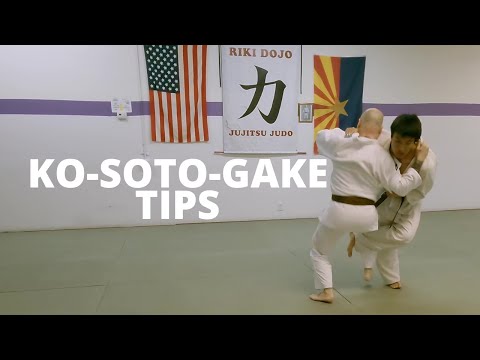
Ko-Soto-Gake Tips | Riki Judo Dojo

0
Standard Ko Soto Gake·Riki Judo Dojo·Added by Admin

Riki sensei explained ko-soto-gake (小外掛 - small outer hook) during judo class on 2-18-2022. 0:00 Definition 0:20 Jujit

1 video

Изучить технику

Учебных курсов по этой технике пока нет.

Войдите, чтобы предложить курс.

Оценки

Уровень опасности

Риск травмы для человека, к которому применяется техника

5
Высокий5/10

Hooking action can cause knee/ankle injury if resisted; moderate impact on landing

Сложность

Уровень мастерства, необходимый для надёжного выполнения техники

Средний
Допустимость на соревнованиях

Разрешена ли техника по основным соревновательным правилам

Ограничено
no leg attacks below waist
UWW International Wrestling Rules, January 2026PDF
Разрешено
IJF — Legal throwing technique
IJF Sport and Organisation Rules 2025, Article 27PDF
IBJJF — Legal at all belt levels
IBJJF Rules Book v6.0, June 2024PDF
Unified MMA — Legal throwing technique
Unified Rules of MMA, August 2025PDF
FIAS Sport Sambo — Legal
FIAS International Sambo Competition RulesPDF
FIAS Combat Sambo — Legal
FIAS Combat Sambo RulesPDF

Заметки по тренировке

From a standard gripping position, step your lead foot close to the opponent's lead foot
Place the sole of your rear foot behind and outside the opponent's rear heel
Drive forward and downward with the hands — pushing the opponent's upper body over the hooked foot
Your chest drives into the opponent's chest, and your weight pushes them backward over the hook
The throw finishes with the opponent falling backward over the trapped foot
Maintain grip control throughout to follow the opponent to the ground for pinning or transition
The timing is: close distance, hook, drive — all as one flowing motion

Типичные ошибки

!Hooking the foot but not driving forward — the opponent simply lifts their foot off the hook
!Placing the hook and then pausing before driving — the hook and drive must be simultaneous
!Leaving the upper body upright instead of driving the chest forward and down
!Hooking the wrong foot — target the foot that is weighted as you push them backward
!Losing grip during the drive and letting the opponent spin out
!Over-extending the hooking leg and losing your own base
!Not practising the footwork pattern — the approach and hook placement require precise stepping

Связанные техники

Контрприёмы

Цепочка подготовки

1Grip Setup (Kumi-kata)establish the controlling grips needed for the throw
2Off-Balance (Kuzushi)break the opponent's balance in the throwing direction
3Entry (Tsukuri)position the body for the throw by turning, stepping, or loading
4Execution (Kake)complete the throwing action with full commitment and follow-through

Источники и ссылки

Основной источник

Kodokan Judo — Official Nage-waza Classification

1КнигаKodokan Judo — Official Nage-waza Classification

Traditional Judo throwing technique terminology (Kodokan Institute)

Official Kodokan ground technique classification system

3Учебная программаKodokan Judo Institute — Official Waza Names

Standard Japanese martial arts terminology (kanji/hiragana)

4ДругоеJapanese Martial Arts Standard Terminology (武道用語)

Established Japanese martial arts naming convention — native Japanese term (和語/漢語)

5ЦитатаKodokan Judo — Official Nage-waza Classification

Traditional Judo throwing technique terminology (Kodokan Institute)

Сообщество

Атлетизм

Requires

single-leg balance, hip flexibility, explosive driving power

Favours

long legs for hooking reach, strong standing balance

Key muscles

glutes, hip flexors, hamstrings, core, calves (balance)

Часто задаваемые вопросы

Does my heel actually need to touch the back of the knee for ko soto gake to work?

No—Riki Judo Dojo emphasizes that getting your heel precisely on the back of the knee is difficult and unnecessary. Even if only a third of your calf makes contact with the knee, once you catch the hinge and it goes down, the throw will work.

What's the most important motion in executing ko soto gake?

The cutting motion (kari) is most critical. Rather than just hooking, you need to cut the leg with a sickle-like action, which will traumatize the knee and cause the throw to work effectively.

How should my foot be positioned when I hook the leg?

Your toes should point outward (unlike kuzutagari where they come in), and the hook should come from behind the Achilles tendon like a heel strike. Pivot into position before executing the hook motion.

Where exactly should I control my opponent's body during the setup?

Control the hip bone with your foot placement—come right down on the hip bone and keep your foot there rather than underneath the leg, making sure not to leave your foot trapped in that position.

Как работает Standard Ko Soto Gake?

Standard Ko Soto Gake executes the classical minor outer hook where the thrower places the sole of the foot behind the opponent's heel from the outside, hooks it to prevent backward stepping, and drives the opponent rearward with chest and hand pressure. The opponent, unable to retreat because the foot is trapped, falls backward over the hooked ankle.

Откуда происходит Standard Ko Soto Gake?

The standard form of ko soto gake has been part of the Kodokan judo syllabus as a recognised nage-waza technique. It is commonly taught alongside the reaping techniques as an alternative finishing mechanic for close-range standing situations.

Разрешён ли Standard Ko Soto Gake на соревнованиях?

IJF: разрешён — Legal throwing technique; IBJJF: разрешён — Legal at all belt levels; UWW: ограничен — Legal in freestyle, banned in Greco-Roman (no leg attacks below waist); Unified MMA: разрешён — Legal throwing technique; ADCC: разрешён — Legal; FIAS Sport Sambo: разрешён — Legal; FIAS Combat Sambo: разрешён — Legal

Насколько опасен Standard Ko Soto Gake?

Оценка опасности 5/10. High — hooking action can cause knee/ankle injury if resisted; moderate impact on landing

Как подготовить Standard Ko Soto Gake?

Стандартная цепочка подготовки: Grip Setup (Kumi-kata) → Off-Balance (Kuzushi) → Entry (Tsukuri) → Execution (Kake).

Как защититься от Standard Ko Soto Gake?

Стандартные контрприёмы: Lower Centre of Gravity — bend knees and drop hips to make the throw harder to execute / Grip Break — deny the thrower their preferred gripping configuration / Stiff-Arm — maintain distance with straight arms to prevent the entry.

Какие есть варианты Standard Ko Soto Gake?

Распространённые варианты: Standard technique (primary execution from standard grip and positioning); No-gi adaptation (modified without gi grips for submission grappling or MMA); Combination entry (entering from a failed attack or chain of techniques); Counter throw (applied as a direct counter to the opponent's throw or at…).

Насколько эффективен Standard Ko Soto Gake на соревнованиях?

The standard ko soto gake is seen in IJF competition.

Какие типичные ошибки при выполнении Standard Ko Soto Gake?

Основные ошибки, на которые стоит обратить внимание: Hooking the foot but not driving forward — the opponent simply lifts their foot off the hook / Placing the hook and then pausing before driving — the hook and drive must be simultaneous / Leaving the upper body upright instead of driving the chest forward and down / Hooking the wrong foot — target the foot that is weighted as you push them backward.

Какие ещё названия есть у Standard Ko Soto Gake?

Standard Ko Soto Gake также известен как Ko Soto Gake, Classical Minor Outer Hook, Standard Small Outside Hook.