How to Do a Perfect De Ashi Harai | Gordon Ryan
0
Standard De Ashi Barai·Gordon Ryan·Added by Admin
Brand New Inside Camping Instructional Here: https://bjjfanatics.com/collections/new-releases/products/systematically-at…
Перевод: advancing foot sweep
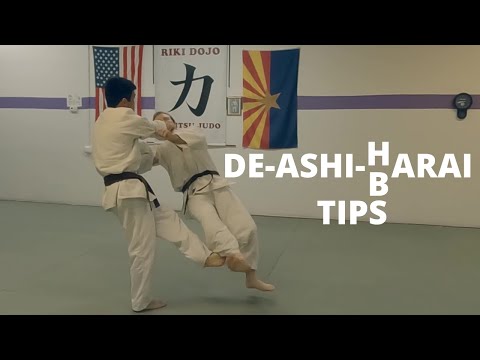
Standard De Ashi Barai is the classical execution of the advancing foot sweep where the thrower uses the sole of the foot to sweep the opponent's lead foot laterally as it advances, while both hands (tsurite lifting and hikite pulling) direct the opponent's upper body over the swept leg. [1] The sweep is performed with a snapping motion of the ankle, contacting the opponent's foot at or just above the ankle joint and brushing it in the direction of travel. [1],[2] The technique scores when the opponent, deprived of their advancing support, falls to the mat from the combined effect of the sweep and hand direction. [2],[3]
De ashi barai is considered one of the purest expressions of judo's efficiency principle — when timed perfectly, it requires minimal physical effort to produce a clean ippon. [1] Mifune described it as the technique that best demonstrates seiryoku zenyo (maximum efficiency, minimum effort). [2] Its effectiveness depends almost entirely on timing rather than strength, making it equally applicable regardless of the size differential between fighters. [3]
De ashi barai is regularly scored at IJF World Tour events and Olympic Games, valued as a counter-attack and as an opportunistic technique during transitions. [1] Its scoring frequency increases at the highest levels of competition where fighters possess the timing sensitivity to exploit momentary weight transfers. [1]
Изображений для этой техники пока нет.
Войдите, чтобы предложить изображение.
Brand New Inside Camping Instructional Here: https://bjjfanatics.com/collections/new-releases/products/systematically-at…
Riki sensei showed us the fundamental way of doing de-ashi-harai / de-ashi-barai (advancing foot sweep) during judo clas…
De ashi barai is a foot sweep executed against the opponent's advancing foot, recognized across both judo and grappling contexts as highly effective despite often being underestimated. Gordon Ryan (Gordon Ryan channel) emphasizes the technique from a rear body lock position in no-gi grappling, prioritizing the creation of forward or backward movement to break the opponent's balance before executing the sweep. Ryan stresses timing the sweep to the moment the foot leaves the floor during the opponent's step, rather than when it is planted, and outlines a progressive drilling sequence: mirroring footwork with hands on hips, catching the elevated foot, locking the hands, adding a hip pop, and finally integrating full-body mechanics to execute the throw while maintaining control position. Riki Judo Dojo (Riki Judo Dojo channel) approaches de ashi barai from a traditional judo perspective, highlighting the critical role of kuzushi (off-balancing) through the pulling hand (hikite) moving downward and inward, and the pushing hand (tsuite) rotating to generate power. Both instructors agree on the importance of timing and full-body commitment, though they differ in context—Ryan focuses on control and transition in no-gi grappling, while Riki emphasizes the violent throwing power and proper grip mechanics essential to judo. Riki additionally stresses maintaining a straight leg during the sweep to preserve energy transfer and warns against prematurely abandoning the technique if initial contact fails.
Сформировано на основе 2 инструкторов
Учебных курсов по этой технике пока нет.
Войдите, чтобы предложить курс.
Риск травмы для человека, к которому применяется техника
Foot sweeps use timing over force; lower impact but head strike risk remains
Уровень мастерства, необходимый для надёжного выполнения техники
Разрешена ли техника по основным соревновательным правилам
Kodokan Judo — Official Nage-waza Classification
Traditional Judo throwing technique terminology (Kodokan Institute)
Official Kodokan ground technique classification system
Standard Japanese martial arts terminology (kanji/hiragana)
Established Japanese martial arts naming convention — native Japanese term (和語/漢語)
Traditional Judo throwing technique terminology (Kodokan Institute)
precise timing, ankle coordination, upper body kuzushi ability
excellent balance and quick reflexes
tibialis anterior, calves, hip rotators, forearms (grip)
Gordon Ryan emphasizes creating movement first by either pulling your opponent backwards or pushing them forward to get them off balance. This forces them to focus on not falling over rather than defending their hands, which makes them vulnerable to the sweep.
Gordon Ryan advises not catching the foot when it's weighted, because you'll have no effect. Instead, monitor your opponent's footwork and catch the foot as they're shifting their weight and beginning to move.
According to Riki Judo Dojo, your pulling hand (hikite) should come down to bend your opponent forward, and you must maintain proper distance so that your arm stays straight rather than bending at the elbow.
Gordon Ryan explains that you step in and lift with a slight pop of the hips, eventually bringing your full body into it—as you lift, you pop everything up, then sweep the foot while your right elbow rises and left elbow cracks down over the hip to put your opponent down.
Standard De Ashi Barai is the classical execution of the advancing foot sweep where the thrower uses the sole of the foot to sweep the opponent's lead foot laterally as it advances, while both hands (tsurite lifting and hikite pulling) direct the opponent's upper body over the swept leg. The sweep is performed with a snapping motion of the ankle, contacting the opponent's foot at or just above the ankle joint and brushing it in the direction of travel.
The standard form of de ashi barai has been taught in the Kodokan curriculum since 1895 and remains one of the first techniques introduced to beginning judo students worldwide. Its emphasis on timing over strength makes it an ideal introductory throw for understanding kuzushi.
IJF: разрешён — Legal throwing technique; IBJJF: разрешён — Legal at all belt levels; UWW: ограничен — Legal in freestyle, banned in Greco-Roman (no leg attacks below waist); Unified MMA: разрешён — Legal throwing technique; ADCC: разрешён — Legal; FIAS Sport Sambo: разрешён — Legal; FIAS Combat Sambo: разрешён — Legal
Оценка опасности 4/10. Moderate — foot sweeps use timing over force; lower impact but head strike risk remains
Стандартная цепочка подготовки: Grip Setup (Kumi-kata) → Off-Balance (Kuzushi) → Entry (Tsukuri) → Execution (Kake).
Стандартные контрприёмы: Lower Centre of Gravity — bend knees and drop hips to make the throw harder to execute / Lift the Targeted Leg — raise the foot being attacked above the sweeping action / Counter-Throw — exploit the attacker's committed weight to throw them instead / Grip Break — deny the thrower their preferred gripping configuration.
Распространённые варианты: Forward sweep (sweeping the foot in the direction the opponent is stepping); Rear sweep (sweeping the foot backward as the opponent retreats); Combination sweep (chaining sweeps to both feet); Counter sweep (timing the sweep as the opponent initiates their own attack).
De ashi barai is regularly scored at IJF World Tour events and Olympic Games, valued as a counter-attack and as an opportunistic technique during transitions. Its scoring frequency increases at the highest levels of competition where fighters possess the timing sensitivity to exploit momentary weight transfers.
Основные ошибки, на которые стоит обратить внимание: Sweeping upward instead of across — the foot should travel horizontally at ankle height / Not accelerating through the sweep — the foot must gain speed through the arc, fastest at the point of contact / Pulling with the hands before the sweep contacts the foot, which warns the opponent / Sweeping from too far away and only clipping the toes instead of catching the full ankle.
Standard De Ashi Barai также известен как De Ashi Barai, De Ashi Harai, Classical Advancing Foot Sweep, Basic Foot Sweep.