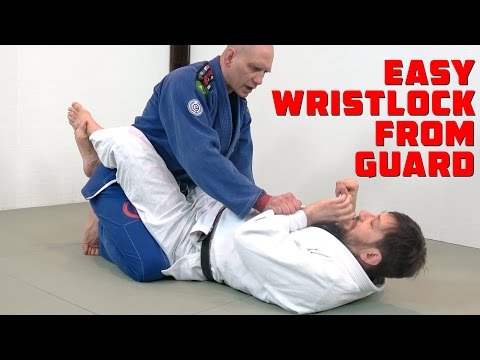
An Easy Wristlock from the Guard
0
From Seated : Guard·Stephan Kesting
Jeff Meszaros shares an easy wrist lock you can do from the closed guard. You can read some great BJJ training articles…
Перевод: from seated/guard
The two-on-one wrist lock from seated guard uses both hands to control and manipulate a single wrist while maintaining guard position. [1] The attacker grips the opponent's hand with both hands and applies leverage against the wrist joint through flexion or deviation, using the guard to prevent the opponent from posturing away. [1],[2]
The two-on-one wrist lock from guard uses both hands to control and lever the opponent's single wrist into a compromised position. Two-on-one wrist control is a fundamental concept in Japanese jujutsu and aikido (where it relates to techniques such as nikkyo and sankyo), and was adapted into ground grappling through Brazilian Jiu-Jitsu. [1],[2] From the guard, the two-on-one grip allows the bottom player to overcome the strength advantage of the top player by concentrating both hands against one wrist. [3] Cunningham notes that the two-on-one wrist lock is particularly effective when the opponent stiff-arms to maintain posture in the guard, as the rigid arm provides a stable lever for the wrist attack. [4]
Seated guard submissions exploit the seated position's hip mobility to attack with guillotines, arm drags to back takes, and leg entanglements. [1]
Seated guard submissions were refined in modern BJJ competition, particularly in no-gi formats where seated guard became a primary playing position. [1]
Seated guard attacks are a standard part of modern no-gi competition, used extensively at ADCC and no-gi IBJJF events. [1]
Изображений для этой техники пока нет.
Войдите, чтобы предложить изображение.
Jeff Meszaros shares an easy wrist lock you can do from the closed guard. You can read some great BJJ training articles…
Учебных курсов по этой технике пока нет.
Войдите, чтобы предложить курс.
Риск травмы для человека, к которому применяется техника
Wrist lock variant targeting carpal and radioulnar joints through forced deviation or torsion
Уровень мастерства, необходимый для надёжного выполнения техники
Разрешена ли техника по основным соревновательным правилам
Japanese wrestling/BJJ standard terminology
Japanese wrestling/BJJ standard terminology
Mixed Japanese-Western terminology — combines traditional Japanese terms with katakana loanwords
Japanese terminology sourced from Japanese wrestling/BJJ standard terminology
fine motor control, grip sensitivity, quick hand transitions
dexterous hands with strong fingers
forearm flexors and extensors, intrinsic hand muscles
You need to secure their wrist position first, then quickly sit in to control their elbow so they can't pull it up and away from you.
Apply wristlocks slowly and without force during training so you can gauge their effectiveness and avoid injuring your partner. Save the speed and intensity for competition or self-defense situations where appropriate.
The finish combines a crunching motion with bringing your legs in to apply pressure and complete the lock.
The two-on-one wrist lock from seated guard uses both hands to control and manipulate a single wrist while maintaining guard position. The attacker grips the opponent's hand with both hands and applies leverage against the wrist joint through flexion or deviation, using the guard to prevent the opponent from posturing away.
The two-on-one wrist lock from guard uses both hands to control and lever the opponent's single wrist into a compromised position. Two-on-one wrist control is a fundamental concept in Japanese jujutsu and aikido (where it relates to techniques such as nikkyo and sankyo), and was adapted into ground grappling through Brazilian Jiu-Jitsu.
IBJJF: разрешён — Legal at all belt levels; IJF: запрещён — Only elbow joint locks (kansetsu-waza) permitted in judo — all other joint lo…; ADCC: разрешён — Legal — all submissions legal in ADCC; Unified MMA: разрешён — Legal submission technique; FIAS Sport Sambo: разрешён — Legal; FIAS Combat Sambo: разрешён — Legal
Оценка опасности 5/10. Wrist lock variant targeting carpal and radioulnar joints through forced deviation or torsion
Стандартная цепочка подготовки: Establish Position → Create the Threat → Secure the Hold → Finish.
Стандартные контрприёмы: Early Recognition — identify the submission attempt early and begin defence immediately / Posture and Base — maintain strong posture and base to prevent submission setups / Grip Fight — deny the attacker their preferred gripping configuration.
Распространённые варианты: Standard wrist lock (kote gaeshi) (two-handed rotational lock on the wrist); Gooseneck wrist lock (flexion lock bending the wrist down toward the forearm); Standing wrist lock (applied during grip fighting or a standing exchange); Ground wrist lock (catching the opponent's posted hand from mount, side cont…).
Seated guard attacks are a standard part of modern no-gi competition, used extensively at ADCC and no-gi IBJJF events.
Основные ошибки, на которые стоит обратить внимание: Sacrificing guard position for the wrist lock — maintain guard integrity while attacking the wrist; losing guard for … / Not using the legs to prevent posture — the guard must restrict the opponent's ability to retract the arm / Attempting against retracted hands — the opponent's hands must be committed (pushing, posting, gripping) for the wris… / Not integrating wrist locks with the guard game — wrist locks should complement sweeps, armbars, and triangles, not e….
From Seated : Guard также известен как Zai / Gādo kara, Guard Two-on-One Wrist Lock, Seated Double Wrist Lock.