Standing BJJ Submissions & Takedown Options | Texas BJJ
0
From Standing·Aces Jiu Jitsu Club
Do you LOVE takedowns? Then this month is for you! Hey Aces!! Watch Coach Mikal and Coach Ty demonstrate Standing submis…
Перевод: from standing
The chin-down wrist lock from standing is applied by gripping the opponent's hand and bending the wrist into flexion while directing the pressure downward toward the opponent's own chin or sternum. [1],[2] The standing position allows the attacker to use body weight and stance changes to amplify the wrist flexion force. [1] The technique requires close range and is commonly initiated from a handshake grip, wrist grab, or collar-tie position where the opponent's hand is already within reach. [1],[2]
Standing wrist flexion techniques directed against the opponent's body are core methods in aikido (kote-gaeshi and kote-hineri families) and traditional jujutsu. [1],[2] The chin-down direction of force appears specifically in self-defense curricula where the goal is to control a standing aggressor using pain compliance. [1] The technique is widely distributed across Asian and Western martial arts traditions that emphasize standing joint manipulation. [1],[2]
Standing submissions (guillotines, standing kimuras, standing arm triangles) are applied from the feet and are high-percentage in MMA where the opponent's guard pull attempt exposes them. [1]
Standing submissions come from judo (tachi-waza ne-waza transitions) and catch wrestling. [1]
Standing submissions, particularly guillotine chokes, are among the most common finishes in UFC competition. [1]
Изображений для этой техники пока нет.
Войдите, чтобы предложить изображение.
Do you LOVE takedowns? Then this month is for you! Hey Aces!! Watch Coach Mikal and Coach Ty demonstrate Standing submis…
✅ 31 Ways In 31 Days to get better faster: https://hpucoaching.aweb.page/p/8bbc26b0-66ae-4a71-af9a-ae95862201e0 ✅Systemi…
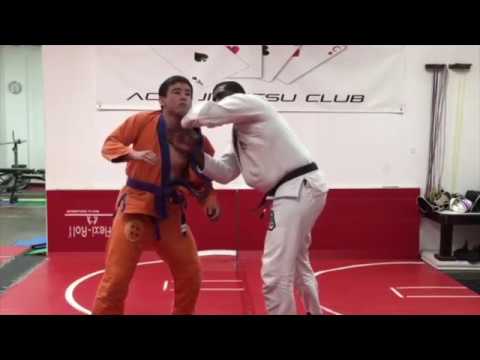
Standing wrist-lock submissions from the chin-down position integrate defensive and offensive principles when a takedown attempt encounters resistance. Aces Jiu Jitsu Club emphasizes intelligent submission transitions during takedown exchanges, specifically the collar choke application when an opponent defends a jacket-based takedown. Their approach involves opening the collar with tension, placing the hand inside to grip the throat, positioning the head near the temple, and executing a 'motorcycle' wrist motion (alternating wrist rotation) while maintaining elbow control to prevent back-take defense. This technique is framed as a high-percentage counter that simultaneously mitigates striking danger and creates follow-up takedown opportunities. Josh Saunders' instruction focuses on the broader takedown framework—controlling posture, manipulating foot positioning, and accessing underhooks—but does not directly address wrist-lock submissions from standing. Instead, Saunders emphasizes collar-tie control and rear body lock transitions as preferred standing submission pathways. Both instructors agree that standing submissions should emerge opportunistically when primary takedown techniques meet resistance, and that head positioning is critical for safety and leverage. Aces Jiu Jitsu Club provides the most direct technical detail for standing wrist-lock execution, while Saunders' material establishes the contextual framework of standing grapple exchanges without specific wrist-lock methodology.
Сформировано на основе 2 инструкторов
Учебных курсов по этой технике пока нет.
Войдите, чтобы предложить курс.
Риск травмы для человека, к которому применяется техника
Wrist lock variant targeting carpal and radioulnar joints through forced deviation or torsion
Уровень мастерства, необходимый для надёжного выполнения техники
Разрешена ли техника по основным соревновательным правилам
Japanese BJJ community standard katakana transliteration
Japanese BJJ community standard katakana transliteration
Standard Japanese martial arts terminology (kanji/hiragana)
Established Japanese martial arts naming convention — native Japanese term (和語/漢語)
Japanese terminology sourced from Japanese BJJ community standard katakana transliteration
fine motor control, grip sensitivity, quick hand transitions
dexterous hands with strong fingers
forearm flexors and extensors, intrinsic hand muscles
Josh Saunders emphasizes getting your forehead to match your opponent's forehead, which allows you to control and move them around by snapping them forward and circling.
Josh Saunders explains that you need to pull your opponent forward so that your lead foot aligns with their lead foot, rather than having your legs opposite to theirs.
Aces Jiu Jitsu Club recommends attacking in an intelligent way to get yourself to a safe place rather than purely defending, since constant defensive reactions can lead to getting walked into bad positions.
Aces Jiu Jitsu Club suggests instituting a submission as a filler when an opponent resists your takedown, such as a collar choke when they're wearing a gi.
The chin-down wrist lock from standing is applied by gripping the opponent's hand and bending the wrist into flexion while directing the pressure downward toward the opponent's own chin or sternum. The standing position allows the attacker to use body weight and stance changes to amplify the wrist flexion force.
Standing wrist flexion techniques directed against the opponent's body are core methods in aikido (kote-gaeshi and kote-hineri families) and traditional jujutsu. The chin-down direction of force appears specifically in self-defense curricula where the goal is to control a standing aggressor using pain compliance.
IBJJF: разрешён — Legal at all belt levels; IJF: запрещён — Only elbow joint locks (kansetsu-waza) permitted in judo — all other joint lo…; ADCC: разрешён — Legal — all submissions legal in ADCC; Unified MMA: разрешён — Legal submission technique; FIAS Sport Sambo: разрешён — Legal; FIAS Combat Sambo: разрешён — Legal
Оценка опасности 5/10. Wrist lock variant targeting carpal and radioulnar joints through forced deviation or torsion
Стандартная цепочка подготовки: Establish Position → Create the Threat → Secure the Hold → Finish.
Стандартные контрприёмы: Early Recognition — identify the submission attempt early and begin defence immediately / Posture and Base — maintain strong posture and base to prevent submission setups / Grip Fight — deny the attacker their preferred gripping configuration.
Распространённые варианты: Standard wrist lock (kote gaeshi) (two-handed rotational lock on the wrist); Gooseneck wrist lock (flexion lock bending the wrist down toward the forearm); Standing wrist lock (applied during grip fighting or a standing exchange); Ground wrist lock (catching the opponent's posted hand from mount, side cont…).
Standing submissions, particularly guillotine chokes, are among the most common finishes in UFC competition.
Основные ошибки, на которые стоит обратить внимание: Attempting standing wrist locks against a mobile opponent — the opponent must be momentarily committed (gripping, pus… / Not controlling the elbow — a free elbow allows the opponent to retract the arm; control the forearm and elbow while … / Using standing wrist locks as primary attacks — they work best as opportunistic attacks during grip fighting transitions / Holding the wrist lock standing when it isn't finishing — if the standing lock doesn't tap, transition to a takedown ….
From Standing также известен как Tachi-waza kara, Standing Chin-Down Wrist Lock, Tachi Chin-Down Lock.