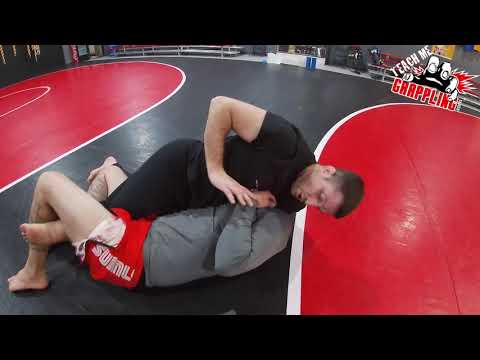
Catch Them by SURPRISE in Half Guard!!
0
Near-Side Cradle·TeachMeGrappling Coach Brian
In this video I breakdown a guillotine you can hit from top half guard or quarter guard. Check out the details and you …
Перевод: Near-Side Cradle
The near-side cradle from top half guard hooks the opponent's near leg — the leg on the same side as the attacker's head — and connects it to the head through a clasped grip, folding the opponent laterally. [1] From top half guard, the attacker uses the crossface hand to control the head while reaching around the near thigh with the other arm, linking the hands to complete the cradle. [1],[2] The near-side variant creates a tighter fold because the head and leg are on the same side, minimising the distance between them and intensifying the cervical compression. [2] The half-guard position provides an ideal entry because the bottom player's near leg is already partially trapped by the attacker's legs. [2],[3]
Near-side cradles are a staple of American folkstyle wrestling, where they serve as both a pinning combination and a control technique. [1] The half-guard application as a neck crank was developed by wrestlers transitioning to BJJ and MMA who recognised the submission potential of their existing cradle skills. [2],[3]
The near-side cradle pins the opponent by connecting the head to the knee, and can be used as a crank submission when applied aggressively. [1]
Near-side cradles are fundamental wrestling pinning techniques used across all wrestling styles. [1]
Near-side cradles are one of the most common pinning combinations in folkstyle and freestyle wrestling competition. [1]
Изображений для этой техники пока нет.
Войдите, чтобы предложить изображение.
In this video I breakdown a guillotine you can hit from top half guard or quarter guard. Check out the details and you …
Учебных курсов по этой технике пока нет.
Войдите, чтобы предложить курс.
Риск травмы для человека, к которому применяется техника
Cervical flexion cranks force the chin toward the chest, compressing the anterior cervical spine
Уровень мастерства, необходимый для надёжного выполнения техники
Разрешена ли техника по основным соревновательным правилам
Japanese amateur wrestling terminology
Japanese amateur wrestling terminology
Standard Japanese martial arts terminology (kanji/hiragana)
Established Japanese martial arts naming convention — native Japanese term (和語/漢語)
Japanese terminology sourced from Japanese amateur wrestling terminology
grip or squeeze strength, positional control
strong upper body for sustained compression
forearms, biceps, pectorals, core stabilisers
Coach Brian recommends jamming your hand over their neck as they come on top while their hands are focused low. Keep your weight on your knee to control their neck position, then wrap them up as they attempt to escape—they can't defend both the underhook and the neck attack at once.
Coach Brian advises grabbing the meat of the neck rather than going all the way down the fingers. Once you have this grip, you can drive the bone upward to secure the choke more effectively.
Instead of smashing them, Coach Brian suggests letting them come up to open their neck naturally. You can put light pressure or a 'roof' on them to guide their movement, then start the high elbow guillotine as they work to improve their position.
The near-side cradle from top half guard hooks the opponent's near leg — the leg on the same side as the attacker's head — and connects it to the head through a clasped grip, folding the opponent laterally. From top half guard, the attacker uses the crossface hand to control the head while reaching around the near thigh with the other arm, linking the hands to complete the cradle.
Near-side cradles are a staple of American folkstyle wrestling, where they serve as both a pinning combination and a control technique. The half-guard application as a neck crank was developed by wrestlers transitioning to BJJ and MMA who recognised the submission potential of their existing cradle skills.
IBJJF: разрешён — Legal at all belt levels, gi and no-gi — chokes are the safest submission cat…; IJF: разрешён — Legal (shime-waza) — strangulation techniques are one of three permitted subm…; ADCC: разрешён — Legal; Unified MMA: разрешён — Legal — choke submissions are among the most common finishes in MMA; FIAS Sport Sambo: запрещён — All chokes prohibited in Sport Sambo; FIAS Combat Sambo: разрешён — Legal
Оценка опасности 8/10. Cervical flexion cranks force the chin toward the chest, compressing the anterior cervical spine
Стандартная цепочка подготовки: Establish Position → Create the Threat → Secure the Hold → Finish.
Стандартные контрприёмы: Early Recognition — identify the submission attempt early and begin defence immediately / Posture and Base — maintain strong posture and base to prevent submission setups / Grip Fight — deny the attacker their preferred gripping configuration.
Распространённые варианты: Standard grip variation (primary hand configuration for maximum choking pressure); Gi variation (uses the lapel or collar as an anchor for additional fric…); No-gi variation (adapted grip and positioning for submission grappling wit…); Transition finish (applied during a positional change to catch the opponent …).
Near-side cradles are one of the most common pinning combinations in folkstyle and freestyle wrestling competition.
Основные ошибки, на которые стоит обратить внимание: Not driving the shoulder into the opponent during the lock — chest and shoulder pressure reinforce the cradle; arms a… / Reaching for the knee without head control — the head must be secured first; losing head control while reaching for t… / Locking too loosely — the cradle must be tight; a loose connection allows the opponent to extend the leg and break th… / Not using the near knee strategically — from half guard, the near leg is already bent and close; recognise this oppor….
Near-Side Cradle также известен как Temae Yurikago, Near-Side Wrestling Cradle, Close-Side Cradle.