Удар и защитаЗамкиБлижний бойБой против нескольких
Дистанция
БлижняяСредняяДальняя
Целевая зона
Верхняя частьСредняя частьНижняя часть
Обзор
The rear neck crank from body triangle uses the stable body triangle back control to anchor the opponent's torso while the attacker grips under the chin, across the forehead, or on the face and pulls the head backward into cervical hyperextension. [1],[2] The body triangle's exceptional hip control means the opponent cannot rotate or slide down to relieve the cranking pressure, making this one of the most controlling positions from which to apply a neck crank. [1] The attacker uses the body triangle squeeze and upper body pull simultaneously. [1],[2]
The body triangle became a dominant back control method in high-level BJJ and MMA in the 2010s, particularly after fighters like Luke Rockhold and Islam Makhachev demonstrated its effectiveness. [1],[2] The neck crank from body triangle emerged as a secondary attack when rear naked choke attempts were defended — rather than abandoning the back position, attackers could threaten the spine to force a reaction or tap. [1] This technique represents the modern integration of cranking attacks into the back-attack system. [1],[2]
Страна происхождения· показано в случайном порядке
A powerful secondary attack from body triangle back control that pressures the cervical spine through extension; effective when the opponent defends rear naked choke by protecting the neck [1]
Родословная
Developed in MMA and no-gi grappling as athletes recognized body triangle's potential for neck cranks beyond traditional chokes. Associated with Khabib Nurmagomedov's back control system [1]
Соревновательные результаты
Multiple UFC finishes from body triangle neck crank position; increasingly common in MMA as body triangle back control becomes standard [1]
Изображения
Изображений для этой техники пока нет.
Войдите, чтобы предложить изображение.
Биомеханический механизм
Primary Action — Compression of the neck structures — restricts blood flow or airway depending on technique application
Joints Involved — Cervical spine, surrounding musculature, and vascular structures of the neck
Force Vector — Directed compression against the neck from the choking limb or body position
Finishing Mechanic — Sustained pressure causes either vascular occlusion (unconsciousness) or tracheal restriction (breathing difficulty)
Позиция и вход
From back control with seatbelt — Establish hooks or body triangle, slide choking arm under the chin, connect hands and squeeze
From turtle top (back take) — Break down the turtle, insert hooks, secure seatbelt grip, slide to back control and apply the choke
From standing back clinch — Secure rear body lock, drag opponent to the mat while inserting hooks, transition to choking position
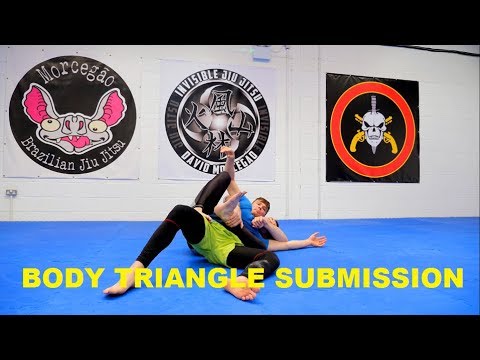
Rear Neck Crank From Body Triangle·Invisible Jiu Jitsu
Holding and attacking the back with the body triangle, stopping their escape, and tapping them with it, all the info all…
1 / 2
3 videos
Что говорят инструкторы
The rear neck crank from body triangle is a cervical extension submission executed from back control with a body triangle (leg lock across the opponent's torso). Freestyle Fighting Academy emphasizes that the technique requires the opponent to be flattened on their back before execution; the attacker must maintain control of one arm while circling the free leg underneath to grip their own thigh, keeping the opponent's arm extended as long as possible to prevent escape via elbow tuck. Once the leg is clasped around the thigh, the attacker leans back and brings the knees together to apply crushing pressure, functioning as both a positional lock and a choke mechanism. Invisible Jiu-Jitsu highlights that the body triangle submission works by restricting the opponent's diaphragm (positioning the triangle above the lungs rather than across the hips) to induce positional asphyxiation, and emphasizes keeping the triangle on the top side to prevent foot lock counters. Both sources note that the submission can succeed through either immediate tap from the neck crank or through sustained positional pressure that restricts breathing. Hand placement high on the inside of the thigh near the knees maximizes leverage (treating the leg as a lever with the handle, not hinge), and consistent squeezing pressure with the knees generates the primary finishing force. The technique is reliable against trained grapplers including wrestlers, though flexibility variations require positional adjustments.
Сформировано на основе 3 инструкторов
Freestyle Fighting Academy — Avellan Shows Bas Rutten Neck Crank for BJJ and MMA: Detailed the mechanics of maintaining arm control, leg positioning to create the thigh grip, and the importance of keeping the opponent flat-backed. Explained hand placement leverage, the thigh-master squeeze with knees together, and how to maintain pressure when immediate tap doesn't occur.
Invisible Jiu Jitsu — BODY TRIANGLE SUBMISSION!!: Emphasized positioning the body triangle high on the diaphragm rather than across hips to create positional asphyxiation. Discussed managing the triangle from back control, maintaining it on the top side during positional transitions, and applying progressive pressure using the snake principle of waiting for breathing cycles.
Brazilian Jiu-Jitsu & Submission Grappling — How to counter Can Opener neck crank from closed guard for BJJ: Provided context on dangerous neck cranks and emphasized the importance of neck strength and protection in defensive positioning, relevant to understanding the submission's force and why opponents must tap.
Изучить технику
Учебных курсов по этой технике пока нет.
Войдите, чтобы предложить курс.
Оценки
Уровень опасности
Риск травмы для человека, к которому применяется техника
9
Экстремальный9/10
Extension cranks force the head backward; risk of vertebral disc and ligament damage
Сложность
Уровень мастерства, необходимый для надёжного выполнения техники
Продвинутый
Допустимость на соревнованиях
Разрешена ли техника по основным соревновательным правилам
Запрещено
— FIAS Sport Sambo — All chokes prohibited in Sport Sambo
✓The rear neck crank from body triangle applies cervical extension or flexion from back control with body triangle locked — the body triangle stabilises the torso to isolate all cranking force on the cervical spine (Danaher, Back Attacks: Enter the System, 2018)
✓From body triangle back control: the legs are locked in a body triangle around the torso — the arms can then manipulate the head in any direction (extension, flexion, or rotation) while the torso remains fixed
✓The body triangle provides superior torso stabilisation compared to hooks: the interlocked legs create a rigid frame that prevents the opponent from adjusting their body to relieve neck pressure
✓Extension variant: push the head backward (body-triangle extension crank)
✓Flexion variant: push the chin to the chest using the forearm on the back of the head
✓The body triangle neck crank is a systematic back-attack tool: it creates openings for the RNC by forcing the opponent to move their head in response to the crank
✓The fixed-torso principle: by immobilising the torso with the body triangle, all head manipulation force is concentrated on the cervical spine — nothing is wasted on body movement
✓The body triangle neck crank is a positional advantage unique to back control: the combination of posterior position and torso control creates cervical attack angles unavailable from other positions
Типичные ошибки
!Applying cervical manipulation without the body triangle locked — the torso must be stabilised first; without it, the opponent moves their body to relieve the neck pressure
!Using explosive force — body triangle cranks concentrate force on the cervical spine; progressive application is essential
!Not transitioning to the RNC — the crank forces head movement; capitalise on the opened chin with the choking arm
!Holding cranking positions without purpose — the crank should create transitions, not be held at end range
!Not maintaining the body triangle during the crank — the arm manipulations can shift body position; keep the body triangle tight throughout
!Applying the same crank direction repeatedly — alternate between extension, flexion, and rotation to keep the opponent guessing
!Ignoring the opponent's tap — body triangle cranks can cause pain rapidly; respect the tap immediately
1Establish Position — achieve the controlling position needed for this submission
2Create the Threat — begin the submission setup to force a defensive reaction
3Secure the Hold — lock the submission grip with proper body mechanics
4Finish — apply increasing pressure until the opponent taps or the joint/choke takes effect
Источники и ссылки
Основной источник
Japanese MMA/BJJ standard terminology
1ДругоеJapanese Martial Arts Community Terminology
Japanese MMA/BJJ standard terminology
2ДругоеJapanese Combat Sports Katakana Convention
Standard katakana transliteration of Western martial arts terminology (外来語) — used in Japanese MMA, boxing, and BJJ communities
3ЦитатаJapanese MMA/BJJ standard terminology
Japanese terminology sourced from Japanese MMA/BJJ standard terminology
Сообщество
Атлетизм
Requires
hip flexibility, long legs relative to torso
Favours
longer limbs for easier figure-four lock around head and arm
Key muscles
hip adductors, hamstrings, quadriceps
Подтехники
Ищите по тому, что делает техника, — а не по её названию
Каждое движение в любом боевом искусстве обладает рядом универсальных свойств. Комбинируйте параметры ниже, чтобы найти нужный инструмент или сравнить аналоги из разных стилей.
Where should I position the body triangle on my opponent's body to make it work as a choke?
You want to sit the triangle above the diaphragm, just below the lungs, so you constrict the opponent's ability to move their diaphragm and they choke themselves through positional asphyxiation. Invisible Jiu Jitsu emphasizes positioning high on the body, not low across the hips, which only provides control without the choke.
What's the correct pressure and mechanics for squeezing the body triangle?
The pressure works just like a regular triangle—flare your heel and squeeze your knees together in a downward and inward motion. Invisible Jiu Jitsu notes that most of the real squeeze comes from the knees rather than pulling back with your hands.
When attacking from the back, which direction should I fall to apply the rear neck crank from body triangle?
Fall to the side of your choking hand so it doesn't get trapped underneath your opponent, and position yourself to get high on their thigh so you can apply pressure back and in toward the diaphragm. Invisible Jiu Jitsu stresses not letting the triangle drop to the floor, as your opponent can then escape by stepping over your foot.
Как работает Rear Neck Crank From Body Triangle?
The rear neck crank from body triangle uses the stable body triangle back control to anchor the opponent's torso while the attacker grips under the chin, across the forehead, or on the face and pulls the head backward into cervical hyperextension. The body triangle's exceptional hip control means the opponent cannot rotate or slide down to relieve the cranking pressure, making this one of the most controlling positions from which to apply a neck crank.
Откуда происходит Rear Neck Crank From Body Triangle?
The body triangle became a dominant back control method in high-level BJJ and MMA in the 2010s, particularly after fighters like Luke Rockhold and Islam Makhachev demonstrated its effectiveness. The neck crank from body triangle emerged as a secondary attack when rear naked choke attempts were defended — rather than abandoning the back position, attackers could threaten the spine to force a reaction or tap.
Разрешён ли Rear Neck Crank From Body Triangle на соревнованиях?
IBJJF: разрешён — Legal at all belt levels, gi and no-gi — chokes are the safest submission cat…; IJF: разрешён — Legal (shime-waza) — strangulation techniques are one of three permitted subm…; ADCC: разрешён — Legal; Unified MMA: разрешён — Legal — choke submissions are among the most common finishes in MMA; FIAS Sport Sambo: запрещён — All chokes prohibited in Sport Sambo; FIAS Combat Sambo: разрешён — Legal
Насколько опасен Rear Neck Crank From Body Triangle?
Оценка опасности 9/10. Extension cranks force the head backward; risk of vertebral disc and ligament damage
Как подготовить Rear Neck Crank From Body Triangle?
Стандартная цепочка подготовки: Establish Position → Create the Threat → Secure the Hold → Finish.
Как защититься от Rear Neck Crank From Body Triangle?
Стандартные контрприёмы: Early Recognition — identify the submission attempt early and begin defence immediately / Posture and Base — maintain strong posture and base to prevent submission setups / Grip Fight — deny the attacker their preferred gripping configuration.
Какие есть варианты Rear Neck Crank From Body Triangle?
Распространённые варианты: Standard triangle (classic figure-four leg lock around the head and one arm …); Reverse triangle (legs locked from behind or inverted angle for different a…); Mounted triangle (applied from mount position with gravity assisting the sq…); No-arm triangle (both arms excluded, legs-only compression on the neck).
Насколько эффективен Rear Neck Crank From Body Triangle на соревнованиях?
Multiple UFC finishes from body triangle neck crank position; increasingly common in MMA as body triangle back control becomes standard
Какие типичные ошибки при выполнении Rear Neck Crank From Body Triangle?
Основные ошибки, на которые стоит обратить внимание: Applying cervical manipulation without the body triangle locked — the torso must be stabilised first; without it, the… / Using explosive force — body triangle cranks concentrate force on the cervical spine; progressive application is esse… / Not transitioning to the RNC — the crank forces head movement; capitalise on the opened chin with the choking arm / Holding cranking positions without purpose — the crank should create transitions, not be held at end range.
Какие ещё названия есть у Rear Neck Crank From Body Triangle?
Rear Neck Crank From Body Triangle также известен как Ria Nekku Kuranku, Body Triangle Neck Crank, BT Extension Crank.