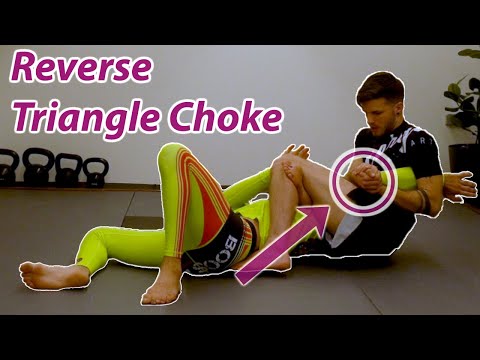
How To Do A Reverse Triangle From The Back
0
Reverse Triangle·Wim Deputter BJJ
How To Do A Reverse Triangle From The Back - In this video, Tum shows some cool details from the Reverse Triangle. Tum …
Перевод: Reverse Triangle Strangle
The reverse triangle from side control locks the triangle choke in reverse orientation — the attacker's legs wrap around the opponent's head and arm from the opposite direction compared to the standard triangle. [1] From side control, the attacker threads the near leg over the opponent's neck and under the far arm, then locks the reverse triangle by hooking the ankle behind the opposite knee from a top or perpendicular position. [1],[2] The reverse orientation means the compression angle comes from above rather than below, using the attacker's weight to press down into the triangle. [2] This variant catches opponents who are focused on defending standard side control attacks and don't anticipate the leg-based threat. [2],[3]
The reverse triangle from side control became prominent in competition BJJ during the 2010s, as athletes explored unconventional submission pathways from dominant positions. [1] The technique's counter-intuitive leg entry from a top position made it an effective surprise weapon against experienced defenders. [2],[3]
The reverse triangle applies the triangle from an inverted angle, catching opponents who defend the standard triangle. [1]
Reverse triangles were developed as an advanced BJJ technique to catch opponents defending standard triangle attempts. [1]
Reverse triangles appear at high-level BJJ competition as a surprise submission. [1]
Изображений для этой техники пока нет.
Войдите, чтобы предложить изображение.
How To Do A Reverse Triangle From The Back - In this video, Tum shows some cool details from the Reverse Triangle. Tum …
Учебных курсов по этой технике пока нет.
Войдите, чтобы предложить курс.
Риск травмы для человека, к которому применяется техника
Reverse triangle applies pressure from a reversed angle; attacks both carotids from behind
Уровень мастерства, необходимый для надёжного выполнения техники
Разрешена ли техника по основным соревновательным правилам
Japanese Judo — Kashiwazaki; widely used in Japanese competition
Japanese terminology sourced from Japanese Judo — Kashiwazaki; widely used in Japanese competition
Standard Japanese martial arts terminology (kanji/hiragana)
Established Japanese martial arts naming convention — native Japanese term (和語/漢語)
Japanese terminology sourced from Japanese Judo — Kashiwazaki; widely used in Japanese competition
hip flexibility, long legs relative to torso
longer limbs for easier figure-four lock around head and arm
hip adductors, hamstrings, quadriceps
The reverse triangle appears in 10 passages across 4 books. Applied with the legs configured in the opposite direction of the standard triangle — the locking leg goes over the back of the opponent's neck rather than the front. Used from back control and from top position. (4 books in corpus)
Most people just get their hands stuck and try to pull the opponent's arm out without proper control. Instead, you should use your choke hand to work the opponent's hand off while maintaining control on the neck, then post on the mat and shove back before catching your own shin under their neck.
Once you catch your own shin under the opponent's neck, fall to the side and close the triangle by eliminating the space between their carotid artery and your knee. You can then squeeze by closing your calf, or attack their arm with an armbar before transitioning back to the triangle.
Catch the elbow, not the wrist, because the opponent can easily bend their arm at the wrist and create slack. Controlling the elbow gives you better options for an armbar or forces them back into the triangle finish.
If they position their head to one side to block the choke, you can insert your fist or use a calf squeeze along their neck instead. You can also transition to a shoulder lock by catching their elbow with a gable grip and falling to the side.
The reverse triangle from side control locks the triangle choke in reverse orientation — the attacker's legs wrap around the opponent's head and arm from the opposite direction compared to the standard triangle. From side control, the attacker threads the near leg over the opponent's neck and under the far arm, then locks the reverse triangle by hooking the ankle behind the opposite knee from a top or perpendicular position.
The reverse triangle from side control became prominent in competition BJJ during the 2010s, as athletes explored unconventional submission pathways from dominant positions. The technique's counter-intuitive leg entry from a top position made it an effective surprise weapon against experienced defenders.
IBJJF: разрешён — Legal at all belt levels, gi and no-gi — chokes are the safest submission cat…; IJF: разрешён — Legal (shime-waza) — strangulation techniques are one of three permitted subm…; ADCC: разрешён — Legal; Unified MMA: разрешён — Legal — choke submissions are among the most common finishes in MMA; FIAS Sport Sambo: запрещён — All chokes prohibited in Sport Sambo; FIAS Combat Sambo: разрешён — Legal
Оценка опасности 8/10. Reverse triangle applies pressure from a reversed angle; attacks both carotids from behind
Стандартная цепочка подготовки: Achieve Controlling Position → Isolate the Neck → Set the Grip → Apply Pressure.
Стандартные контрприёмы: Tuck Chin — protect the neck by lowering the chin to prevent the choke from sinking / Two-on-One Grip Fight — use both hands to strip the choking grip before it locks / Turn Into — rotate toward the choking arm to relieve carotid pressure / Posture Up — straighten the spine and create distance to break the choking angle.
Распространённые варианты: Standard triangle (classic figure-four leg lock around the head and one arm …); Reverse triangle (legs locked from behind or inverted angle for different a…); Mounted triangle (applied from mount position with gravity assisting the sq…); No-arm triangle (both arms excluded, legs-only compression on the neck).
Reverse triangles appear at high-level BJJ competition as a surprise submission.
Основные ошибки, на которые стоит обратить внимание: Not understanding the orientation — the reverse triangle has the same triangle structure but the body faces the oppos… / Attempting to finish with the same mechanics as a standard triangle — the head pull and angle are different due to th… / Not locking the figure-four properly in the reversed position — the ankle-behind-knee connection is the same, but the… / Losing the position during the transition — the reverse triangle often emerges from scrambles; maintaining the lock d….
Reverse Triangle также известен как Ura-sankaku-jime, Gyaku-sankaku-jime, Inverted Triangle, Reverse Side Triangle.