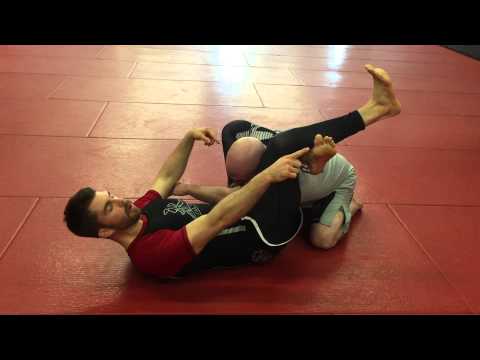
No Gi Triangle Choke From Closed Guard
0
Standard Triangle·Chewjitsu
WWW.CHEWJITSU.NET In this video I show a triangle choke from guard. This is a great setup for either gi or no gi Brazil…
Перевод: Triangle Strangle
The standard triangle choke from closed guard is the foundational variety of the triangle family, where the attacker locks a figure-four leg configuration around the opponent's head and one arm from bottom guard. [1] The attacker isolates one arm inside the triangle while pushing the other arm outside, then locks the triangle by hooking the ankle behind the opposite knee, pulling the head down, and squeezing the thighs together. [1],[2] The trapped arm's own shoulder compresses one carotid artery while the attacker's thigh compresses the other, creating bilateral vascular occlusion. [2] The standard triangle from guard is one of the most frequently taught and successfully applied submissions across all levels of BJJ competition. [2],[3]
The triangle choke (sankaku-jime) originated in judo, with Yaichibei Kanemitsu credited with its development in the early 1900s. [1] It became one of Brazilian Jiu-Jitsu's most iconic submissions, with the guard application being the most commonly taught and practiced version in academies worldwide. [2],[3]
The triangle choke (sankaku-jime) originated in judo and was adopted and refined in BJJ, becoming a signature technique. [1]
Изображений для этой техники пока нет.
Войдите, чтобы предложить изображение.
WWW.CHEWJITSU.NET In this video I show a triangle choke from guard. This is a great setup for either gi or no gi Brazil…
Учебных курсов по этой технике пока нет.
Войдите, чтобы предложить курс.
Риск травмы для человека, к которому применяется техника
Triangle chokes compress the carotid arteries using the legs; loss of consciousness in 8-12 seconds
Уровень мастерства, необходимый для надёжного выполнения техники
Разрешена ли техника по основным соревновательным правилам
Kodokan Judo — Sankaku-jime
Japanese terminology sourced from Kodokan Judo — Sankaku-jime
Official Kodokan ground technique classification system
Standard Japanese martial arts terminology (kanji/hiragana)
Established Japanese martial arts naming convention — native Japanese term (和語/漢語)
Japanese terminology sourced from Kodokan Judo — Sankaku-jime
hip flexibility, long legs relative to torso
longer limbs for easier figure-four lock around head and arm
hip adductors, hamstrings, quadriceps
Grab the shin with one hand and the head with the other hand simultaneously after getting the arm across. This dual grip helps secure the position and gives you downward pressure to prevent your opponent from straightening their body and escaping.
Push your knee in towards your neck, which will cause your foot to go out naturally, and then clamp down tightly. This leg positioning creates pressure that often causes the small muscle to strain and makes the choke more effective.
If your knees aren't pinched tight and providing downward pressure, your opponent can straighten their body up and you'll lose your grip. Tight knee clamping secures the position so your opponent can't escape by extending.
The standard triangle choke from closed guard is the foundational variety of the triangle family, where the attacker locks a figure-four leg configuration around the opponent's head and one arm from bottom guard. The attacker isolates one arm inside the triangle while pushing the other arm outside, then locks the triangle by hooking the ankle behind the opposite knee, pulling the head down, and squeezing the thighs together.
The triangle choke (sankaku-jime) originated in judo, with Yaichibei Kanemitsu credited with its development in the early 1900s. It became one of Brazilian Jiu-Jitsu's most iconic submissions, with the guard application being the most commonly taught and practiced version in academies worldwide.
IBJJF: разрешён — Legal at all belt levels, gi and no-gi — chokes are the safest submission cat…; IJF: разрешён — Legal (shime-waza) — strangulation techniques are one of three permitted subm…; ADCC: разрешён — Legal; Unified MMA: разрешён — Legal — choke submissions are among the most common finishes in MMA; FIAS Sport Sambo: запрещён — All chokes prohibited in Sport Sambo; FIAS Combat Sambo: разрешён — Legal
Оценка опасности 8/10. Triangle chokes compress the carotid arteries using the legs; loss of consciousness in 8-12 seconds
Стандартная цепочка подготовки: Achieve Controlling Position → Isolate the Neck → Set the Grip → Apply Pressure.
Стандартные контрприёмы: Tuck Chin — protect the neck by lowering the chin to prevent the choke from sinking / Two-on-One Grip Fight — use both hands to strip the choking grip before it locks / Turn Into — rotate toward the choking arm to relieve carotid pressure / Posture Up — straighten the spine and create distance to break the choking angle.
Распространённые варианты: Standard triangle (classic figure-four leg lock around the head and one arm …); Reverse triangle (legs locked from behind or inverted angle for different a…); Mounted triangle (applied from mount position with gravity assisting the sq…); No-arm triangle (both arms excluded, legs-only compression on the neck).
The triangle choke is one of the most commonly finished submissions in both IBJJF competition and UFC history.
Основные ошибки, на которые стоит обратить внимание: Not isolating one arm before shooting the leg — the triangle requires one arm in and one arm out; shooting the leg wi… / Locking the triangle without cutting the angle — the angle is essential; a straight-on triangle doesn't drive the sho… / Allowing the opponent to posture before locking — break posture immediately; an opponent who stands up in an unlocked… / Not pulling the head down — the head pull tightens the front of the triangle; without it, the opponent can posture up….
Standard Triangle также известен как Sankaku-jime, Classic Triangle Choke, Standard Sankaku-jime, Basic Triangle.
Angle is key — you cannot finish a straight-on triangle against a strong opponent. Cut a perpendicular angle by grabbing their leg and walking your shoulders away. Keep the back of your knee directly on their neck (not high on the shoulder), and pull their head down or hook their leg to prevent them from lifting to stack.
Yes. Cut a sharper 90-degree angle — this makes the choke dramatically tighter regardless of leg length. Focus on squeezing your thigh into one carotid artery and driving their shoulder into the other. If you cannot fully lock the figure-four, grab your own shin, pull them down, and use your other foot on their hip to lift your hips for a tighter angle.
Three critical mistakes: (1) Crossing ankles instead of locking the figure-four (foot in the knee pit), which weakens the lock and exposes you to ankle locks. (2) Not hiding their shoulder behind your leg — if you can see their shoulder, they can survive. Walk your shoulders away to fix this. (3) Not establishing one-arm-in, one-arm-out before shooting — both arms in means no choke, both arms out means no control.
The triangle is part of the 'three brothers' trio — triangle, armbar, and omoplata. If they pull their arm out, switch to an armbar on the trapped arm. If they posture up and hide the arm, transition to an omoplata. If they turn to escape, look for a reverse triangle. Never abandon the position — always chain to the next attack.
Three proven setups: (1) Wrist control — control both wrists, put one foot on the hip, stuff the opposite hand into their chest, then throw the leg over. (2) Hip bump setup — go for a hip bump sweep, and when they push back, use that momentum to shoot the triangle. (3) From overhook — establish an overhook on one arm, hip escape to create the angle, then swing the leg over.