How to do the Rear Triangle Choke (or 'Ura Sankaku')
0
Triangle From Back·Stephan Kesting
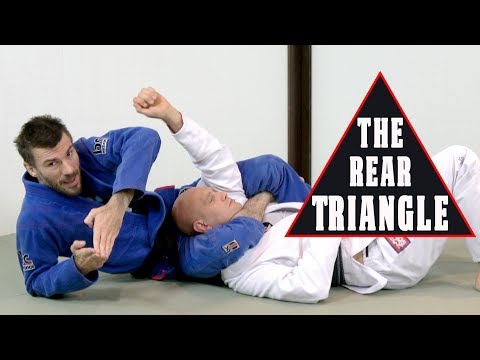
Rob Biernacki breaks down the rear triangle choke (aka Ura Sankaku). This is from the back attacks module that will be …
Перевод: Triangle Strangle — From Back
The triangle choke from back control is applied by the attacker who has back mount and threads one leg across the side of the opponent's neck while locking the other leg behind the knee to form the triangular figure. [1],[2] Unlike the standard front-facing triangle, the rear triangle compresses the carotid arteries from behind, using the opponent's own trapped shoulder as the wedge against one carotid and the thigh against the other. [1] The attacker adjusts the angle by turning perpendicular to the opponent and squeezing the legs while pulling the head to complete the strangle. [1],[2],[3]
The rear triangle choke evolved as back-attack systems in BJJ became more sophisticated in the 2000s and 2010s. [1],[2] Competitors discovered that when the rear naked choke was defended by tucking the chin, transitioning to a triangle from the back provided an alternative strangle. [1],[3] Ryan Hall and other triangle specialists helped popularize the rear triangle as a systematic component of the back-attack arsenal in competitive submission grappling. [1],[2]
The triangle from back control uses the legs to strangle from behind, an alternative to the RNC when hand fighting is unsuccessful. [1]
Back triangle chokes were developed in modern BJJ competition as back control attacks expanded beyond the RNC. [1]
Back triangles are increasingly common in ADCC and no-gi competition. [1]
Изображений для этой техники пока нет.
Войдите, чтобы предложить изображение.
Rob Biernacki breaks down the rear triangle choke (aka Ura Sankaku). This is from the back attacks module that will be …
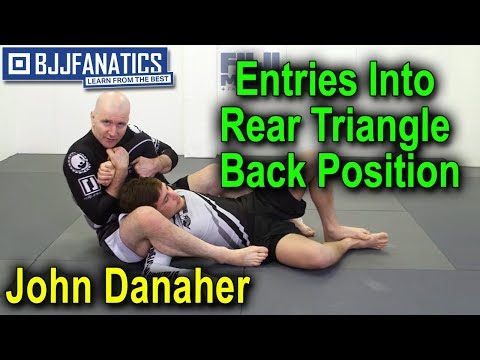
John Danaher demonstrates one of the best Jiu Jitsu Techniques for Entries Into Rear Triangle Back Position. Here John …
The triangle choke from back position, known as Ushiro Sankaku or Ura Sankaku in judo terminology, is a leg-based strangulation applied when controlling an opponent's back. John Danaher (BJJ Fanatics) emphasizes entry from turtle position using a tight waist control, breaking the opponent to their hip, then securing one arm by locking the tricep with the knee before transitioning to a unified leg position. He describes progressing through a trap triangle configuration before adjusting to a figure-four leg lock for the finish. Stephan Kesting (Grappler Arts) approaches the technique from rear mount position, particularly when standard back attacks fail, and stresses proper triangle alignment—positioning the calf across the side of the neck with the hip flexor driving the shoulder into the neck rather than over the back of the neck. Both instructors agree on the importance of arm trapping and unified lower legs, though Kesting notes the technique can succeed without arm entrapment if alignment is correct. Kesting additionally describes two triangle variations depending on which leg crosses, and emphasizes the posture break as an important finishing detail. Both recognize this technique as particularly effective for shorter-legged practitioners against larger opponents.
Сформировано на основе 2 инструкторов
Учебных курсов по этой технике пока нет.
Войдите, чтобы предложить курс.
Риск травмы для человека, к которому применяется техника
Back triangle uses the legs from back control; combines back dominance with leg choke
Уровень мастерства, необходимый для надёжного выполнения техники
Разрешена ли техника по основным соревновательным правилам
Kodokan Judo — Sankaku-jime
Japanese terminology sourced from Kodokan Judo — Sankaku-jime
Official Kodokan ground technique classification system
Standard Japanese martial arts terminology (kanji/hiragana)
Established Japanese martial arts naming convention — native Japanese term (和語/漢語)
Japanese terminology sourced from Kodokan Judo — Sankaku-jime
hip flexibility, long legs relative to torso
longer limbs for easier figure-four lock around head and arm
hip adductors, hamstrings, quadriceps
Каждое движение в любом боевом искусстве обладает рядом универсальных свойств. Комбинируйте параметры ниже, чтобы найти нужный инструмент или сравнить аналоги из разных стилей.
Stephan Kesting emphasizes that the triangle angle must be lined up correctly—it should go over the side of the neck, not over the back of the neck and shoulder, or it won't choke effectively. You need to scoot back far enough so your calf caps off the arteries and your hip flexor drives the opponent's shoulder into their neck.
According to Stephan Kesting, make sure your Achilles tendon insertion is cutting off the artery, position your hip so the opponent's shoulder rotates into their neck, and use your thigh to break their posture to complete the choke.
John Danaher explains that from turtle position, you can place your knee behind the opponent's elbow, kick your foot in around the corner, add your second leg, sit down to the floor, and then transition to finish with the triangle (Ushiro Senkaku).
The triangle choke from back control is applied by the attacker who has back mount and threads one leg across the side of the opponent's neck while locking the other leg behind the knee to form the triangular figure. Unlike the standard front-facing triangle, the rear triangle compresses the carotid arteries from behind, using the opponent's own trapped shoulder as the wedge against one carotid and the thigh against the other.
The rear triangle choke evolved as back-attack systems in BJJ became more sophisticated in the 2000s and 2010s. Competitors discovered that when the rear naked choke was defended by tucking the chin, transitioning to a triangle from the back provided an alternative strangle.
IBJJF: разрешён — Legal at all belt levels, gi and no-gi — chokes are the safest submission cat…; IJF: разрешён — Legal (shime-waza) — strangulation techniques are one of three permitted subm…; ADCC: разрешён — Legal; Unified MMA: разрешён — Legal — choke submissions are among the most common finishes in MMA; FIAS Sport Sambo: запрещён — All chokes prohibited in Sport Sambo; FIAS Combat Sambo: разрешён — Legal
Оценка опасности 8/10. Back triangle uses the legs from back control; combines back dominance with leg choke
Стандартная цепочка подготовки: Achieve Controlling Position → Isolate the Neck → Set the Grip → Apply Pressure.
Стандартные контрприёмы: Tuck Chin — protect the neck by lowering the chin to prevent the choke from sinking / Two-on-One Grip Fight — use both hands to strip the choking grip before it locks / Turn Into — rotate toward the choking arm to relieve carotid pressure / Posture Up — straighten the spine and create distance to break the choking angle.
Распространённые варианты: Standard triangle (classic figure-four leg lock around the head and one arm …); Reverse triangle (legs locked from behind or inverted angle for different a…); Mounted triangle (applied from mount position with gravity assisting the sq…); No-arm triangle (both arms excluded, legs-only compression on the neck).
Back triangles are increasingly common in ADCC and no-gi competition.
Основные ошибки, на которые стоит обратить внимание: Releasing both hooks to shoot the triangle — maintain one hook or body triangle while the other leg shoots across the… / Not trapping the arm — the rear triangle requires one arm inside the leg loop; if both arms are outside, it becomes a… / Attempting on an opponent who has already turned to face you — the rear triangle requires the opponent to face away; … / Not squeezing the knees together — the rear triangle's compression comes from knee-together adductor engagement; open….
Triangle From Back также известен как Sankaku-jime — From Back, Rear Triangle, Ushiro-sankaku-jime, Back Triangle.