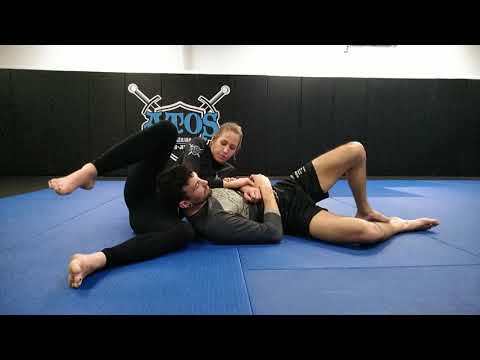
Scissor Choke Tutorial by Nikki Sullivan
0
Side Headscissors·nicsulli
I hit this choke back at EBI 12 and it can be pretty sneaky when your opponent's focused on defending the kimura. Check …
Перевод: Head Scissors (katakana loanword)
The side headscissors applies the leg-based head squeeze from side control, where the attacker is positioned perpendicular to the supine opponent. [1] The attacker captures the opponent's head between the thighs while maintaining a side control orientation, then squeezes the legs together to compress the carotid arteries from a lateral angle. [1],[2] The side position allows the attacker to use hip rotation to amplify the squeeze — rotating the hips generates a twisting compression that is difficult to defend. [2] This variant is commonly used as a transitional attack during guard passes or when the attacker is moving between side control and mount. [2],[3]
The side angle provides good compression but is harder to maintain than standard guard headscissors; opponents can often roll to escape [1]
A variation present in catch wrestling and sambo, where side-body attacks are more emphasized than in traditional BJJ [1]
Rare at elite competition; occasionally seen in sambo and catch wrestling events [1]
Изображений для этой техники пока нет.
Войдите, чтобы предложить изображение.
I hit this choke back at EBI 12 and it can be pretty sneaky when your opponent's focused on defending the kimura. Check …
Учебных курсов по этой технике пока нет.
Войдите, чтобы предложить курс.
Риск травмы для человека, к которому применяется техника
Headscissors use the thighs to squeeze the head laterally; risk of neck strain
Уровень мастерства, необходимый для надёжного выполнения техники
Разрешена ли техника по основным соревновательным правилам
Japanese grappling/BJJ standard terminology; JBJJF competition usage
Official Japanese BJJ federation — competition rules and terminology
Standard katakana transliteration of Western martial arts terminology (外来語) — used in Japanese MMA, boxing, and BJJ communities
Japanese terminology sourced from Japanese grappling/BJJ standard terminology; JBJJF competition usage
grip or squeeze strength, positional control
strong upper body for sustained compression
forearms, biceps, pectorals, core stabilisers
According to Nikki Sullivan, when your opponent is defending with their arms but their neck is exposed, you can transition to the side headscissors by keeping your grip tight, maintaining chest pressure on their arm, sliding the knee behind their shoulder under their head, and then bringing your top leg over to apply the choke.
Nikki Sullivan explains that you should lock your top foot under the bottom foot, then extend and turn your hips down to apply the choke. If your opponent hides their chin, you can use the tendon on the back of your knee to ratchet underneath their chin to dig it up.
Nikki Sullivan emphasizes that keeping the Kimura grip tight—pushing your opponent's hand and wrist into their own body—is crucial because it prevents them from escaping by getting their elbow out and coming on top. It also allows you to return to attacking the Kimura if the choke isn't working, without losing position.
The side headscissors applies the leg-based head squeeze from side control, where the attacker is positioned perpendicular to the supine opponent. The attacker captures the opponent's head between the thighs while maintaining a side control orientation, then squeezes the legs together to compress the carotid arteries from a lateral angle.
Side-mounted headscissors positions appear in catch wrestling and judo ground work, where attacking the head from side control was a standard offensive strategy. The technique was adapted into BJJ competition as an alternative to arm-based submissions from side control.
IBJJF: разрешён — Legal at all belt levels, gi and no-gi — chokes are the safest submission cat…; IJF: разрешён — Legal (shime-waza) — strangulation techniques are one of three permitted subm…; ADCC: разрешён — Legal; Unified MMA: разрешён — Legal — choke submissions are among the most common finishes in MMA; FIAS Sport Sambo: запрещён — All chokes prohibited in Sport Sambo; FIAS Combat Sambo: разрешён — Legal
Оценка опасности 7/10. Headscissors use the thighs to squeeze the head laterally; risk of neck strain
Стандартная цепочка подготовки: Establish Position → Create the Threat → Secure the Hold → Finish.
Стандартные контрприёмы: Early Recognition — identify the submission attempt early and begin defence immediately / Posture and Base — maintain strong posture and base to prevent submission setups / Grip Fight — deny the attacker their preferred gripping configuration.
Распространённые варианты: Standard grip variation (primary hand configuration for maximum choking pressure); Gi variation (uses the lapel or collar as an anchor for additional fric…); No-gi variation (adapted grip and positioning for submission grappling wit…); Transition finish (applied during a positional change to catch the opponent …).
Rare at elite competition; occasionally seen in sambo and catch wrestling events
Основные ошибки, на которые стоит обратить внимание: Not getting the leg fully over the head — the far leg must clear the head completely to position the thigh on the nec… / Losing side control during the leg transition — maintain upper body control while the legs move; releasing side contr… / Not locking the figure-four — the lateral angle requires the lock for structural compression; unlocked legs are easil… / Squeezing from the wrong angle — adjust the hip position until the inner thighs contact the carotid arteries; the sid….
Side Headscissors также известен как Heddo Shizāzu, Side Scissor Choke, Lateral Kubi-basami.