Side Mount Series: The Scissor Choke
0
Headscissors From Side Control·Cheat Code Jiu Jitsu
Follow Cheat Code Jiu Jitsu on social media: https://www.facebook.com/Cheat-Code-Jiu-Jitsu-2479604595490997 https://www.…
Перевод: Head Scissors (katakana loanword)
The headscissors from side control is applied by the top player who isolates the opponent's head and threads the legs around the neck while transitioning from a side control pin. [1],[2] The attacker typically swings the far leg over the opponent's face and locks the ankles or thighs together, creating the scissoring compression around the neck. [1] This entry requires the attacker to momentarily sacrifice chest-to-chest pressure to achieve the leg-over-head position, making timing and control critical during the transition. [1],[2]
Headscissors from side control positions have roots in catch wrestling and judo's katame-waza, where pins were used as platforms to transition into strangulation techniques. [1],[2] In BJJ, the side-control headscissors became an option for fighters who preferred leg-based attacks over the more common americana, kimura, or arm triangle from side mount. [1] The technique saw increased attention as nogi grapplers explored creative submissions from dominant positions. [1],[2]
Low-to-moderate percentage — transitioning from side control to headscissors sacrifices dominant position for an uncertain submission; better used as a surprise attack [1]
Found in catch wrestling and sambo systems where transitioning between pins and submissions is fundamental [1]
Uncommon at major competition; used occasionally in submission-only formats where position is less important [1]
Изображений для этой техники пока нет.
Войдите, чтобы предложить изображение.
Follow Cheat Code Jiu Jitsu on social media: https://www.facebook.com/Cheat-Code-Jiu-Jitsu-2479604595490997 https://www.…
I hit this choke back at EBI 12 and it can be pretty sneaky when your opponent's focused on defending the kimura. Check …
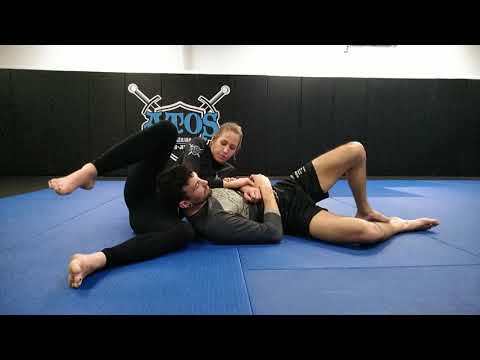
The headscissors from side control is a leg-based strangulation that both nicsulli and Cheat Code Jiu Jitsu present as a tactical exit or complement to the Kimura grip when arm-lock defenses tighten. Both instructors establish the position from a Kimura setup in top side control, maintaining wrist pressure to control the opponent's arm throughout. The core mechanics are consistent: the bottom leg slides beneath the opponent's head to create a platform, while the top leg crosses over and locks under the bottom ankle with the shin or knee positioned across the throat. nicsulli emphasizes using the knee tendon to dig under the chin and ratchet upward if the opponent hides their chin, and highlights the ability to return to top position without losing advantage if the choke fails. Cheat Code Jiu Jitsu stresses proper leg-locking mechanics—specifically that the top leg must loop back around the bottom ankle rather than the opposite way, as this alignment directs pressure downward into the throat during extension. Both agree the technique comes on quickly and can be devastating if the Kimura grip remains intact, allowing transitions to arm locks if the opponent releases their hands to defend the leg choke. Cheat Code Jiu Jitsu explicitly frames this as a "back pocket move" that increases finishing options and forces opponents into difficult defensive choices.
Сформировано на основе 2 инструкторов
Учебных курсов по этой технике пока нет.
Войдите, чтобы предложить курс.
Риск травмы для человека, к которому применяется техника
Headscissors use the thighs to squeeze the head laterally; risk of neck strain
Уровень мастерства, необходимый для надёжного выполнения техники
Разрешена ли техника по основным соревновательным правилам
Japanese grappling/BJJ standard terminology; JBJJF competition usage
Official Japanese BJJ federation — competition rules and terminology
Standard katakana transliteration of Western martial arts terminology (外来語) — used in Japanese MMA, boxing, and BJJ communities
Japanese terminology sourced from Japanese grappling/BJJ standard terminology; JBJJF competition usage
grip or squeeze strength, positional control
strong upper body for sustained compression
forearms, biceps, pectorals, core stabilisers
Каждое движение в любом боевом искусстве обладает рядом универсальных свойств. Комбинируйте параметры ниже, чтобы найти нужный инструмент или сравнить аналоги из разных стилей.
Switch to the headscissors when your opponent is defending with his arms and the Kimura doesn't feel like it's coming, but you notice his neck is exposed. Nikki Sullivan emphasizes that if you can't get the Kimura out quickly, it becomes hard to break whatever grip your opponent makes, so that's when the headscissors becomes the better option.
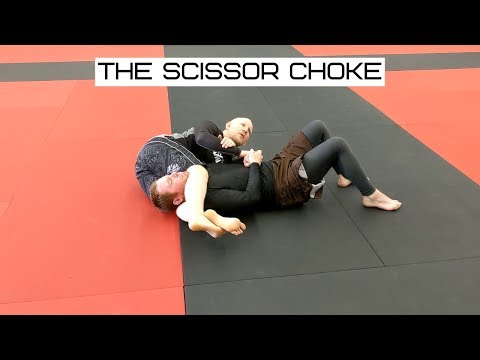
Slide your bottom knee underneath your opponent's head as a base, then bring your top leg over and position the tendon behind your knee under their chin. Lock your top foot under the bottom foot and extend your hips down to finish the choke.
If your opponent is hiding their chin, use the tendon in your knee to ratchet underneath their chin to dig it up. You can also scratch their face with your legs and then extend—sometimes turning their head to the side actually makes the choke work better on the carotids.
Keeping the Kimura grip tight—pushing your opponent's hand and wrist into their own body—prevents them from getting their elbow out and coming on top. If you can't finish the choke, this grip allows you to recover position and come back on top without losing anything.
The headscissors from side control is applied by the top player who isolates the opponent's head and threads the legs around the neck while transitioning from a side control pin. The attacker typically swings the far leg over the opponent's face and locks the ankles or thighs together, creating the scissoring compression around the neck.
Headscissors from side control positions have roots in catch wrestling and judo's katame-waza, where pins were used as platforms to transition into strangulation techniques. In BJJ, the side-control headscissors became an option for fighters who preferred leg-based attacks over the more common americana, kimura, or arm triangle from side mount.
IBJJF: разрешён — Legal at all belt levels, gi and no-gi — chokes are the safest submission cat…; IJF: разрешён — Legal (shime-waza) — strangulation techniques are one of three permitted subm…; ADCC: разрешён — Legal; Unified MMA: разрешён — Legal — choke submissions are among the most common finishes in MMA; FIAS Sport Sambo: запрещён — All chokes prohibited in Sport Sambo; FIAS Combat Sambo: разрешён — Legal
Оценка опасности 7/10. Headscissors use the thighs to squeeze the head laterally; risk of neck strain
Стандартная цепочка подготовки: Establish Position → Create the Threat → Secure the Hold → Finish.
Стандартные контрприёмы: Early Recognition — identify the submission attempt early and begin defence immediately / Posture and Base — maintain strong posture and base to prevent submission setups / Grip Fight — deny the attacker their preferred gripping configuration.
Распространённые варианты: Standard grip variation (primary hand configuration for maximum choking pressure); Gi variation (uses the lapel or collar as an anchor for additional fric…); No-gi variation (adapted grip and positioning for submission grappling wit…); Transition finish (applied during a positional change to catch the opponent …).
Uncommon at major competition; used occasionally in submission-only formats where position is less important
Основные ошибки, на которые стоит обратить внимание: Losing side control pressure during the leg threading — the upper body must maintain control while the legs move; lif… / Threading the legs too slowly — the transition must be decisive; slow leg movement allows the opponent to tuck the he… / Not maintaining the arm/shoulder control during the transition — the near arm should be controlled to prevent the opp… / Not locking the figure-four immediately — lock as soon as both legs are around the neck; delay allows the opponent to….
Headscissors From Side Control также известен как Heddo Shizāzu, Side Control Head Scissors, Lateral Scissor Choke.