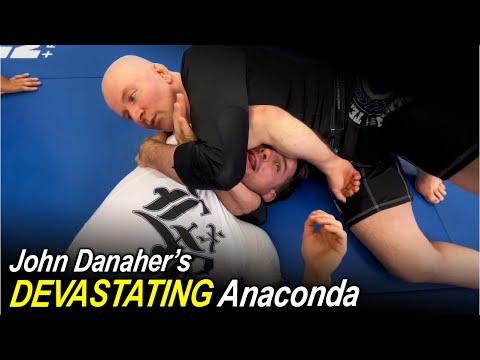
John Danaher's Devastating Anaconda
0
Anaconda Choke From Front Headlock·Bernardo Faria BJJ Fanatics
John Danaher's Best Jiu Jitsu Anaconda Secrets - John Danaher shows his secrets to perfect the Jiu Jitsu Anaconda, in th…
Перевод: Anaconda Choke (katakana loanword)
The anaconda choke from front headlock is applied by threading the attacking arm under the opponent's far-side arm and across the near side of the neck, then locking a figure-four grip and performing a gator roll to tighten the strangle. [1],[2] From the front headlock, the attacker reaches across to encircle both the head and one arm, creating the arm-in compression structure. [1] The gator roll — a lateral rolling motion — is used to flatten the opponent and eliminate their base, pulling the choke tight as the bodies rotate. [1],[2]
The anaconda choke was popularized in submission grappling and MMA by Milton Vieira and later by fighters like Nogueira and others who used the front headlock as the primary entry. [1],[2] The technique shares mechanical DNA with the D'Arce choke but threads the arm in the opposite direction, under the far arm rather than the near arm. [1] The gator roll finishing mechanic distinguishes the anaconda from other front headlock strangles and has become its signature movement. [1],[2]
The anaconda from front headlock is a primary arm-in choke — the over-neck-under-arm threading creates reliable bilateral compression using the opponent's shoulder. High finishing rate when properly locked. [1]
Popularised by Milton Vieira in BJJ competition. The mechanics appear in catch wrestling (arm-in headlock) and were systematised within the Danaher front headlock system. [1]
A staple front headlock submission at ADCC, no-gi worlds, and MMA. One of the primary alternatives to the guillotine from front headlock control. [1]
Изображений для этой техники пока нет.
Войдите, чтобы предложить изображение.
John Danaher's Best Jiu Jitsu Anaconda Secrets - John Danaher shows his secrets to perfect the Jiu Jitsu Anaconda, in th…
Welcome to my channel! Short, clear, and concise BJJ techniques that include footage of the technique every time. Like…
The anaconda choke from front headlock is a submission technique that evolved from wrestling in the 1990s, combining figure-four grip mechanics with positional control to create a highly effective stranglehold. According to John Danaher (via Bernardo Faria BJJ Fanatics), the technique's development involved adapting wrestling strangles—historically performed with palm-to-palm grips by wrestlers like David Schultz—into jiu-jitsu's preferred figure-four configuration. The critical innovation was the T-position, where the attacker's body forms a perpendicular angle relative to the opponent, forcing the opponent's head into an unnatural position with the ear driven toward the shoulder. This geometry creates dual carotid occlusion: the attacker's forearm on one side and the opponent's own shoulder on the other. Danaher emphasizes that elbow position dictates technique selection; anaconda suits scenarios where the opponent's elbow is positioned forward and across the body. Jordan Teaches Jiujitsu stresses precise elbow alignment perpendicular to the neck during the choke itself, ensuring pressure targets the soft tissue containing the carotid artery rather than the hard muscle, preventing ineffective cranking. Both instructors agree that the roll-through transition—using a gable grip and head tuck before rolling—proves more effective than immediately locking the grip, as premature grip establishment allows the opponent to widen elbows and escape. If the opponent flares elbows defensively, leg-lock variations can neutralize arm defense.
Сформировано на основе 2 инструкторов
Учебных курсов по этой технике пока нет.
Войдите, чтобы предложить курс.
Риск травмы для человека, к которому применяется техника
Anaconda/gator-roll chokes use a rolling motion to tighten the arm-in head-and-arm strangle
Уровень мастерства, необходимый для надёжного выполнения техники
Разрешена ли техника по основным соревновательным правилам
Tri-force BJJ Academy (triforce-bjj.com); Tri-force Shiki BJJ (tfshiki-bjj.com); Aoki Shinya (note.com/a_ok_i)
Japan's largest BJJ academy chain — Japanese technique terminology
Japanese BJJ technique naming conventions article (2019)
Top Japanese MMA fighter — BJJ technique terminology
Standard katakana transliteration of Western martial arts terminology (外来語) — used in Japanese MMA, boxing, and BJJ communities
Japanese terminology sourced from Tri-force BJJ Academy (triforce-bjj.com); Tri-force Shiki BJJ (tfshiki-bjj.com); Aoki Shinya (note.com/a_ok_i)
long arms for head-and-arm wrap, core strength for gator roll
longer limbs, athletic build
biceps, deltoids, core rotators, hip flexors
Каждое движение в любом боевом искусстве обладает рядом универсальных свойств. Комбинируйте параметры ниже, чтобы найти нужный инструмент или сравнить аналоги из разных стилей.
The anaconda choke from front headlock with gator roll entry uses a rolling transition to tighten the head-and-arm strangle while repositioning the opponent from their knees to their side. [1] The attacker threads the arm around the opponent's neck and arm in an anaconda configuration from front headlock, then rolls diagonally — similar to a crocodile's death roll — pulling the opponent over and onto their side. [1,2] The gator roll serves two purposes: it tightens the compression loop by coiling the attacker's body around the opponent, and it eliminates posting base, preventing the opponent from resisting the strangle. [2] The rolling momentum generates additional squeeze pressure that is difficult to replicate from a static position. [2,3]
The anaconda choke from front headlock with hip-walk finish uses a slow, grinding hip-walking motion to tighten the strangle rather than a rolling transition. [1] After establishing the anaconda arm wrap from front headlock, the attacker walks the hips in small increments toward the opponent's head, progressively tightening the compression loop with each step. [1,2] The hip-walk method provides more control than the gator roll, as the attacker maintains a stable base throughout the finishing sequence. [2] This variant is preferred when the opponent is too heavy to roll or when the attacker wants to methodically increase pressure while monitoring the opponent's response. [2,3]
The anaconda choke from front headlock with sit-through finish uses a sit-through motion to transition the attacker from a sprawl or kneeling position to a seated position beside the opponent, tightening the choke during the transition. [1] After locking the anaconda grip, the attacker swings one leg through and sits to the hip on the choking side, which changes the angle of pressure from vertical to lateral. [1,2] The sit-through creates a powerful rotational force on the choke as the attacker's body weight shifts, and the seated position provides a stable platform for sustained squeezing. [2] This finish is effective when the opponent resists the gator roll by posting with their free arm. [2,3]
According to Bernardo Faria, instructors prefer the figure-four grip for anacondas. The figure-four variation works from the same front headlock position but uses a different hand lock instead of palm-to-palm, making it a simple adjustment that doesn't require much additional technique.
Jordan Teaches Jiujitsu emphasizes that elbow position is crucial—your elbow must be completely in line with the neck with no weird angles. Use a gable grip, shoot your arm across the body, tuck your head, and roll through to apply pressure cleanly without cranking.
If you can't reach the T position, Bernardo Faria explains that you can finish from god position instead. Alternatively, you can throw your legs around your opponent and come up to a standing position to complete the choke.
Jordan Teaches Jiujitsu notes that flaring the elbow is an effective defense because it makes it very hard to lock up the choke effectively. If an opponent uses this defense, you can counter by bringing your legs up and then down.
The anaconda choke from front headlock is applied by threading the attacking arm under the opponent's far-side arm and across the near side of the neck, then locking a figure-four grip and performing a gator roll to tighten the strangle. From the front headlock, the attacker reaches across to encircle both the head and one arm, creating the arm-in compression structure.
The anaconda choke was popularized in submission grappling and MMA by Milton Vieira and later by fighters like Nogueira and others who used the front headlock as the primary entry. The technique shares mechanical DNA with the D'Arce choke but threads the arm in the opposite direction, under the far arm rather than the near arm.
IBJJF: разрешён — Legal at all belt levels, gi and no-gi — chokes are the safest submission cat…; IJF: разрешён — Legal (shime-waza) — strangulation techniques are one of three permitted subm…; ADCC: разрешён — Legal; Unified MMA: разрешён — Legal — choke submissions are among the most common finishes in MMA; FIAS Sport Sambo: запрещён — All chokes prohibited in Sport Sambo; FIAS Combat Sambo: разрешён — Legal
Оценка опасности 9/10. Anaconda/gator-roll chokes use a rolling motion to tighten the arm-in head-and-arm strangle
Стандартная цепочка подготовки: Achieve Controlling Position → Isolate the Neck → Set the Grip → Apply Pressure.
Стандартные контрприёмы: Tuck Chin — protect the neck by lowering the chin to prevent the choke from sinking / Two-on-One Grip Fight — use both hands to strip the choking grip before it locks / Turn Into — rotate toward the choking arm to relieve carotid pressure / Posture Up — straighten the spine and create distance to break the choking angle.
Распространённые варианты: Standard anaconda (arm threaded under the neck and over the far arm, finishe…); No-roll anaconda (finished in place without the gator roll by sprawling and…); Anaconda from guard (applied from bottom position when the opponent's head is low).
A staple front headlock submission at ADCC, no-gi worlds, and MMA. One of the primary alternatives to the guillotine from front headlock control.
Основные ошибки, на которые стоит обратить внимание: Threading over the neck without going under the far arm — the arm must pass under the arm to trap the shoulder; over-… / Not connecting the hands — the grip must close the loop; an unconnected threading allows the opponent to pull the hea… / Attempting the anaconda with the near arm trapped instead of the far arm — the far arm provides the shoulder wedge; t… / Not choosing a finishing method — decide between gator roll and hip walk before committing; indecision stalls the pos….
Anaconda Choke From Front Headlock также известен как Anakonda Chōku, Front Headlock Anaconda, Headlock Anaconda Choke.