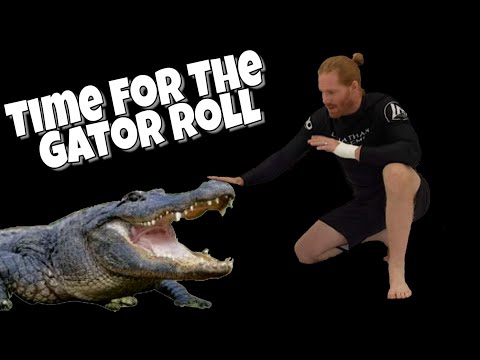
Gator Roll to Anaconda Choke
0
Anaconda Choke From Front Headlock Gator Roll·Still Rolling
Attacking from the front head position with the Gator Roll then transitioning to the Anaconda Choke. Also transitioning …
Перевод: Anaconda Choke (katakana loanword)
The anaconda choke from front headlock with gator roll entry uses a rolling transition to tighten the head-and-arm strangle while repositioning the opponent from their knees to their side. [1] The attacker threads the arm around the opponent's neck and arm in an anaconda configuration from front headlock, then rolls diagonally — similar to a crocodile's death roll — pulling the opponent over and onto their side. [1],[2] The gator roll serves two purposes: it tightens the compression loop by coiling the attacker's body around the opponent, and it eliminates posting base, preventing the opponent from resisting the strangle. [2] The rolling momentum generates additional squeeze pressure that is difficult to replicate from a static position. [2],[3]
The gator roll entry for the anaconda choke was popularised by Milton Vieira and later refined by competitors in the ADCC and no-gi competition circuit during the 2000s. [1] The rolling mechanic was inspired by the hunting behaviour of crocodilians, which gave the technique its evocative name. [2],[3]
The gator roll finish is highly effective — the rolling momentum cinches the arm triangle tighter than static squeezing. Multiple rolls create progressive, irreversible compression. [1]
The gator roll derives from catch wrestling turning techniques and was named for the alligator's hunting behaviour. Milton Vieira popularised the anaconda with gator roll in BJJ competition. [1]
The gator roll is the most common anaconda finish in competition — the dynamic tightening overcomes defences that resist static compression. Regularly seen at ADCC and no-gi worlds. [1]
Изображений для этой техники пока нет.
Войдите, чтобы предложить изображение.
Attacking from the front head position with the Gator Roll then transitioning to the Anaconda Choke. Also transitioning …
Учебных курсов по этой технике пока нет.
Войдите, чтобы предложить курс.
Риск травмы для человека, к которому применяется техника
Anaconda/gator-roll chokes use a rolling motion to tighten the arm-in head-and-arm strangle
Уровень мастерства, необходимый для надёжного выполнения техники
Разрешена ли техника по основным соревновательным правилам
Tri-force BJJ Academy (triforce-bjj.com); Tri-force Shiki BJJ (tfshiki-bjj.com); Aoki Shinya (note.com/a_ok_i)
Japan's largest BJJ academy chain — Japanese technique terminology
Japanese BJJ technique naming conventions article (2019)
Top Japanese MMA fighter — BJJ technique terminology
Standard katakana transliteration of Western martial arts terminology (外来語) — used in Japanese MMA, boxing, and BJJ communities
Japanese terminology sourced from Tri-force BJJ Academy (triforce-bjj.com); Tri-force Shiki BJJ (tfshiki-bjj.com); Aoki Shinya (note.com/a_ok_i)
long arms for head-and-arm wrap, core strength for gator roll
longer limbs, athletic build
biceps, deltoids, core rotators, hip flexors
Lock your hand over top and pull in tight. While you can hook it up underneath, locking over top is preferred because it gives your opponent fewer defense options if they know that escape.
Pull back and extend your opponent's arm to get it pulled out before attempting the roll—this makes the roll much easier than just tucking your head and trying to force it.
Get tight around your opponent and get under their head—that's where you'll really be able to finish the choke. Use a gable grip with elbows in tight after pulling them to you.
Try to hook a leg if you can to stop the escape, but focus primarily on getting tight and getting under their head, as that's where you generate finishing power.
The anaconda choke from front headlock with gator roll entry uses a rolling transition to tighten the head-and-arm strangle while repositioning the opponent from their knees to their side. The attacker threads the arm around the opponent's neck and arm in an anaconda configuration from front headlock, then rolls diagonally — similar to a crocodile's death roll — pulling the opponent over and onto their side.
The gator roll entry for the anaconda choke was popularised by Milton Vieira and later refined by competitors in the ADCC and no-gi competition circuit during the 2000s. The rolling mechanic was inspired by the hunting behaviour of crocodilians, which gave the technique its evocative name.
IBJJF: разрешён — Legal at all belt levels, gi and no-gi — chokes are the safest submission cat…; IJF: разрешён — Legal (shime-waza) — strangulation techniques are one of three permitted subm…; ADCC: разрешён — Legal; Unified MMA: разрешён — Legal — choke submissions are among the most common finishes in MMA; FIAS Sport Sambo: запрещён — All chokes prohibited in Sport Sambo; FIAS Combat Sambo: разрешён — Legal
Оценка опасности 9/10. Anaconda/gator-roll chokes use a rolling motion to tighten the arm-in head-and-arm strangle
Стандартная цепочка подготовки: Achieve Controlling Position → Isolate the Neck → Set the Grip → Apply Pressure.
Стандартные контрприёмы: Tuck Chin — protect the neck by lowering the chin to prevent the choke from sinking / Two-on-One Grip Fight — use both hands to strip the choking grip before it locks / Turn Into — rotate toward the choking arm to relieve carotid pressure / Posture Up — straighten the spine and create distance to break the choking angle.
Распространённые варианты: Standard anaconda (arm threaded under the neck and over the far arm, finishe…); No-roll anaconda (finished in place without the gator roll by sprawling and…); Anaconda from guard (applied from bottom position when the opponent's head is low).
The gator roll is the most common anaconda finish in competition — the dynamic tightening overcomes defences that resist static compression. Regularly seen at ADCC and no-gi worlds.
Основные ошибки, на которые стоит обратить внимание: Rolling in the wrong direction — roll toward the trapped-arm side; rolling opposite loosens the anaconda grip / Not connecting the hands before rolling — the grip must be locked; rolling with an unconnected grip loses the position / Rolling without hip engagement — the roll must come from the hips, not just the shoulders; hip-driven rolls are more … / Stopping after one roll when the choke isn't finished — continue rolling; the technique often requires 2-3 rolls to f….
Anaconda Choke From Front Headlock Gator Roll также известен как Anakonda Chōku, Gator Roll Headlock Anaconda, Rolling Anaconda from Headlock.