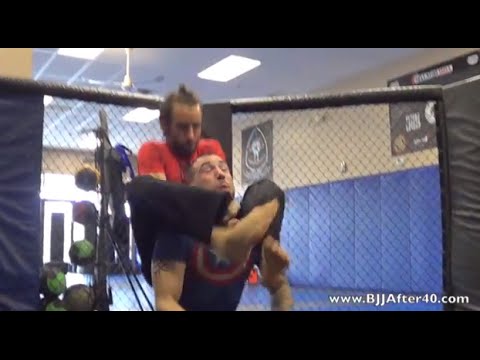
Brandon Bergeron "Technique of the Week" - Hangman's Noose
0
Own Lapel Rear Noose Choke·Brandon Bergeron·Added by Admin
Another Brandon Bergeron Original! This one is a pretty slick and potentially sneaky lapel choke from Side Control. It c…
Перевод: own lapel rear noose choke
The own-lapel rear noose choke is executed by the attacker pulling their own gi lapel free, feeding it under the opponent's chin from back control, catching the tail with the other hand, and cinching a noose that compresses the carotid arteries on both sides of the neck. [1],[2] The self-lapel provides a long fabric tail that can be routed in ways the opponent does not expect, since the fabric originates from the attacker's body rather than the opponent's collar. [1] The noose configuration tightens as the attacker pulls the tail end while pressing their chest into the opponent's back. [1],[3]
Self-lapel chokes developed in Brazilian Jiu-Jitsu as practitioners explored creative fabric manipulation beyond traditional judo collar grips. [1],[2] While judo focused on gripping the opponent's uniform, [2] BJJ competitors in the 2000s began systematically using their own lapel as an offensive weapon, creating chokes that were difficult to anticipate or defend. [1],[3]
Using one's own lapel as a noose from rear control creates a powerful choke that is difficult to strip because the attacker controls their own gi. [1]
Own-lapel chokes were developed in BJJ competition as creative uses of the gi from back control. [1]
Own-lapel rear chokes appear at advanced IBJJF competition levels. [1]
Изображений для этой техники пока нет.
Войдите, чтобы предложить изображение.
Another Brandon Bergeron Original! This one is a pretty slick and potentially sneaky lapel choke from Side Control. It c…
Mike 'Spider Ninja' Bidwell learned this back take in 1999 from Jean Jacques Machado at an awesome seminar. Jeff Glover…
The Own Lapel Rear Noose Choke is a strangulation technique executed using the attacker's own gi lapel as the primary choking mechanism. Brandon Bergeron (Brandon Bergeron "Technique of the Week") details the technique from side control, emphasizing the importance of untucking both lapels to maximize available length. The setup involves obtaining an underhook from cross-body position, then extracting the lapel tip, feeding it underneath the opponent's head, and passing it to the opposite hand. Bergeron advocates creating space by rotating to the opposite hip, allowing the free arm to feed through the created opening, then repositioning to square up while pulling the lapel downward and raising the elbow to generate neck pressure. Bergeron also emphasizes disguising the attack by applying shoulder pressure to distract the opponent before executing the lapel feed. BJJ After Forty ("BJJ After 40 Ninja Back Take + 'Evil Ninja Choke'") approaches a similar choking mechanic from back control and turtle position, using both lapels in a V-grip configuration around the neck before transitioning to hook the legs and apply constriction. While Bergeron focuses on lapel mechanics and positioning subtleties from side control, BJJ After Forty emphasizes the back-control application and the synchronization of upper-body pressure with lower-body hooks. Both instructors agree on the fundamental principle of using one's own lapel as a choking tool and the importance of proper body positioning to maximize pressure.
Сформировано на основе 2 инструкторов
Учебных курсов по этой технике пока нет.
Войдите, чтобы предложить курс.
Риск травмы для человека, к которому применяется техника
Using one's own lapel creates a noose-like mechanism that tightens under tension
Уровень мастерства, необходимый для надёжного выполнения техники
Разрешена ли техника по основным соревновательным правилам
Japanese BJJ community terminology
Japanese BJJ community terminology
Standard Japanese martial arts terminology (kanji/hiragana)
Established Japanese martial arts naming convention — native Japanese term (和語/漢語)
Japanese terminology sourced from Japanese BJJ community terminology
grip or squeeze strength, positional control
strong upper body for sustained compression
forearms, biceps, pectorals, core stabilisers
Start in cross body side control with an underhook, then grab the tip of your own lapel and stretch it out underneath your opponent's head. Brandon Bergeron emphasizes maintaining chest pressure while creating this opening.
Brandon Bergeron notes that the more your gi is untucked, the more lapel length you have available to work with, giving you more material to use for the technique.
Feed your arm through the opening you've created by sitting back on your hip, then drop your head to one side with your hand down and elbow up to finish the choke while maintaining hip pressure, according to Brandon Bergeron.
Brandon Bergeron suggests maintaining heavy pressure on the hip to make your opponent look the other way, then grab the lapel while still pressing with your arm and shoulder so the opponent doesn't realize the lapel is being positioned around the neck.
The own-lapel rear noose choke is executed by the attacker pulling their own gi lapel free, feeding it under the opponent's chin from back control, catching the tail with the other hand, and cinching a noose that compresses the carotid arteries on both sides of the neck. The self-lapel provides a long fabric tail that can be routed in ways the opponent does not expect, since the fabric originates from the attacker's body rather than the opponent's collar.
Self-lapel chokes developed in Brazilian Jiu-Jitsu as practitioners explored creative fabric manipulation beyond traditional judo collar grips. While judo focused on gripping the opponent's uniform, BJJ competitors in the 2000s began systematically using their own lapel as an offensive weapon, creating chokes that were difficult to anticipate or defend.
IBJJF: разрешён — Legal at all belt levels, gi and no-gi — chokes are the safest submission cat…; IJF: разрешён — Legal (shime-waza) — strangulation techniques are one of three permitted subm…; ADCC: ограничен — N/A (no-gi competition only — technique requires gi); Unified MMA: ограничен — N/A (technique requires gi — not applicable in MMA); FIAS Sport Sambo: запрещён — All chokes prohibited in Sport Sambo; FIAS Combat Sambo: разрешён — Legal
Оценка опасности 8/10. Using one's own lapel creates a noose-like mechanism that tightens under tension
Стандартная цепочка подготовки: Achieve Controlling Position → Isolate the Neck → Set the Grip → Apply Pressure.
Стандартные контрприёмы: Tuck Chin — protect the neck by lowering the chin to prevent the choke from sinking / Two-on-One Grip Fight — use both hands to strip the choking grip before it locks / Turn Into — rotate toward the choking arm to relieve carotid pressure / Posture Up — straighten the spine and create distance to break the choking angle.
Распространённые варианты: Standard grip variation (primary hand configuration for maximum choking pressure); Gi variation (uses the lapel or collar as an anchor for additional fric…); No-gi variation (adapted grip and positioning for submission grappling wit…); Transition finish (applied during a positional change to catch the opponent …).
Own-lapel rear chokes appear at advanced IBJJF competition levels.
Основные ошибки, на которые стоит обратить внимание: Feeding the lapel too loosely — the fabric must pass snugly behind the neck; excess slack prevents the noose from cin… / Losing back control while feeding — maintain hooks and body triangle throughout; the feed requires patience, not aban… / Not controlling the head — the free hand must block the opponent's head from turning into you during the feed / Feeding over the shoulder instead of under the arm — the lapel must travel under the arm and behind the neck for prop….
Own Lapel Rear Noose Choke также известен как Ji-eri Okuri-jime, Self-Lapel Rear Strangle, Own-Collar Noose Choke.