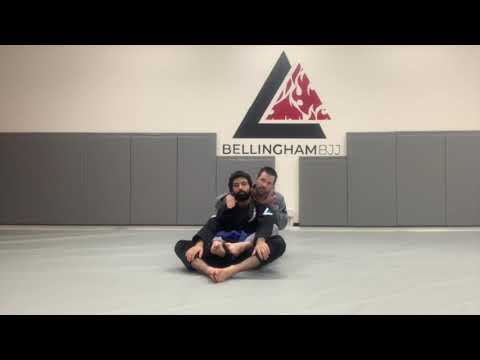
Fundamentals: Gable Grip Choke from the Back
0
Gable Grip·Bellingham BJJ
The Gable Grip Choke, also known as the Short Choke or Fedor Choke, is the air choke counterpart to the Rear Naked Choke…
Перевод: gable grip
The Gable Grip finishing variation uses a palm-to-palm grip (no thumbs interlocked) to secure the short choke — the strongest clasp grip available, named after wrestling legend Dan Gable. [1] The Gable grip prevents the hands from being stripped because there are no fingers to peel. [1],[2]
Developed within the BJJ/grappling submission system. [1]
Used in BJJ, MMA, and submission grappling competition. [1]
Изображений для этой техники пока нет.
Войдите, чтобы предложить изображение.
The Gable Grip Choke, also known as the Short Choke or Fedor Choke, is the air choke counterpart to the Rear Naked Choke…
Учебных курсов по этой технике пока нет.
Войдите, чтобы предложить курс.
Риск травмы для человека, к которому применяется техника
Chokes and neck cranks carry significant risk; blood chokes cause unconsciousness in 6-10 seconds; neck cranks can cause cervical spine damage; always tap early
Уровень мастерства, необходимый для надёжного выполнения техники
Разрешена ли техника по основным соревновательным правилам
Jiu-Jitsu University (Saulo Ribeiro, 2008)
Description sources — [1] Choking/cranking technique curriculum [2] Competition analysis
Standard katakana transliteration of Western martial arts terminology (外来語) — used in Japanese MMA, boxing, and BJJ communities
Description sources — [1] Choking/cranking technique curriculum [2] Competition analysis
grip strength, arm positioning precision, back control ability
forearms (squeeze), biceps (compression), shoulders (positioning)
If your opponent hangs on your arms to defend the rear naked choke, you can transition to a gable grip choke by bringing your elbow behind their shoulder blade instead. This elbow ratchet position is more powerful than finishing the choke without it.
Yes, you can still finish the rear naked choke without bringing the elbow ratchet in front, although it won't be as powerful as the fully executed version.
You have to control before you attack because you always compromise a little bit of control when you attack, so establishing solid positioning first ensures a more effective finish.
The Gable Grip finishing variation uses a palm-to-palm grip (no thumbs interlocked) to secure the short choke — the strongest clasp grip available, named after wrestling legend Dan Gable. The Gable grip prevents the hands from being stripped because there are no fingers to peel.
This variation developed within the broader choking/cranking system of its parent technique family.
IBJJF: разрешён — Legal at all belt levels, gi and no-gi — chokes are the safest submission cat…; IJF: разрешён — Legal (shime-waza) — strangulation techniques are one of three permitted subm…; ADCC: разрешён — Legal; Unified MMA: разрешён — Legal — choke submissions are among the most common finishes in MMA; FIAS Sport Sambo: запрещён — All chokes prohibited in Sport Sambo; FIAS Combat Sambo: разрешён — Legal
Оценка опасности 8/10. High — chokes and neck cranks carry significant risk; blood chokes cause unconsciousness in 6-10 seconds; neck cranks can cause cervical spine damage; always tap early
Стандартная цепочка подготовки: Establish Control Position → Secure the Specific Grip → Position the Choking Surface → Apply Compression → Finish.
Стандартные контрприёмы: Hand fighting — stripping the grip before the choke is set / Chin tuck — protecting the throat / Posture — creating distance to prevent the choke / Turning — turning to face the attacker.
Распространённые варианты: This is a specific variation (see parent genus/species for alternative variations).
Used in BJJ, MMA, and submission grappling competition.
Основные ошибки, на которые стоит обратить внимание: Applying too fast — gradual application is safer and often more effective / Wrong grip positioning — the specific grip variation defines this technique; incorrect grip = different technique / Not controlling posture before applying / Holding after the tap — release immediately.
Gable Grip также известен как Gēburu Gurippu, Gable Grip Finish, Palm-to-Palm No Thumbs, Greco Grip.