Удар и защитаЗамкиБлижний бойБой против нескольких
Дистанция
БлижняяСредняяДальняя
Целевая зона
Верхняя частьСредняя частьНижняя часть
Обзор
The crucifix rear strangle is applied from the crucifix position, where the attacker traps one of the opponent's arms with their legs (typically threading the far arm between the legs and locking it) while controlling the second arm with their hands or shoulder pin, holding the opponent face-down with both arms immobilised. [1],[2] With both arms neutralised, the attacker threads a forearm or feeds a lapel/sleeve across the neck and applies direct compression without defensive hand-fighting. [1] The crucifix can be entered from side control, turtle, or back control by isolating one arm with the legs and rolling to trap the second. [1],[3]
The crucifix position appears in catch wrestling and sambo as a restraint and finishing position. [1],[2] In judo, forearm strangles without the gi (hadaka-jime variants) provided the mechanical foundation. [2],[3] Brazilian Jiu-Jitsu competitors like Braulio Estima and Alexandre Vieira popularized the crucifix as a high-percentage finishing system in the 2000s. [1]
Страна происхождения· показано в случайном порядке
The Crucifix is such a dominant position, but I get lots of questions about submission options from there, particularly …
2 videos
Что говорят инструкторы
The crucifix rear strangle is a back-control submission that exploits resistance to traditional neck grip placement by using the legs to expose and control the opponent's arm, then rolling through to finish a choke. Both Brian Glick and Knight Jiu-Jitsu agree on the foundational mechanics: when facing a tight X-block or elbow-inside defense on the back, the attacker places a knee on the ramp of the opponent's leg between elbow and knee to flare the arm outward, then captures and locks the far arm while folding the legs to control it. Glick emphasizes the importance of opening the top leg during the roll to prevent the opponent from escaping over the top, while Knight Jiu-Jitsu provides the same core sequence but focuses heavily on submission variety once in the crucifix position. Both instructors agree the armtrap initiates the roll, but Knight Jiu-Jitsu catalogs multiple finishing options including the one-arm choke (using trap and elbow pull rather than squeeze), a compression choke with the top leg, a guillotine-style head-and-arm choke, triangle possibilities, north-south transitions, and arm locks. Glick presents a more linear path to the rear strangle finish with trapped arm control. Knight Jiu-Jitsu's approach acknowledges that no-gi slipperiness demands multiple contingencies, whereas Glick treats the technique as a systematic off-balance tool for opening tight defensive positions. Both agree the technique is particularly valuable when traditional back-control grips are unavailable or heavily resisted.
Сформировано на основе 2 инструкторов
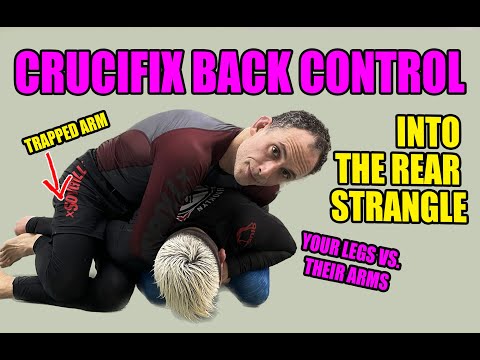
Brian Glick — Crucifix Back Control to Rear Strangle: Your Legs Vs. Their Arms (BJJ No Gi/Jiu-Jitsu/Judo): Detailed mechanical setup of the crucifix roll from tight back control, emphasis on leg positioning to expose the arm, the importance of opening the top leg during rotation to prevent escape, and the linear path to rear strangle finish with arm control.
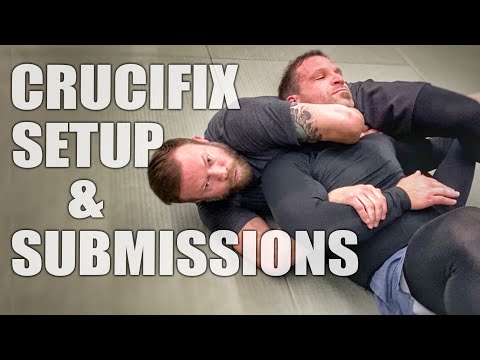
Knight Jiu-Jitsu — Crucifix Submission Options | Jiu-Jitsu Submissions: Comprehensive catalog of submission options available from the crucifix position including one-arm choke mechanics, compression chokes, guillotine-style finishes, triangle setups, north-south transitions, and armlock variations; addresses no-gi contingencies and panic-creation tactics.
Изучить технику
Учебных курсов по этой технике пока нет.
Войдите, чтобы предложить курс.
Оценки
Уровень опасности
Риск травмы для человека, к которому применяется техника
9
Экстремальный9/10
Crucifix position traps both arms, eliminating all common choke defense options
Сложность
Уровень мастерства, необходимый для надёжного выполнения техники
Продвинутый
Допустимость на соревнованиях
Разрешена ли техника по основным соревновательным правилам
Запрещено
— FIAS Sport Sambo — All chokes prohibited in Sport Sambo
✓The crucifix position traps both of the opponent's arms using the attacker's legs and body — leaving the neck completely exposed for any choking technique (Danaher, Back Attacks, 2019)
✓In the crucifix: one of the opponent's arms is trapped between the attacker's legs (like a figure-four), and the other arm is controlled by the attacker's arm — both hands are neutralised
✓With both defensive arms trapped, the opponent cannot protect their neck — creating the highest-percentage choking position in grappling
✓The rear strangle from crucifix uses the free arm (the one not trapping an arm) to apply a choke: RNC variation, collar choke, or forearm compression
✓The crucifix is entered from back control, from turtle attacks, or from side control when the opponent reaches back
✓The crucifix rear strangle is nearly impossible to defend once locked: the opponent's arms are captured, leaving only bridging and rolling as escape options
✓In MMA, the crucifix allows strikes to the face combined with choke attempts — creating a devastating combination of damage and submission threat
Типичные ошибки
!Not securing both arms before attempting the choke — the crucifix's power comes from arm control; the choke is the finishing touch
!Losing the leg trap while setting up the choke — maintain the figure-four leg control on the trapped arm throughout
!Not controlling the opponent's hips — the opponent will try to bridge and roll; control the hip line with your positioning
!Rushing the choke without stabilising the crucifix — take time to cement the position; a loose crucifix allows arm extraction
!Using only the RNC from crucifix — collar chokes, wrist chokes, and forearm compressions are also available; use what's open
!Not following up if the choke fails — from crucifix, transition to arm locks, back control, or mount if the choke doesn't finish
!Applying the crucifix in a position where the opponent can roll on top — maintain the angle that keeps the opponent's back on the mat
Japanese terminology sourced from Japanese grappling terminology; 十字架 (crucifix) + 絞め (strangle)
Сообщество
Атлетизм
Requires
grip or squeeze strength, positional control
Favours
strong upper body for sustained compression
Key muscles
forearms, biceps, pectorals, core stabilisers
Часто задаваемые вопросы
When should I use the crucifix to set up a rear strangle instead of going for the arm drag?
Use the crucifix when you're behind your partner and it's difficult to establish a classic seatbelt grip and strangle, such as in no-gi where it's slippery. Brian Glick emphasizes that the crucifix opens up your partner's body, allowing you to rotate them and take the back before finishing the strangle.
What's the critical detail I'm missing if my opponent keeps escaping over the top during the crucifix roll?
You must open your leg as you roll over the top—if you don't, your partner will go over the top and land in the crucifix instead. Brian Glick stresses this is one of the most important details to execute the technique correctly.
How do I finish the one-arm crucifix strangle without just squeezing?
Rather than relying purely on grip strength, grab your opponent's trap and pull your elbow back to finish the strangle, according to Knight Jiu-Jitsu's submission breakdown.
Как работает Crucifix Rear Strangle?
The crucifix rear strangle is applied from the crucifix position, where the attacker traps one of the opponent's arms with their legs (typically threading the far arm between the legs and locking it) while controlling the second arm with their hands or shoulder pin, holding the opponent face-down with both arms immobilised. With both arms neutralised, the attacker threads a forearm or feeds a lapel/sleeve across the neck and applies direct compression without defensive hand-fighting.
Откуда происходит Crucifix Rear Strangle?
The crucifix position appears in catch wrestling and sambo as a restraint and finishing position. In judo, forearm strangles without the gi (hadaka-jime variants) provided the mechanical foundation.
Разрешён ли Crucifix Rear Strangle на соревнованиях?
IBJJF: разрешён — Legal at all belt levels, gi and no-gi — chokes are the safest submission cat…; IJF: разрешён — Legal (shime-waza) — strangulation techniques are one of three permitted subm…; ADCC: разрешён — Legal; Unified MMA: разрешён — Legal — choke submissions are among the most common finishes in MMA; FIAS Sport Sambo: запрещён — All chokes prohibited in Sport Sambo; FIAS Combat Sambo: разрешён — Legal
Насколько опасен Crucifix Rear Strangle?
Оценка опасности 9/10. Crucifix position traps both arms, eliminating all common choke defense options
Как подготовить Crucifix Rear Strangle?
Стандартная цепочка подготовки: Achieve Controlling Position → Isolate the Neck → Set the Grip → Apply Pressure.
Как защититься от Crucifix Rear Strangle?
Стандартные контрприёмы: Tuck Chin — protect the neck by lowering the chin to prevent the choke from sinking / Two-on-One Grip Fight — use both hands to strip the choking grip before it locks / Turn Into — rotate toward the choking arm to relieve carotid pressure / Posture Up — straighten the spine and create distance to break the choking angle.
Какие есть варианты Crucifix Rear Strangle?
Распространённые варианты: Standard grip variation (primary hand configuration for maximum choking pressure); Gi variation (uses the lapel or collar as an anchor for additional fric…); No-gi variation (adapted grip and positioning for submission grappling wit…); Transition finish (applied during a positional change to catch the opponent …).
Насколько эффективен Crucifix Rear Strangle на соревнованиях?
The crucifix submission has been used in UFC competition by fighters like Matt Hughes, and is a recognised position in ADCC competition.
Какие типичные ошибки при выполнении Crucifix Rear Strangle?
Основные ошибки, на которые стоит обратить внимание: Not securing both arms before attempting the choke — the crucifix's power comes from arm control; the choke is the fi… / Losing the leg trap while setting up the choke — maintain the figure-four leg control on the trapped arm throughout / Not controlling the opponent's hips — the opponent will try to bridge and roll; control the hip line with your positi… / Rushing the choke without stabilising the crucifix — take time to cement the position; a loose crucifix allows arm ex….
Какие ещё названия есть у Crucifix Rear Strangle?
Crucifix Rear Strangle также известен как Jūjika Kōhō-jime, Crucifix Choke, Rear Crucifix Strangle, Juji-garami-jime.