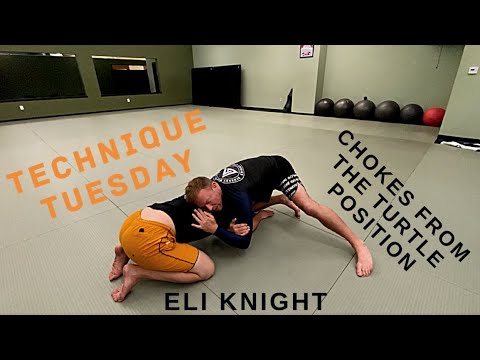
Technique Tuesday: Eli Knight - Chokes from turtle position
0
Turtle to Mount Arm Triangle Choke Transition·McDojoLife
Today my homie Eli Knight will be covering a few chokes from the turtle position. Enjoy :) If you enjoyed these techniq…
Перевод: Shoulder Hold / Head-and-Arm Choke — Turtle to Mount
A kata gatame variation where the attacker breaks down the turtle and transitions directly into mount while keeping the head-and-arm locked. The choke is set from turtle, and as the defender collapses, the attacker slides into mount, finishing with strong shoulder and chest pressure.
Developed as an adaptation of kata gatame in Judo; widely used in BJJ to convert turtle defense into dominant mount and finish.
Combines positional advancement with submission threat, using the turtle-to-mount transition to trap the arm naturally as the opponent attempts to defend the position change. [1]
This transition takes the opponent from turtle through mount to arm triangle, chaining positional advancement with submission attack. [1]
Turtle-to-mount-to-arm triangle chains are used at advanced BJJ competition levels. [1]
Изображений для этой техники пока нет.
Войдите, чтобы предложить изображение.
Today my homie Eli Knight will be covering a few chokes from the turtle position. Enjoy :) If you enjoyed these techniq…
Учебных курсов по этой технике пока нет.
Войдите, чтобы предложить курс.
Риск травмы для человека, к которому применяется техника
Transition to mount amplifies control and choke pressure.
Уровень мастерства, необходимый для надёжного выполнения техники
Разрешена ли техника по основным соревновательным правилам
Kodokan Judo — Official Katame-waza Classification (肩固め Kata-gatame)
Japanese terminology sourced from Kodokan Judo — Official Katame-waza Classification (肩固め Kata-gatame)
Official Kodokan ground technique classification system
Established Japanese martial arts naming convention — native Japanese term (和語/漢語)
Japanese terminology sourced from Kodokan Judo — Official Katame-waza Classification (肩固め Kata-gatame)
hip flexibility, long legs relative to torso
longer limbs for easier figure-four lock around head and arm
hip adductors, hamstrings, quadriceps
Useful in competition as it gives both points for mount and a submission threat simultaneously.
According to Eli Knight, start by establishing a chin strap with your arm across the trachea while hugging the jawline, then drive your chest toward the base of their shoulder so their head goes into your diaphragm. Cup your second hand and drive forward while cutting back—this creates a sharp ten-finger guillotine.
Eli Knight explains that if they block with their arm, cup the back of their bicep, pull back to open space, then shoot your arm through under their armpit with your back hand against their lat and shoulder. Once you roll to mount position, squeeze and bring your other leg over for an arm triangle or anaconda choke.
Eli Knight teaches two setups: entering by the neck and out by the armpit leads to one choke variation, while entering by the armpit and out by the neck allows you to cup both hands together, use an S-grip, and crank under their armpit to flip them before shooting your arm in deep with your bicep across their neck.
A kata gatame variation where the attacker breaks down the turtle and transitions directly into mount while keeping the head-and-arm locked. The choke is set from turtle, and as the defender collapses, the attacker slides into mount, finishing with strong shoulder and chest pressure.
Developed as an adaptation of kata gatame in Judo; widely used in BJJ to convert turtle defense into dominant mount and finish.
Danger: 9/10 | Transition to mount amplifies control and choke pressure.
Стандартная цепочка подготовки: Achieve Controlling Position → Isolate the Neck → Set the Grip → Apply Pressure.
Стандартные контрприёмы: Tuck Chin — protect the neck by lowering the chin to prevent the choke from sinking / Two-on-One Grip Fight — use both hands to strip the choking grip before it locks / Turn Into — rotate toward the choking arm to relieve carotid pressure / Posture Up — straighten the spine and create distance to break the choking angle.
Распространённые варианты: Turtle collapse directly to mount finish; Turtle to S-mount arm triangle; Turtle to mount then slide to side control.
Turtle-to-mount-to-arm triangle chains are used at advanced BJJ competition levels.
Основные ошибки, на которые стоит обратить внимание: Climbing to mount before securing choke / Allowing defender’s elbow to slip free / Not driving shoulder deep enough in transition.
Turtle to Mount Arm Triangle Choke Transition также известен как Kata Gatame — Turtle to Mount Transition, Turtle to Mount Kata Gatame, Turtle-to-Mount Arm Triangle, Kata Gatame Mount Transition.