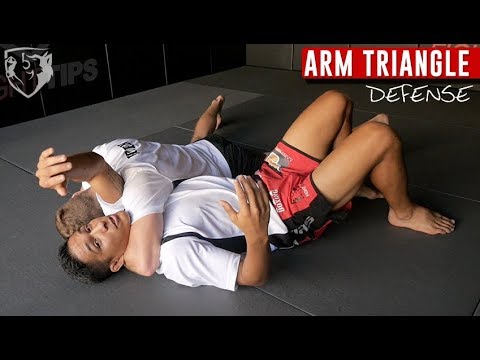
How to Defend: Head-Arm Triangle Choke
0
Head And Arm Choke·fightTIPS
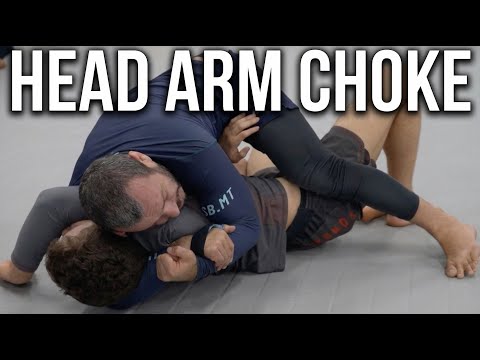
Used in the UFC by Chris Weidman, Randy Couture, and Brock Lesnar, the head-arm (or arm triangle) choke is a fight-finis…
Перевод: Shoulder Hold / Arm-and-Head Lock
The head-and-arm choke subfamily encompasses all arm triangle variations where the attacker traps the opponent’s head and one arm together, using the trapped arm as a wedge against one carotid artery while the attacker’s shoulder compresses the other side. [1],[2] The classic kata-gatame configuration involves wrapping one arm around the opponent’s head while their arm is pinned alongside it, then clasping hands and squeezing laterally to restrict bilateral blood flow. [2],[3] This subfamily can be applied from mount, side control, half guard, and north-south, making it one of the most versatile choke systems in grappling. [1] The trapped arm is essential — without it wedged against the neck, the compression geometry fails to occlude both carotid arteries simultaneously.
Kata-gatame (肩固め, 'shoulder hold') is classified in Kodokan Judo as an osaekomi-waza (pinning technique), though its choking application has been recognized since the technique's early codification. [2],[3] In judo competition, kata-gatame was historically valued more for its immobilization properties than as a submission. [3] The technique was adopted into Brazilian Jiu-Jitsu through the Gracie lineage and became a primary finishing submission from top positions, particularly mount and side control. [1] Modern MMA competitors have further popularized the head-and-arm choke as a high-percentage finish from half guard and mount. [4]
The arm triangle (kata-gatame) is one of the highest-percentage chokes from top position, using the opponent's own trapped shoulder as a compression point against the neck to create bilateral carotid occlusion. [1],[2] The technique works identically in gi and no-gi, making it a staple in both BJJ competition and MMA. [1] When applied from side control with correct sprawl pressure, defensive options are extremely limited. [2],[3]
Изображений для этой техники пока нет.
Войдите, чтобы предложить изображение.
Used in the UFC by Chris Weidman, Randy Couture, and Brock Lesnar, the head-arm (or arm triangle) choke is a fight-finis…
Lachlan teaches a class on the head and arm choke! To learn from Lachlan head to https://submeta.io
Учебных курсов по этой технике пока нет.
Войдите, чтобы предложить курс.
Риск травмы для человека, к которому применяется техника
Can render unconscious quickly; requires careful training and tap awareness.
Уровень мастерства, необходимый для надёжного выполнения техники
Разрешена ли техника по основным соревновательным правилам
Kodokan Judo — Official Katame-waza Classification (肩固め Kata-gatame)
Japanese terminology sourced from Kodokan Judo — Official Katame-waza Classification (肩固め Kata-gatame)
Official Kodokan ground technique classification system
Established Japanese martial arts naming convention — native Japanese term (和語/漢語)
Japanese terminology sourced from Kodokan Judo — Official Katame-waza Classification (肩固め Kata-gatame)
hip flexibility, long legs relative to torso
longer limbs for easier figure-four lock around head and arm
hip adductors, hamstrings, quadriceps
Каждое движение в любом боевом искусстве обладает рядом универсальных свойств. Комбинируйте параметры ниже, чтобы найти нужный инструмент или сравнить аналоги из разных стилей.
Can transition from failed triangle or armbar attempts; commonly chained in positional sequences.
The choke works by compressing the opponent's shoulder into the side of their neck, cutting off the carotid arteries on both sides. One arm must be isolated and squeezed against the head and neck to be effective.
The first and most important defense is to prevent the choke from being set up in the first place by not allowing your arm to be isolated. If you feel your arm being isolated, immediately swim it around your opponent's head and face to create space before they can apply pressure.
If the choke is already locked, use a high bridge by making a C-shape with your free hand under your opponent's armpit and bucking your hips upward to create space and escape. As a last resort, you can use stalling techniques to create enough space to breathe until you can fully escape.
According to Lachlan Giles, the finishing pressure should drive the opponent's shoulder underneath and into your bicep rather than just pushing straight down. You want to guide their shoulder almost diagonally into the choke rather than applying purely vertical pressure.
The head-and-arm choke subfamily encompasses all arm triangle variations where the attacker traps the opponent’s head and one arm together, using the trapped arm as a wedge against one carotid artery while the attacker’s shoulder compresses the other side. The classic kata-gatame configuration involves wrapping one arm around the opponent’s head while their arm is pinned alongside it, then clasping hands and squeezing laterally to restrict bilateral blood flow.
Kata-gatame (肩固め, 'shoulder hold') is classified in Kodokan Judo as an osaekomi-waza (pinning technique), though its choking application has been recognized since the technique's early codification. In judo competition, kata-gatame was historically valued more for its immobilization properties than as a submission.
Danger: 9/10 | Can render unconscious quickly; requires careful training and tap awareness.
Стандартная цепочка подготовки: Slide around opponent’s trapped arm, lock head → Control opponent’s arm, pivot to side → side control → Underhook arm, drive shoulder into neck → north-south.
Стандартные контрприёмы: Tuck Chin — protect the neck by lowering the chin to prevent the choke from sinking / Two-on-One Grip Fight — use both hands to strip the choking grip before it locks / Turn Into — rotate toward the choking arm to relieve carotid pressure / Posture Up — straighten the spine and create distance to break the choking angle.
Распространённые варианты: Classic arm triangle (head-and-arm); Mounted arm triangle; Side control arm triangle; North-south arm triangle; From turtle to arm triangle roll.
The arm triangle is a frequent finish in UFC competition. Khabib Nurmagomedov, Jon Jones, and numerous other champions have finished fights with the arm triangle.
Основные ошибки, на которые стоит обратить внимание: Head placement too high or low / Insufficient shoulder pressure / Arm not fully trapped / Poor body alignment reduces choke effectiveness.
Head And Arm Choke также известен как Kata Gatame, Arm Triangle, Side Headlock, Kata Gatame Choke.