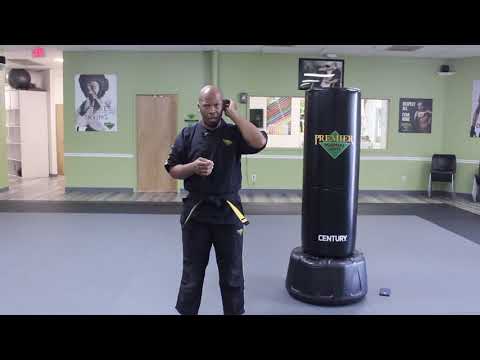
Lesson Plan 3: Combatives: Palm Strikes
0
Standard Palm Strike Technique·Premier Martial Arts Marietta Ga.·Added by Admin
This week's combatives are focusing on palm strikes and the different ranges we can use.
Перевод: standard palm strike technique
The standard palm strike technique is the basic execution of the palm heel blow, delivered with a thrusting or rising motion to the opponent's chin or face. [1] Fairbairn described this as 'one of the most effective blows that can be delivered,' noting that even a relatively weak individual can generate knockout force with a properly executed upward palm strike to the chin. [2] In Shotokan karate, Nakayama documented the teisho technique in the Tekki and Bassai kata, emphasising that the palm heel must be driven forward with full hip engagement. [3] The technique continues to be a core component of military combatives and law enforcement defensive tactics training worldwide. [1]
The palm strike delivers force through the heel of the palm, which is a dense, padded bone structure that can absorb impact without the risk of hand fractures associated with closed-fist punches ('boxer's fracture'). [1] This makes it a practical self-defence technique, though it is rarely used in sport competition where gloves protect the hands. [1]
The palm strike (shotei/teisho in karate, zhang in Chinese martial arts) is found across numerous martial arts traditions. [1] Bas Rutten popularised the palm strike in Pancrase competition, where closed-fist punches to the head were prohibited, forcing him to adapt boxing technique to open-hand delivery. [2]
Bas Rutten used palm strikes exclusively to the head during his Pancrase career due to the promotion's rules, winning the King of Pancrase title three times (1995-1998) and demonstrating that palm strikes could be used as effective knockout weapons. [1]
Изображений для этой техники пока нет.
Войдите, чтобы предложить изображение.
This week's combatives are focusing on palm strikes and the different ranges we can use.
Учебных курсов по этой технике пока нет.
Войдите, чтобы предложить курс.
Риск травмы для человека, к которому применяется техника
Palm strike reduces hand fracture risk; used in self-defense systems
Уровень мастерства, необходимый для надёжного выполнения техники
Разрешена ли техника по основным соревновательным правилам
The Essence of Okinawan Karate-Do (Shoshin Nagamine, 1976)
Alias sources — [1] Karate-Do Kyohan (Funakoshi, 1935) [2] Kukkiwon Taekwondo Textbook (Kukkiwon, 2006) [3] Dynamic Karate (Nakayama, 1966)
Effectiveness sources — [1] Karate-Do Kyohan (Funakoshi, 1935)
Official karate technique names (和語/漢語)
Established Japanese martial arts naming convention — native Japanese term (和語/漢語)
Alias sources — [1] Karate-Do Kyohan (Funakoshi, 1935) [2] Kukkiwon Taekwondo Textbook (Kukkiwon, 2006) [3] Dynamic Karate (Nakayama, 1966)
Effectiveness sources — [1] Karate-Do Kyohan (Funakoshi, 1935)
speed, power generation through kinetic chain, striking surface conditioning
athletic build with fast-twitch muscle fibres
varies by strike — hip rotators, shoulders, core
Group your fingers together rather than relying on individual fingers to make contact. Premier Martial Arts Marietta GA emphasizes turning your hand slightly to ensure proper finger alignment for the strike.
Add rotation and torque to your strike by rotating your body as you throw the palm strike, which will significantly increase both the reaction and power output of the technique.
The basic palm heel strike thrusting the base of the palm forward into the opponent's nose, chin, or solar plexus, with fingers pulled back to avoid jamming.
The standard palm strike technique is the basic execution of the palm heel blow, delivered with a thrusting or rising motion to the opponent's chin or face. Fairbairn described this as 'one of the most effective blows that can be delivered,' noting that even a relatively weak individual can generate knockout force with a properly executed upward palm strike to the chin.
Unified MMA: разрешён — Legal (palm strikes, slaps permitted); WBC/Boxing: запрещён — Only closed-fist punches permitted; WKF: ограничен — Varies by technique — some open-hand strikes legal in kata, generally restric…; Kyokushin: запрещён — Only closed-fist strikes to body permitted; WT: запрещён — Prohibited; ITF: ограничен — Some knife hand techniques legal; WAKO: запрещён — Closed fist only; K: запрещён — 1/GLORY — Closed fist only; IFMA: разрешён — Legal — palm strikes permitted in Muay Thai
Оценка опасности 4/10. Moderate — palm strike reduces hand fracture risk; used in self-defense systems
Стандартная цепочка подготовки: Assume Fighting Stance → Generate Power → Execute Strike → Recover to Guard.
Стандартные контрприёмы: Block — absorb the strike with a protective guard position / Evasion — move the target out of the strike's path / Counter-Attack — time an offensive response during the recovery phase of the strike.
Распространённые варианты: Standard variation (primary execution of the strike from the most common stance); Power variation (modified mechanics for maximum force generation); Speed variation (minimised telegraph for a faster, harder-to-read attack); Counter variation (timed to exploit the opponent's offensive commitment).
Bas Rutten used palm strikes exclusively to the head during his Pancrase career due to the promotion's rules, winning the King of Pancrase title three times (1995-1998) and demonstrating that palm strikes could be used as effective knockout weapons.
Основные ошибки, на которые стоит обратить внимание: Extending without hip rotation — arm-only palm strikes lack the force to affect the opponent / Not pulling the fingers all the way back — they can jam on the target or poke the eyes / Bending the wrist at impact instead of keeping it rigidly locked / Reaching with the head forward instead of stepping to close distance.
Standard Palm Strike Technique также известен как Shōtei-uchi (Kihon-gata), Standard Shotei Uchi, Standard Batangson, Standard Palm Heel.