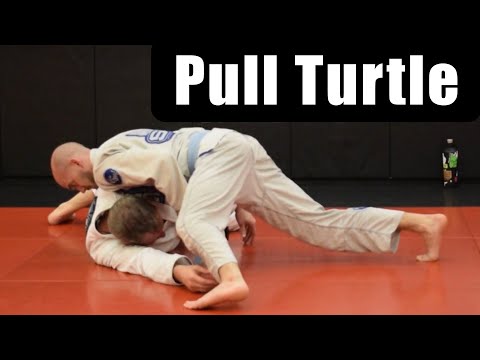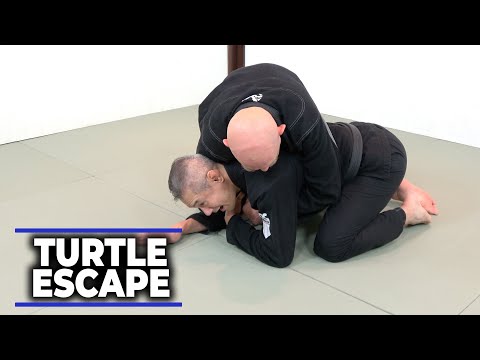
The 5 Best Ways To Escape The Turtle Position
0
Turtle Escape·Ritchie Yip
Turtle Sweep. The longer the lever, the greater the torque. With my partner’s centre of gravity so far away from me, th…
Перевод: turtle escape
The Turtle Escape group encompasses all techniques for escaping the turtle position — the defensive curled-up posture on hands and knees where a grappler protects against attacks from the opponent on top or behind. [1] Turtle escapes are critical because while the turtle position prevents immediate submissions and pins, it is a fundamentally defensive position that scores negatively in many rulesets and leaves the bottom fighter vulnerable to back takes, turnovers, and ground-and-pound in MMA. [1],[2] This group covers sit-out escapes, rolling escapes (Peterson roll, snap roll), guard pulls from turtle, and stand-ups from turtle, each offering a different pathway back to a neutral or advantageous position. [2],[3]
Turtle escapes have roots in wrestling, where the referee's position (similar to turtle) is a standard starting position and escape techniques are fundamental skills. [1] Judo also developed turtle escapes as responses to turtle (known as 'matamori' in judo). [2] BJJ adapted and expanded turtle escapes, particularly as the turtle position became a transition point between guard pulls, takedown defence, and back control in modern competition. [2],[3]
Turtle escapes are essential in judo (to avoid osaekomi) and in wrestling (to avoid riding time). [1]
Изображений для этой техники пока нет.
Войдите, чтобы предложить изображение.
Turtle Sweep. The longer the lever, the greater the torque. With my partner’s centre of gravity so far away from me, th…
Try out SBG University for a month for free. Use the code: YOUTUBEFREE https://sbgu.samcart.com/referral/OD1DNOAi/vUiYFZ…
Учебных курсов по этой технике пока нет.
Войдите, чтобы предложить курс.
Риск травмы для человека, к которому применяется техника
Turtle escapes involve rolling and granby movements; neck strain risk
Уровень мастерства, необходимый для надёжного выполнения техники
Разрешена ли техника по основным соревновательным правилам
Jiu-Jitsu University (Saulo Ribeiro, 2008)
Alias sources — [1] Jiu-Jitsu University (Ribeiro, 2008) [2] Wrestling Physical Conditioning Encyclopedia (Welker, 2010)
Effectiveness sources — [1] Jiu-Jitsu University (Ribeiro, 2008) [2] Wrestling Physical Conditioning Encyclopedia (Petrov, 1977)
Standard Japanese martial arts terminology (kanji/hiragana)
Established Japanese martial arts naming convention — native Japanese term (和語/漢語)
Alias sources — [1] Jiu-Jitsu University (Ribeiro, 2008) [2] Wrestling Physical Conditioning Encyclopedia (Welker, 2010)
Effectiveness sources — [1] Jiu-Jitsu University (Ribeiro, 2008) [2] Wrestling Physical Conditioning Encyclopedia (Petrov, 1977)
grip fighting ability, hip mobility for sliding to the mat, chin defence
strong hands for grip fighting, flexible hips
forearms (grip fighting), core, hip flexors, neck
Каждое движение в любом боевом искусстве обладает рядом универсальных свойств. Комбинируйте параметры ниже, чтобы найти нужный инструмент или сравнить аналоги из разных стилей.
The Guard Pull From Turtle family covers techniques for transitioning from the turtle position directly into a guard position, typically half guard or full guard. [1] Rather than standing up or rolling away, guard pulls from turtle involve the turtled fighter sitting through to establish a guard, converting a defensive position into an offensive one where sweeps and submissions become available. [1,2] This approach is particularly popular in BJJ where the guard is a strong offensive position, making the turtle-to-guard transition an efficient escape that immediately creates attacking opportunities. [2,3]
The Roll Escape family covers turtle escapes that use rolling mechanics to reverse the position, moving the turtled fighter from a bottom defensive position to a more favourable one through rotational momentum. [1] Roll escapes are derived primarily from wrestling, where rolling from the referee's position is a fundamental escape technique. [1,2] This family includes the Peterson roll (a shoulder roll that reverses the position) and the snap roll (a quick, explosive roll to create space), both of which use the opponent's top pressure against them by redirecting it through the roll. [2,3]
The Sit-Out Escape family covers turtle escapes where the turtled fighter sits the hips out to one side, rotating the body to face the opponent and create a more favourable position. [1] Sit-out escapes are among the most fundamental and widely used turtle escapes in all grappling disciplines because they use a simple, powerful hip motion to escape the turtle while maintaining the ability to face the opponent. [1,2] This family includes the standard sit-out (sitting the hips through to face the opponent) and the Granby roll (a shoulder roll that combines inversion with a sit-out motion). [2,3]
The Stand Up From Turtle family covers techniques for transitioning from the turtle position directly to a standing position, escaping the ground entirely. [1] Standing up from turtle is particularly important in MMA, where returning to the feet can be the highest-priority escape goal, and in wrestling, where the stand-up is a primary escape from the bottom position. [1,2] This family includes the switch (a direction-changing standup) and the technical standup from turtle, each providing a different pathway to the feet while defending against the opponent's attempts to maintain ground control. [2,3]
Turtle escapes — sit-outs, rolls, stand-ups, and guard pulls from turtle — are fundamental wrestling and BJJ skills. Turtle (362 passages across 80 books) is the most common defensive recovery position in grappling. The sit-out and granby roll are the two primary wrestling turtle escapes. (80 books; Gable, Coaching Wrestling Successfully)
There are three fundamental escapes: pull guard, get to your hands and knees into turtle position, or roll them. According to SBG PDX & Vancouver BJJ, it's difficult for your opponent to stop both pulling guard and going to hands and knees simultaneously, so every practitioner needs to develop both options.
When your opponent is passing your guard, glue your forearm to your thigh on the side they're passing. This prevents them from getting the underhook and makes it much harder for them to pin you down, according to SBG PDX & Vancouver BJJ.
Ritchie Yip emphasizes that your spine should be parallel to your opponent's spine, not perpendicular. By positioning yourself as close as possible to your opponent and aligning your spine parallel to theirs, you can execute a turnover from bottom turtle position.
According to Ritchie Yip, you should trap your opponent's knee and ankle, keeping their leg completely off the ground, which converts their leg from a frame into a lever you can use to your advantage for escaping or attacking.
The Turtle Escape group encompasses all techniques for escaping the turtle position — the defensive curled-up posture on hands and knees where a grappler protects against attacks from the opponent on top or behind. Turtle escapes are critical because while the turtle position prevents immediate submissions and pins, it is a fundamentally defensive position that scores negatively in many rulesets and leaves the bottom fighter vulnerable to back takes, turnovers, and ground-and-pound in MMA.
Turtle escapes have roots in wrestling, where the referee's position (similar to turtle) is a standard starting position and escape techniques are fundamental skills. Judo also developed turtle escapes as responses to turtle (known as 'matamori' in judo).
Unified MMA: разрешён — Legal defensive/transitional technique; IBJJF: разрешён — Legal; IJF: разрешён — Legal; ADCC: разрешён — Legal; UWW: разрешён — Legal, escape scores 1 point (freestyle), reversal scores 1 point; FIAS Sport Sambo: разрешён — Legal; NCAA Folkstyle: разрешён — Legal, escape scores 1 point, reversal scores 2 points
Оценка опасности 3/10. Moderate — turtle escapes involve rolling and granby movements; neck strain risk
Стандартная цепочка подготовки: Create Space → Disrupt Control → Execute Escape → Recover Position.
Стандартные контрприёмы: Maintain Pressure — keep consistent weight distribution to limit escape space / Anticipate Direction — read escape attempt direction and block early / Transition — flow to a new position when the current one is threatened.
Распространённые варианты: Slide to side (choking-arm side) (fighting hands and sliding hips to the mat on the choking…); Peel-and-turn (stripping the seatbelt grip and turning into the opponent); Trap-arm escape (trapping one arm and rolling to pin the opponent's back); Body triangle escape (addressing the body triangle lock before escaping the hooks).
Turtle escapes are essential in judo (to avoid osaekomi) and in wrestling (to avoid riding time).
Основные ошибки, на которые стоит обратить внимание: Staying in turtle too long — turtle is transitional, not a resting position; escape immediately / Flattening out from turtle to belly-down — a flat position is the worst outcome; maintain the all-fours structure / Not protecting the neck in turtle — keep the chin tucked and hands near the neck to prevent chokes / Exposing the back while escaping — many turtle escapes create back-take opportunities if done incorrectly.
Turtle Escape также известен как Kame Nige, Turtle Recovery, All-Fours Escape.