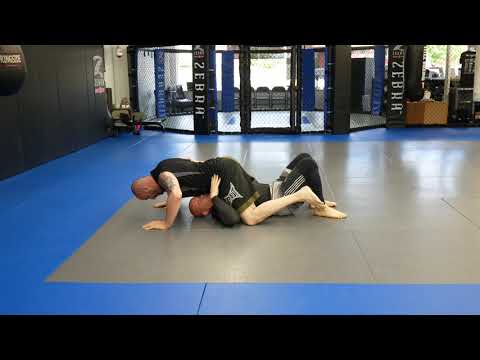
How to Escape the MOUNT in MMA: Best Mount escape for BJJ or MMA
0
MMA Escape·UltimateMMA Plus
Join Ultimate MMA Plus Online University Now! https://ultimate-mma-and-jiu-jitsu-training-center.sparkuniversity.co/ C…
Перевод: MMA escape
The MMA Escape family covers escape techniques specifically adapted for mixed martial arts competition, where the threat of ground-and-pound strikes fundamentally changes the mechanics, urgency, and priorities of positional escapes. [1] In pure grappling, a bottom player can take time to methodically work an escape; in MMA, every second on bottom under a dominant position means absorbing punches, elbows, and hammer fists that can end the fight. [1],[2] MMA escapes incorporate the cage wall for leverage (something unavailable in gi or no-gi grappling), account for striking threats (protecting the face while escaping), and often prioritise getting back to the feet (rather than recovering guard, which invites more ground-and-pound). [2],[3] Fighters like Khabib Nurmagomedov's opponents and fighters defending against Jon Jones' top game have demonstrated that MMA-specific escape skills are essential for survival in the modern UFC. [3]
MMA escapes evolved as the sport matured beyond the early UFC era, where fighters had limited ground skills. [1] Wrestling coaches like Greg Jackson and the Albuquerque-based team developed systematic cage escape techniques in the mid-2000s, teaching fighters to use the fence for leverage. [1],[2] Khabib Nurmagomedov's dominance from top position (2012–2020) forced the MMA world to develop more sophisticated escape systems, as his opponents needed to escape unprecedented top control combined with ground-and-pound. [2],[3]
MMA escapes are essential for competitive fighting — the ability to escape dominant positions under fire separates fighters who survive bad positions from those who get finished. [1] The technical standup is the most valued bottom skill in MMA, as returning the fight to standing often resets the fight in the escaping fighter's favour. [2] Fighters like Tony Ferguson, Derrick Lewis, and Max Holloway have demonstrated the ability to escape from desperate bottom positions and turn fights around. [3]
Изображений для этой техники пока нет.
Войдите, чтобы предложить изображение.
Join Ultimate MMA Plus Online University Now! https://ultimate-mma-and-jiu-jitsu-training-center.sparkuniversity.co/ C…
Учебных курсов по этой технике пока нет.
Войдите, чтобы предложить курс.
Риск травмы для человека, к которому применяется техника
MMA escapes are performed while absorbing or defending against strikes; even a successful escape may involve taking significant damage; failed escape attempts in MMA can result in TKO/KO from ground-and-pound
Уровень мастерства, необходимый для надёжного выполнения техники
Разрешена ли техника по основным соревновательным правилам
Wrestling for Fighting (Ben Askren, 2019)
Description sources — [1] MMA coaching literature and Greg Jackson methodology [2] Wrestling for Fighting (Askren, 2019) [3] UFC fight analysis, particularly Khabib Nurmagomedov opponents' escape challenges
Description sources — [1] MMA coaching literature and Greg Jackson methodology [2] Wrestling for Fighting (Askren, 2019) [3] UFC fight analysis, particularly Khabib Nurmagomedov opponents' escape challenges
mental toughness (remaining calm under strikes), explosive hip power (escaping under pressure), cardio endurance (escaping while fatigued), impact absorption (taking strikes while working)
athletic/explosive body type, wrestling background (stand-up ability), strong chin (absorbing strikes during escape)
hip flexors (technical standup), forearms (blocking strikes while framing), core (bridging and scrambling), legs (pushing off the cage, standing up)
Каждое движение в любом боевом искусстве обладает рядом универсальных свойств. Комбинируйте параметры ниже, чтобы найти нужный инструмент или сравнить аналоги из разных стилей.
The Desperation Escape is a high-energy, explosive escape used when standard technical escapes have failed and the fighter is in immediate danger of being finished — a last-resort survival technique that prioritises getting out of the dangerous position at ANY cost, even if it means sacrificing energy, position, or technical form. [1] BJ Penn presented the Desperation Escape in The Book of Knowledge (2007) as the final option in the escape hierarchy: when the trap-and-roll fails, the hip escape fails, the cage-assisted escape fails, and the opponent is about to finish the fight (via submission or ground-and-pound TKO), the Desperation Escape is an explosive, full-body effort to create ANY space to survive. [1] The technique is not a single defined movement but a CATEGORY of explosive actions that vary based on the specific situation: from bottom mount, it may be a violent, full-body explosive bridge in a random direction combined with scrambling; from a submission, it may be a panicked grip-fight combined with body rotation; from ground-and-pound, it may be a wild grab of the opponent's arms or body combined with a roll. [1] The defining characteristic of the Desperation Escape is INTENSITY over technique: where standard escapes use precise mechanics and timing, the Desperation Escape uses maximum energy output and explosive movement to create momentary chaos from which the defender can survive. [1] Penn noted that the Desperation Escape is not taught as a primary technique — it is a survival instinct that is channelled and directed through training. [1] Every fighter who has competed at the highest levels has used Desperation Escapes: the explosive bridging escapes of fighters about to be submitted, the wild scrambles of fighters escaping ground-and-pound, and the adrenaline-fuelled reversals that save fights when all technical options have been exhausted. [1] The technique is trained by drilling escapes under maximum fatigue and pressure, developing the capacity for one final explosive effort when the body and mind are at their limits. [1]
Getting Up Against the Cage uses the cage wall as support to stand up from bottom position while an opponent is applying top pressure. [1]
The Hip Out Mount Escape is the fundamental technique for recovering guard from the bottom of mount position, combining a hip escape (shrimp) with an elbow-knee connection that inserts the knee between the two bodies, creating a barrier that prevents the mounted opponent from re-establishing full mount. [1] This is the single most important escape in all of grappling: being mounted is the worst position in BJJ and MMA (the mounted opponent has maximum control and striking ability), and the Hip Out Escape is the primary method of recovering from this position at every level from white belt to world championship. [1,2] The mechanical execution follows a precise sequence: (1) frame against the opponent's hip with both hands (creating initial space), (2) bridge slightly to one side (displacing the opponent's weight), (3) hip escape (shrimp) laterally by driving the hips away from the opponent's centre of gravity, (4) insert the near knee into the space created between the bodies (the 'elbow-knee connection' — the elbow meets the knee to create a wedge), (5) continue shrimping until the full guard or half guard is recovered. [1,2] BJ Penn documented the technique in The Book of Knowledge (2007) as one of the 'basic mount escapes' that every MMA fighter must master, noting that the escape works against both ground-and-pound mount (where the opponent is striking) and positional mount (where the opponent is working for submissions). [1] The escape's name — 'Hip Out' — describes the core action: the hips move OUT (laterally away from the mounted opponent) rather than UP (the bridge escape works by moving the hips upward). [1] The Hip Out is complementary to the trap-and-roll (bridge) escape: the bridge displaces the opponent vertically, while the hip out displaces the defender laterally. [1,2] Together, these two escapes provide complete mount defence — if the trap-and-roll fails (the opponent bases out), the hip out escape is the immediate follow-up, and vice versa. [1]
The Running Up the Cage Mount Escape is an MMA-specific technique that uses the cage wall as a physical prop to generate the hip bridge needed to escape mount when the defender is flat on their back near the fence — a situation where standard mount escapes (trap-and-roll, elbow-knee escape) are difficult because the cage restricts movement. [1] When a fighter is mounted near the cage wall, the fence actually HELPS the defender: by placing the feet against the cage mesh and pushing off it (literally 'running up the wall'), the defender generates a powerful upward bridge that elevates the mounted opponent's weight — far more powerful than a standard bridge that pushes off the flat floor, because the cage provides a vertical surface that allows the legs to drive both upward AND backward simultaneously. [1] BJ Penn documented this technique in The Book of Knowledge (2007) as one of several cage-specific escapes, recognising that the MMA cage creates unique tactical situations that require techniques not found in traditional BJJ or wrestling. [1] The cage is typically viewed as a disadvantage for the fighter pinned against it, but the Running Up the Cage technique converts this disadvantage into an advantage — the wall becomes a platform for explosive hip bridging that is unavailable in the centre of the cage. [1] The escape works by pressing both feet flat against the cage mesh (approximately at hip height), then driving explosively upward and toward the centre of the cage — the feet push off the wall while the hips bridge, creating a combined force vector that lifts the mounted opponent significantly higher than a standard floor-based bridge. [1] At the apex of this cage-assisted bridge, the defender can either trap-and-roll (the standard mount escape with the added height advantage) or insert the knee for an elbow-knee escape (the additional height creates more space than a floor bridge provides). [1]
The Spin Around Cage Escape uses the cage to pivot and turn away from a pinning opponent, creating space to stand up or reverse position. [1]
MMA escapes combine grappling escapes with awareness of strikes — you cannot simply shrimp to guard if the opponent is raining down ground-and-pound. MMA-specific escapes prioritize returning to standing (wall walk, technical standup) over recovering guard. (MMA training manuals; The Ultimate MMA Training Guide)
When your opponent sits up to punch, immediately cup both hands on their hips to control them and prevent them from punching effectively. From UltimateMMA Plus, this hip control is the key defensive position that neutralizes their striking threat.
Frame your hips forward by driving your legs up and positioning yourself to create space. The key timing is to execute this as soon as your opponent pops up, as waiting too long makes the escape significantly harder according to UltimateMMA Plus.
Mount escape works even against larger opponents in MMA; UltimateMMA Plus demonstrates escapes specifically designed for size mismatches, and these techniques can also be connected into sweeps to improve your position.
The MMA Escape family covers escape techniques specifically adapted for mixed martial arts competition, where the threat of ground-and-pound strikes fundamentally changes the mechanics, urgency, and priorities of positional escapes. In pure grappling, a bottom player can take time to methodically work an escape; in MMA, every second on bottom under a dominant position means absorbing punches, elbows, and hammer fists that can end the fight.
MMA escapes evolved as the sport matured beyond the early UFC era, where fighters had limited ground skills. Wrestling coaches like Greg Jackson and the Albuquerque-based team developed systematic cage escape techniques in the mid-2000s, teaching fighters to use the fence for leverage.
Unified MMA: разрешён — Legal defensive/transitional technique; IBJJF: разрешён — Legal; IJF: разрешён — Legal; ADCC: разрешён — Legal; UWW: разрешён — Legal, escape scores 1 point (freestyle), reversal scores 1 point; FIAS Sport Sambo: разрешён — Legal; NCAA Folkstyle: разрешён — Legal, escape scores 1 point, reversal scores 2 points
Оценка опасности 8/10. Very high — MMA escapes are performed while absorbing or defending against strikes; even a successful escape may involve taking significant damage; failed escape attempts in MMA can result in TKO/KO from ground-and-pound
Стандартная цепочка подготовки: Protect Face → Create Space → Choose Escape Path → Execute → Stand Up → Re-engage.
Стандартные контрприёмы: When on top in MMA: deliver ground-and-pound to discourage escape attempts / Follow escapes with re-takedowns — when the bottom fighter stands, immediately shoot for another takedown / Maintain cage control — keep the opponent pinned against the cage where their escape options are limited / Switch positions when escape is initiated — transition from side control to mount when the bottom fighter creates spa….
Распространённые варианты: Technical standup (posting one hand, stepping up to standing from bottom; th…); Cage wall walk (using the fence to walk up from bottom to standing); Hip escape to standing (hip escaping to create space then standing up rather than…); Cage-assisted guard recovery (using the cage for leverage during hip escape to recover …); Strike-block escape (blocking ground-and-pound while executing the escape duri…); Sprawl escape (when the opponent attempts to re-establish control, spraw…); Scramble escape (in a chaotic scramble from a bad position, using athletic…).
MMA escapes are performed in every UFC event where ground fighting occurs. Technical standup success rate is one of the most tracked performance metrics in MMA analytics.
Основные ошибки, на которые стоит обратить внимание: Playing guard offensively instead of escaping — in BJJ, bottom guard is an offensive position; in MMA, it invites gro… / Not using the cage — the fence is a tool; ignoring it means giving up a significant leverage advantage for escapes / Trying pure BJJ escapes without addressing strikes — a standard hip escape from side control works differently when t… / Giving up back to escape — some fighters turn away to escape mount or side control, exposing their back; this is ofte….
MMA Escape также известен как MMA Esukēpu, MMA Positional Escape, Cage Escape, UFC Escape Technique.