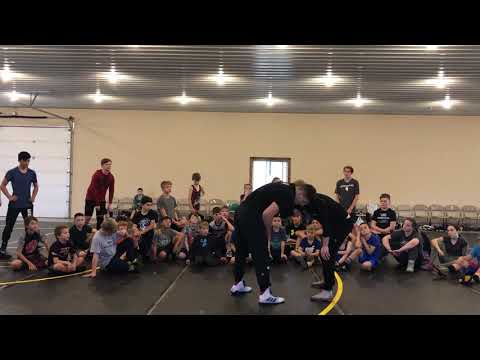
Wrestling Technique: Elbow Control High Crotch
0
Outside Elbow Control·Joshua Nolan Wrestling
High crotch attack with crack down finish
Перевод: outside elbow control
The Outside Elbow Control subfamily covers positions where the attacker controls the opponent's elbow from the outside line, gripping or cupping the outer elbow to redirect the opponent's arm outward and create openings. [1] Outside elbow control pushes the opponent's arm away from their centreline, weakening their defensive structure on that side and potentially exposing them to entries, body locks, or head control. [1],[2] This position is often used in combination with collar ties or head position to create off-balancing opportunities. [2],[3]
Outside elbow control techniques developed within the broader framework of clinch grip fighting in wrestling and judo, where controlling the outside line provides strategic advantages for angle creation. [1] The technique is widely taught as a complement to inside elbow control in modern grappling programmes. [2],[3]
Outside elbow control grips the opponent's elbow from the outside, enabling push-pull manipulation for off-balancing (kuzushi) and throw setups. [1]
Outside elbow control is a key grip in judo and wrestling, used to create kuzushi and set up rotational throws. [1]
Outside elbow control is routinely used in IJF judo competition to set up forward throws. [1]
Изображений для этой техники пока нет.
Войдите, чтобы предложить изображение.
High crotch attack with crack down finish
Учебных курсов по этой технике пока нет.
Войдите, чтобы предложить курс.
Риск травмы для человека, к которому применяется техника
Arm control positions limit opponent's offense; low direct injury risk
Уровень мастерства, необходимый для надёжного выполнения техники
Разрешена ли техника по основным соревновательным правилам
Freestyle Wrestling: A Complete Guide for Coaches and Wrestlers (Petrov, 1977)
Alias sources — [1] Wrestling Physical Conditioning Encyclopedia (Welker, 2010) [2] NCAA Wrestling Rules and Interpretations (NCAA, 2020) [3] Clinch Fighting for MMA (Couture, 2011)
Effectiveness sources — [1] Kodokan Judo (Kano, 1986)
Established Japanese martial arts naming convention — native Japanese term (和語/漢語)
Alias sources — [1] Wrestling Physical Conditioning Encyclopedia (Welker, 2010) [2] NCAA Wrestling Rules and Interpretations (NCAA, 2020) [3] Clinch Fighting for MMA (Couture, 2011)
Effectiveness sources — [1] Kodokan Judo (Kano, 1986)
arm length to wrap the torso, squeeze strength, hip drive
long arms and strong grip, powerful lower back
biceps, pectorals, forearms, erector spinae, glutes
Каждое движение в любом боевом искусстве обладает рядом универсальных свойств. Комбинируйте параметры ниже, чтобы найти нужный инструмент или сравнить аналоги из разных стилей.
Grab high on the opponent's arm, specifically on the tricep area, rather than lower on the forearm. Joshua Nolan emphasizes getting a firm grip on the tricep as the foundation for the control.
Pull the arm in toward you while simultaneously placing your head on the opposite side and driving your shoulder into the opponent's arm to create a chicken-wing effect. This combined pulling and driving action keeps the control tight.
Push the opponent's knee to the outside and lift their leg up while crowding into them, which helps you finish the technique effectively.
The Outside Elbow Control subfamily covers positions where the attacker controls the opponent's elbow from the outside line, gripping or cupping the outer elbow to redirect the opponent's arm outward and create openings. Outside elbow control pushes the opponent's arm away from their centreline, weakening their defensive structure on that side and potentially exposing them to entries, body locks, or head control.
Outside elbow control techniques developed within the broader framework of clinch grip fighting in wrestling and judo, where controlling the outside line provides strategic advantages for angle creation. The technique is widely taught as a complement to inside elbow control in modern grappling programmes.
Unified MMA: разрешён — Legal — clinching is integral to MMA; IJF: разрешён — Legal — kumi-kata (grip fighting) is fundamental to judo; IBJJF: разрешён — Legal — standing grip fighting and clinch work permitted; IFMA: разрешён — Legal — the clinch is a core element of Muay Thai, clinch dominance is highly…; WBC/Boxing: ограничен — Holding is technically a foul — referee breaks clinch, excessive holding resu…; K: ограничен — 1/GLORY — One attack from clinch allowed, then referee breaks; WAKO: ограничен — Clinch generally broken by referee — limited or no clinch fighting in most fo…; UWW: разрешён — Legal — clinch is fundamental to wrestling, the primary position in Greco-Roman
Оценка опасности 3/10. Moderate — arm control positions limit opponent's offense; low direct injury risk
Стандартная цепочка подготовки: Close Distance → Establish Primary Grip → Position the Hips → Apply Pressure.
Стандартные контрприёмы: Pummeling — fight for inside position by swimming arms under opponent's grips / Frame and Push — create distance using forearm frames against the chest or neck / Grip Break — systematically strip the opponent's controlling grips / Posture Up — straighten the spine and drive the hips forward to break clinch control.
Распространённые варианты: Single collar tie (one hand on the nape controlling the head); Double collar tie (plum) (both hands behind the head for maximum control); Collar tie with wrist control (one hand on the nape, other controlling the wrist).
Outside elbow control is routinely used in IJF judo competition to set up forward throws.
Основные ошибки, на которые стоит обратить внимание: Pushing the elbow without stepping to the exposed side — the grip creates the opening, but your feet must exploit it / Gripping too far down on the forearm — cup the elbow area for maximum rotational control / Pushing the arm but staying in front of the opponent — you must angle off to the exposed side / Not maintaining the push long enough — the opponent recovers if you release too early.
Outside Elbow Control также известен как Soto Hiji Seigyo, Outside Elbow Cup, Outside Elbow Tie, Elbow Push Control.