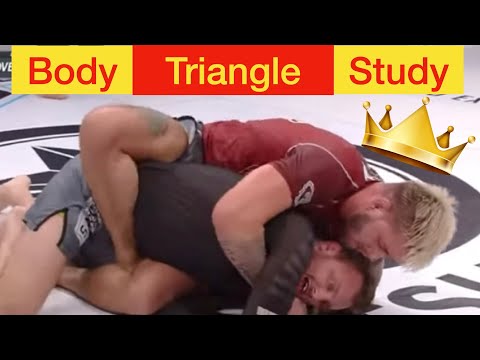
Gordon Ryan - How to properly use a body triangle
0
Контрол на гърба с триъгълник от тялото·Less Impressed More Involved BJJ
**Giveaway** If we reach 1000 subscribers by the end of the year I will be giving away a $50 BJJ fanatics gift card. Ex…
Translation: контрол на гърба с триъгълник от тялото
The body triangle gained prominence as a preferred back control method through MMA, where fighters like Khabib Nurmagomedov and Demian Maia demonstrated its superiority over hooks for maintaining back control against resisting opponents. [1] It has become the standard back control method at the highest levels of both grappling and MMA. [2],[3]
The body triangle provides superior retention compared to standard hooks because the figure-four leg lock is significantly harder to clear. [1] In MMA, the body triangle has become the preferred back control method at the highest level because it allows control with fewer limbs, freeing the arms for choke attacks. [2]
Khabib Nurmagomedov demonstrated the body triangle's effectiveness in MMA across his undefeated career (29-0), consistently using it to maintain back control and threaten rear naked chokes. [1] Demian Maia used the body triangle as his primary control method in numerous UFC back control sequences. [2]
No images yet for this technique.
Sign in to suggest an image.
**Giveaway** If we reach 1000 subscribers by the end of the year I will be giving away a $50 BJJ fanatics gift card. Ex…
No instructional courses yet for this technique.
Sign in to suggest a course.
Risk of injury to the person this technique is applied to
Back control is dominant position; enables rear chokes (Danaher 2021)
Skill level needed to execute this technique reliably
Whether this technique is allowed under major competition rule sets
Advanced Brazilian Jiu-Jitsu Techniques (Marcelo Garcia, 2011)
Alias sources — [1] IBJJF Rules (2024) [2] Jiu-Jitsu University (Ribeiro, 2008) [3] Mastering Jujitsu (Gracie & Danaher, 2003)
Effectiveness sources — [1] Jiu-Jitsu University (Ribeiro, 2008) [2] UFC official statistics (ufcstats.com)
Standard katakana transliteration of Western martial arts terminology (外来語) — used in Japanese MMA, boxing, and BJJ communities
Alias sources — [1] IBJJF Rules (2024) [2] Jiu-Jitsu University (Ribeiro, 2008) [3] Mastering Jujitsu (Gracie & Danaher, 2003)
Effectiveness sources — [1] Jiu-Jitsu University (Ribeiro, 2008) [2] UFC official statistics (ufcstats.com)
hook control, seatbelt grip endurance, hip connection
long legs for deep hooks, strong grip for seatbelt
hip adductors, biceps, forearms, core
При триъгълника над тялото заключващият крак (кракът, който се прекръстосва отгоре, за да образува фигурата четири) лежи върху тялото на противника, обикновено напречно върху корема. [1] Горната конфигурация създава натиск надолу върху средната част на тялото на противника и позволява на контролиращия боец да стисне диафрагмата, добавяйки елемент на физически дискомфорт към позиционния контрол. [1,2] Триъгълникът над тялото е по-често използваната конфигурация, тъй като осигурява едновременно контрол и компресия. [2,3]
Долният телесен триъгълник позиционира заключващия крак под тялото на противника, обикновено провирайки го под бедрото и заключвайки от далечната страна. [1] Долната конфигурация осигурява различен ъгъл на контрол в сравнение с горния телесен триъгълник и може да бъде по-ефективна, когато противникът се опитва да избяга, като се обръща към контролиращия боец. [1,2] Долният телесен триъгълник се използва ситуативно, когато горната позиция е защитена или когато ъгълът на захващане благоприятства долната ключалка. [2,3]
Gordon Ryan emphasizes never letting your opponent cross their feet, as this is a primary escape route from the body triangle position.
Gordon Ryan notes that you should prevent your opponent from moving to that side to crush the body triangle, and using a butterfly hook can help maintain control during this escape attempt.
Семейството позиции „контрол на гърба с триъгълник от тялото
The body triangle gained prominence as a preferred back control method through MMA, where fighters like Khabib Nurmagomedov and Demian Maia demonstrated its superiority over hooks for maintaining back control against resisting opponents. It has become the standard back control method at the highest levels of both grappling and MMA.
IBJJF: легална — Legal, back control with hooks or body triangle scores 4 points; IJF: легална — Legal — back control leads to pin or submission opportunities; ADCC: легална — Legal, back mount scores 3 points (4 from sweep); Unified MMA: легална — Legal — dominant position for ground-and-pound and rear naked choke; UWW: легална — Legal — back exposure is the primary scoring mechanism in wrestling; FIAS Sport Sambo: легална — Legal
Оценка на опасност 4/10. Moderate — back control is dominant position; enables rear chokes (Danaher 2021)
Стандартната верига за подготовка: Achieve Position → Stabilize → Maintain → Attack.
Стандартните контри включват: Hand Fight — grip-fight the choking hand to prevent the rear naked choke / Shoulder Walk — walk shoulders to the mat to escape back control / Turn into Guard — rotate to face the attacker and recover guard position.
Чести варианти: Back control with hooks (both feet hooked inside the opponent's thighs); Body triangle back control (legs locked in a figure-four around the torso); Rear mount (mounted on the back with both hooks, opponent face-down); Chair sit back control (sitting behind the opponent with hooks, upright position).
Khabib Nurmagomedov demonstrated the body triangle's effectiveness in MMA across his undefeated career (29-0), consistently using it to maintain back control and threaten rear naked chokes. Demian Maia used the body triangle as his primary control method in numerous UFC back control sequences.
Основни грешки, за които да внимавате: Locking the body triangle on the opponent's hip bones — position it across the stomach/lower ribs for maximum compres… / Not squeezing after locking — the triangle must apply active compression / Crossing the ankle on the wrong side (over the top of the thigh instead of under) — the lock goes ankle over ankle / Using the body triangle without the seatbelt — both upper and lower body control are needed.
Контрол на гърба с триъгълник от тялото е известна също като Bodi Toraianguru Bakku Kontorōru, Контрол на гърба с обхват на тялото, Заключване на тялото в четворка, Триъгълник от тялото.