Introduction and Context
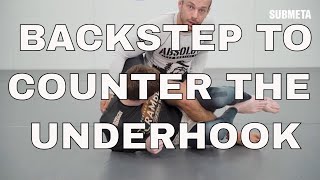
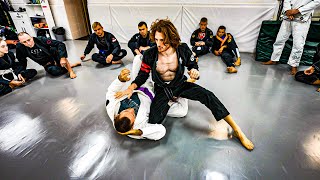
The instructor introduces the backstep pass as a response to opponents who transition from single-leg X guard to X guard. This technique addresses a common scenario where defenders switch their hook positioning as the passer attempts to peel their initial grip.
Recognizing the Transition
When a defender in single-leg X guard perceives the passer beginning to peel their hook, they often instantaneously transition to X guard by switching from an overhook to an underhook. The instructor notes that X guard is technically easier to pass than single-leg X if the timing and mechanics are properly understood.
Controlling Knee Mobility
A skilled X guard player will attempt to prevent the passer from rotating their front knee to the defender's chest. Maintaining knee rotation is essential for the passer; if the defender successfully restricts this mobility by controlling the passer's knee against their shoulder, the pass becomes significantly more difficult.
Timing the Float Entry
As the defender transitions from overhook to underhook, the passer must immediately respond by tightening and loading weight through their front knee while leaning forward into a floating position. This timing prevents the defender from establishing a solid underhook grip before the passer commits their weight forward.
Weight Distribution During Float
The passer distributes weight primarily through their right hand and right side of the body while floating on the defender. This creates a stable position that allows the passer to shift weight fluidly as the defender's hooks move, rather than committing to a static posture that could be swept.
Avoiding the Aggressive Backstep
A common mistake is attempting a large, aggressive backward step to escape the X guard hooks. Such a telegraphed movement allows a skilled defender to execute a sweep by leveraging the passer's committed momentum against them.
The Controlled Leg Extraction
Instead of a dramatic backstep, the passer brings their front knee toward their chest while maintaining the float position, then methodically extracts the leg from the X guard hooks. The passer keeps their weight distributed across both arms rather than falling to the hip, which would create sweep opportunities.
Finishing Position Options
Once the leg is successfully extracted from the X guard hooks, the passer can transition into multiple finishing positions including leg drag variations, knee on belly, or side control. The primary objective is clearing the X guard hooks completely before committing to the final pass.
Passing The X Guard - FLOAT AND BACKSTEP
Key Takeaways
- •Introduction and Context
- •Recognizing the Transition
- •Controlling Knee Mobility
- •Timing the Float Entry
PASSING THE X GUARD - FLOAT AND BACKSTEP // In this video I am demonstrating how to pass the X Guard. The X guard can be a very problematic guard to pass but if you have effective time and learn to float and back step it is easy. If you missed any of my latest videos check them out below: 3 Passes From Single Leg X: https://www.youtube.com/watch?v=7rVPN-spwSc&t=1s Shin To Shin Leg Pummeling - https://www.youtube.com/watch?v=E5tP6HKCA20&t=1s I am a Marcelo Garcia Brown Belt, Bernardo Faria Academy Instructor and avid Brazilian Jiu Jitsu competitor. Thanks for visiting my channel! Don't forget to LIKE & SUBSCRIBE FOR MORE! OSS!
Related Techniques
Frequently Asked Questions
What does this video teach about backstep pass?
This video covers introduction and context, recognizing the transition, controlling knee mobility. It provides detailed instruction from Aaron Benzrihem bjj.
How long does it take to learn backstep pass?
The basic mechanics can be understood in a single session, but developing reliable execution requires consistent drilling over weeks of practice. This 8-part breakdown helps structure your training by isolating each phase of the technique.
What are the key details for finishing backstep pass?
Instead of a dramatic backstep, the passer brings their front knee toward their chest while maintaining the float position, then methodically extracts the leg from the X guard hooks. The passer keeps their weight distributed across both arms rather than falling to the hip, which would create sweep opportunities.