Introduction to Knee-Through Guard Pass
The knee-through guard pass is a fundamental technique for escaping an opponent's closed guard position. While related to the single-under pass variation, it employs a distinct mechanical approach to open the guard and advance position.
Initial Setup and Stance
The passer begins in guard by controlling the opponent's inside arm and using either arm or rib contact to generate upward momentum. The pass initiates with an explosive pop-up into standing posture, which can be adapted to the match format—slower, controlled stands for Brazilian jiu-jitsu and quicker transitions for MMA or submission grappling contexts.
Hip Pressure and Guard Opening
Once standing, the passer applies downward pressure against the opponent's hips, which mechanically opens the closed guard. This hip control is the critical juncture that allows entry into the next phase of the pass.
Knee Placement Through Center
The passer steps one knee through the center line of the opponent's body and plants it firmly on the mat on the opposite side. The arm wraps around the opponent's torso as the passer begins to transition over the top, initiating the final passage into side mount.
Controlled Standing Transition
When unable to stand in a single explosive motion, the passer should stand one leg at a time while protecting against attacks to the posted leg. The first leg is withdrawn to a safe distance away from the opponent's reach before the second leg extends into full standing posture.
Shin Positioning to Prevent Half Guard
As the knee comes through, the passer keeps the foot pinned across the opponent's thigh rather than stepping completely over the leg. This shin placement prevents the opponent from capturing a half-guard position during the transition to side mount.
Shoulder Swimming and Top Pressure
The passer executes a shoulder swim motion to maintain contact and prevent the opponent from bucking or reversing into the back. Distributing full bodyweight across the opponent during this transition ensures control and prevents positional loss.
Final Position and Safety Considerations
The technique concludes with the passer establishing side mount control. Practitioners should wear appropriate protective equipment and train with controlled intensity to avoid injury to training partners.
Knee Through Guard Pass
Key Takeaways
- •Introduction to Knee-Through Guard Pass
- •Initial Setup and Stance
- •Hip Pressure and Guard Opening
- •Knee Placement Through Center
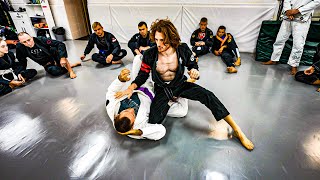
www.TrainFightWin.com This is a basic Knee Through Guard Pass.
Related Techniques
Frequently Asked Questions
What does this video teach about knee-in-the-middle pass?
This video covers introduction to knee-through guard pass, initial setup and stance, hip pressure and guard opening. It provides detailed instruction from TrainFightWin.
How long does it take to learn knee-in-the-middle pass?
The basic mechanics can be understood in a single session, but developing reliable execution requires consistent drilling over weeks of practice. This 8-part breakdown helps structure your training by isolating each phase of the technique.
What are the key details for finishing knee-in-the-middle pass?
The passer executes a shoulder swim motion to maintain contact and prevent the opponent from bucking or reversing into the back. Distributing full bodyweight across the opponent during this transition ensures control and prevents positional loss.
Related videos
Knee Slice Power Pass!
The Grappling Academy
Passing The X Guard - FLOAT AND BACKSTEP
Aaron Benzrihem bjj
Backstep Pass to Counter the Underhook (Lachlan Giles)
Absolute MMA St Kilda - Melbourne
Back step pass series with Stephen Miller
Simplicity Jiu Jitsu
How to Correctly Set Up The Knee Cut Pass
JonThomasBJJ