Cutting Forearm Defense
The defender cuts into the attacker's forearm using a sharp hand motion, targeting pressure point areas along the forearm. This cutting action is followed by stepping inside the opponent while maintaining control, setting up a hammer fist counter.
Exploiting Linear Power
When an attacker holds a wrist grab tightly, their controlling power operates in a linear fashion. The defender can escape by moving perpendicular to this line of force—moving upward, sideways, or downward where the attacker's power cannot effectively control them.
Under-Power Escape with Solar Plexus Strike
The defender moves underneath the attacker's power line and executes a counter-strike to the solar plexus using the elbow. This technique simultaneously releases the wrist grab while creating offensive opportunity.
Upward Escape with Throat Control
The defender pushes the attacker's controlling power upward and away, moving underneath to access the throat and chin pressure points. A U-hand technique is applied to control the attacker's upper body and throat area.
Crane Technique Balance Disruption
The defender breaks the attacker's balance through precise arm positioning rather than muscular force. This technique demonstrates how controlled movement of the defender's arms can disrupt an opponent's stability even while being held.
Downward Acceleration with Knee Strike
The defender controls the attacker's arm and accelerates it downward while simultaneously driving an upward knee strike. The targeting can vary based on objective—the chest or face are both available based on positioning.
Two-Hand Arm Lock Control
The defender rises underneath the attacker's grab and applies a two-handed control system using a U-hand above and below configuration. This cross-over lock securely controls the attacker's arm and prevents escape.
Pain-Response Redirection
The defender maintains arm control while using pain response to redirect the attacker toward an approaching threat. This control position leverages the attacker's own body weight and pain sensation to manage the situation.
Distraction-Based Under-Arm Control
The defender creates an opening using a distraction strike—such as a slap to the face, punch to the solar plexus, or groin strike. While the attacker reacts to the distraction, the defender moves underneath and behind the elbow to establish a secure control position.
MCC - 003 Defending against Wrist Grabs
Key Takeaways
- •Cutting Forearm Defense
- •Exploiting Linear Power
- •Under-Power Escape with Solar Plexus Strike
- •Upward Escape with Throat Control
Striking releases to wrist grabs. How to escape from a wrist grab, using striking counters. DISCLAIMER: These clips are for entertainment and general informational purposes only. We are not instructing you, or encouraging you to do or to believe anything, except to view, enjoy, and think. Never forget that martial arts, like any rigorous course of physical activity, presents the risk of injury, sometimes serious, disabling, or even fatal. Actual techniques should only be practiced in a controlled environment emphasizing safety, under the direct supervision of a Black Belt instructor (in whom you have trust and confidence), and only after you have been cleared by your personal physician. The Gun Fu Manual (http://www.ironcrane.com/html/gfmanual. htm) establishes the criteria and performance expectations for those who undertake this particular path of personal growth. Because the scope of the style is so broad, testing criteria are defined by outcome, and not by how you are to achieve the outcome. For example, in demonstrating your competence in self defense, you would have to execute valid and complete responses to named attacks, within a given window of time (the time window would vary depending on your level). You determine what response to present, just so long as you accomplish the performance objective. This represents the crystallization of your training into confident performance. It is for this reason that Gun Fu has many guises and appearances. It is rare that two Black Belts will execute in exactly the same way. Gun Fu intends that you create your own personal style, best suited to who you are, using the many resources that are made available. Within the system, there is a hard style, a soft style, a Japanese style, a Chinese style, a Korean style, Stick Fighting, Sword, Bo, Short Stick, Joint Locks, Pressure Points, Grappling, Knife, and anything else that can be meaningfully integrated into the system. The Black Belt usually takes 5-6 years of rigorous training to achieve, and the test requires a demonstration of everything learned. Generally, it takes an entire day, and those who undergo the test leave knowing they can apply their skills competently in the most adverse of circumstances. Sort of like the Shao Lin Temple! However, the single most important emphasis in this system is that principles taught are grounded in a sound guiding philosophy. This is a system where ethics and philosophy propel self defense. The highest achievement for any Black Belt of the Iron Crane School is not to beat somebody up, but rather to "self actualize" and become a productive, beneficial, loving and compassionate member of his or her family unit, and society as a whole. Used with Permission. Copyright 2000-2009, Mc Cabe and Associates, Tacoma, WA. All rights reserved.
Related Techniques
Frequently Asked Questions
What does this video teach about arm compression defence?
This video covers cutting forearm defense, exploiting linear power, under-power escape with solar plexus strike. It provides detailed instruction from Spreadswings.
How long does it take to learn arm compression defence?
The basic mechanics can be understood in a single session, but developing reliable execution requires consistent drilling over weeks of practice. This 9-part breakdown helps structure your training by isolating each phase of the technique.
What are the key details for finishing arm compression defence?
The defender maintains arm control while using pain response to redirect the attacker toward an approaching threat. This control position leverages the attacker's own body weight and pain sensation to manage the situation.
Related videos
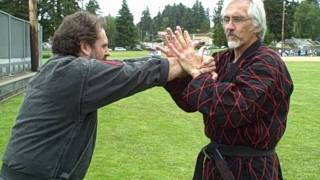
MCC - 083 Defending Front Grab to Both Arms
Spreadswings
FULL LEG LOCK CLASS!! - *Reverse DLR to Knee Compression* - V.O.W. BJJ
VOW BJJ
Episode #108: High percentage Bicep Slicer:Crush options
Rochester Judo

Calf SLICERS from everywhere!
Energia Martial Arts
Leglock Defence Concepts (Dinu Bucalet)
Dinu Bucalet BJJ