Establishing Attachment in De La Riva Guard
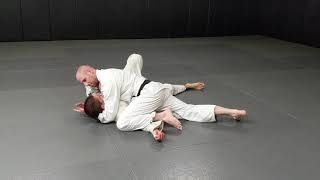
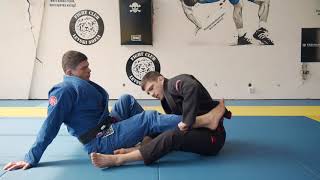
The instructor emphasizes that successful De La Riva guard requires establishing firm attachment to prevent the opponent from escaping. This attachment is achieved through hooking with either the inside or outside arm while maintaining control of the opponent's ankle and hip contact with one's own foot.
Denying Hip and Armpit Access
A core defensive principle is preventing the opponent from occupying the space between hip and armpit, which blocks most passing attempts. When the opponent cannot access this area, they are forced to commit heavily to pass, creating opportunities for the bottom player to attack.
Introduction to Calf Slicer Setup
The instructor demonstrates how to reach with the outside arm and cross the outside leg to transition toward a calf slicer attack. As the instructor kicks the leg back, the bottom player's leg begins to rotate, maintaining connection through a foot hook at the ankle.
Inverting and Positioning for Calf Slicer
From the De La Riva position, the practitioner inverts onto their shoulder and hooks the foot for connection before transitioning to the calf slicer position. The instructor notes that a heel hook opportunity may also be available depending on how the position develops.
Hip Proximity and Heel Control in Calf Slicer
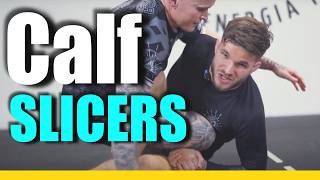
The calf slicer is executed by keeping the hips close to the opponent's hips and positioning the opponent's heel as near to their buttocks as possible. Dropping the hip toward the opponent and driving inward before sitting back creates the compression needed for the submission.
Foot Position Options and Protection
The practitioner has two choices for foot placement: throwing the outside leg over and reaping, or crossing to the inside position. The inside position is preferable because it protects the feet from counter-attacks and heel hook threats.
Finishing the Calf Slicer Compression
The finish relies on wrist compression across the back of the opponent's knee while maintaining a blade-like wrist position. The practitioner achieves a gable grip with feet crossed, then pulls the heels toward the buttocks while scooping inward to create the wider angle necessary for the submission.
Preventing Cross-Face and Maintaining Control
Throughout the technique, the practitioner must never allow the opponent to establish a cross-face, as this creates significant problems for the defender. Maintaining solid outside arm connection and using the outside leg for distance management keeps the opponent from achieving dominant positioning.
FULL LEG LOCK CLASS!! - *Reverse DLR to Knee Compression* - V.O.W. BJJ
Key Takeaways
- •Establishing Attachment in De La Riva Guard
- •Denying Hip and Armpit Access
- •Introduction to Calf Slicer Setup
- •Inverting and Positioning for Calf Slicer
Are you mad you missed a class? Don't Worry! You can now virtually attend some of our classes! Use this for your review and let us know what you think! We are experimenting with this platform in order to 1) Give people an idea of how it is to attend our gym and 2) Give our students a way of reviewing these advanced classes. Are you in the Austin area and need a place to train? Come visit us! We are centrally located and your first class is FREE!! You can add us on social media (IG: @vow_bjj) or visit our website (vowbjj.com) for more detail! #jiujitsu #leglocks #vowbjj
Related Techniques
Frequently Asked Questions
What does this video teach about leg compression defence?
This video covers establishing attachment in de la riva guard, denying hip and armpit access, introduction to calf slicer setup. It provides detailed instruction from VOW BJJ.
How long does it take to learn leg compression defence?
The basic mechanics can be understood in a single session, but developing reliable execution requires consistent drilling over weeks of practice. This 8-part breakdown helps structure your training by isolating each phase of the technique.
What are the key details for finishing leg compression defence?
The finish relies on wrist compression across the back of the opponent's knee while maintaining a blade-like wrist position. The practitioner achieves a gable grip with feet crossed, then pulls the heels toward the buttocks while scooping inward to create the wider angle necessary for the submission.