FULL LEG LOCK CLASS!! - *Reverse DLR to Knee Compression* - V.O.W. BJJ
0
Leg Compression Defence·VOW BJJ
Are you mad you missed a class? Don't Worry! You can now virtually attend some of our classes! Use this for your review …
Translation: leg compression defence
The Leg Compression Defence subfamily covers defences against calf slicers and leg crushes, where the opponent places their shin across the back of the defender's knee or calf and folds the leg to compress the calf muscle against the fulcrum. [1] Defence against leg compressions focuses on preventing the leg from being folded and extracting the knee past the fulcrum point. [1],[2] The defender must act quickly because calf slicers can cause significant pain and potential injury to the knee ligaments in addition to the muscle compression. [2],[3]
Leg compression defences grew in importance with the rise of modern leg lock systems, particularly after the Danaher Death Squad and other leg lock specialists made calf slicers a common competitive technique. [1] Defence against leg compressions is now standard curriculum in advanced BJJ training. [2],[3]
Leg compression defence prevents calf slicers. [1]
Developed in BJJ. [1]
Used in BJJ competition. [1]
No images yet for this technique.
Sign in to suggest an image.
Are you mad you missed a class? Don't Worry! You can now virtually attend some of our classes! Use this for your review …
No instructional courses yet for this technique.
Sign in to suggest a course.
Risk of injury to the person this technique is applied to
Submission defence involves resisting joint locks/chokes; risk of injury if defence fails or is delayed
Skill level needed to execute this technique reliably
Whether this technique is allowed under major competition rule sets
Boxing (Edwin Haislet, 1940)
Alias sources — [1] Jiu-Jitsu University (Ribeiro, 2008) [2] Fundamentals of Brazilian Jiu-Jitsu (Danaher, 2012) [3] Brazilian Jiu-Jitsu: Theory and Technique (Gracie, 2001)
Effectiveness sources — [1] Jiu-Jitsu University (Ribeiro, 2008)
Mixed Japanese-Western terminology — combines traditional Japanese terms with katakana loanwords
Alias sources — [1] Jiu-Jitsu University (Ribeiro, 2008) [2] Fundamentals of Brazilian Jiu-Jitsu (Danaher, 2012) [3] Brazilian Jiu-Jitsu: Theory and Technique (Gracie, 2001)
Effectiveness sources — [1] Jiu-Jitsu University (Ribeiro, 2008)
reaction speed, structural body mechanics, defensive awareness
quick reflexes and conditioned defensive surfaces
varies — forearms (blocking), legs (movement), core (stability)
Every move, in any martial art, shares a few universal traits. Mix and match below to pinpoint the right tool — or compare equivalents across styles.
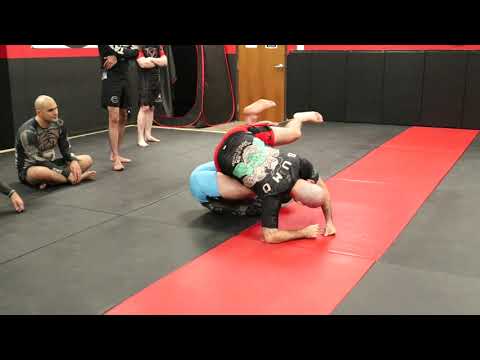
Keep your outside leg activated for distance management and avoid allowing a cross face. Once you get your leg crossed over, you don't need to worry as much about the cross face because your leg blocks the pass (VOW BJJ).
Use a good underhook pulling your opponent's leg into your body and change the direction of their foot. This reduces their weight on you and allows you to come up through the position to finish (VOW BJJ).
Cross your outside leg over and get your knee on top of your opponent's leg, positioning yourself up on your shoulder. This positioning prevents them from bringing their leg behind them and allows you to rotate their leg (VOW BJJ).
The Leg Compression Defence subfamily covers defences against calf slicers and leg crushes, where the opponent places their shin across the back of the defender's knee or calf and folds the leg to compress the calf muscle against the fulcrum. Defence against leg compressions focuses on preventing the leg from being folded and extracting the knee past the fulcrum point.
Leg compression defences grew in importance with the rise of modern leg lock systems, particularly after the Danaher Death Squad and other leg lock specialists made calf slicers a common competitive technique. Defence against leg compressions is now standard curriculum in advanced BJJ training.
Unified MMA: legal — Legal defensive technique; IBJJF: legal — Legal — defensive techniques are fundamental to grappling; IJF: legal — Legal defensive action; ADCC: legal — Legal; UWW: legal — Legal defensive technique; FIAS Sport Sambo: legal — Legal
Danger rating 3/10. Moderate — submission defence involves resisting joint locks/chokes; risk of injury if defence fails or is delayed
The standard setup chain: Anticipate the Attack → Execute Defence → Recover Stance → Counter or Disengage.
Standard counters include: Timing — attack when the defence is recovering or between movements / Feint — use deception to create openings in the defensive structure / Angle Change — attack from an unexpected angle that the defence does not cover.
Common variants: Standard defence (primary defensive technique from the most common position); Reactive defence (triggered by the opponent's attack, minimal movement for …); Proactive defence (anticipating the attack and positioning to neutralise it …); Counter defence (using the defensive movement to create an immediate count…).
Used in BJJ competition.
Top errors to watch for: Bending the knee further to try to slip out — this deepens the compression and can cause immediate damage / Not controlling the opponent's lever leg — the lever creates the compression; it must be addressed / Ignoring the heel hook threat while defending the calf slicer — the same position allows multiple attacks / Trying to stand up without first removing the lever — standing with the lever still in place can worsen the compression.
The Leg Compression Defence is also known as Ashi Appaku Difensu, Calf Slicer Defence, Leg Crush Defence, Calf Crush Escape.