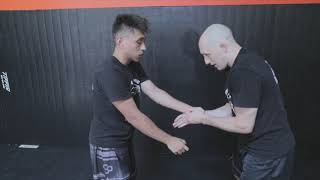
Understanding Clinch Entry Fundamentals
Effective clinch entries begin with recognizing when an opponent creates vulnerabilities. The primary opportunity arises when the opponent's elbows separate from their body, creating exploitable space that the defender can utilize to establish control.
Entry from Two-Handed Choke Attempt
When an opponent attempts a two-handed choke, the defender establishes a strong stack and rotates with their body as if preparing strikes. As space opens on the side, the defender threads a underhook through, breaks the opponent's posture by driving shoulder pressure forward, and snaps the head down to secure the clinch position.
Entry Against Double Overhooks
When an opponent secures double overhooks during a body lock attempt, the defender drops their hips and frames the opponent's hips to create separation. By working the body to the side and off-center, the defender opens the clinch space, then punches an arm through while breaking posture to establish dominant control.
Entry from Arm Stop Defense
As an opponent shoots for a takedown, the defender executes an arm stop to create immediate space. Most shooters do not penetrate deeply, leaving their elbows exposed. The defender exploits this by moving to the side, punching an arm through, and breaking the opponent's posture over the clinch position.
Positioning and Weight Distribution in Entry
Proper positioning is critical when transitioning into the clinch, especially against larger or stronger opponents. By moving to the side rather than remaining directly in front, the defender shifts weight off-center and reduces the opponent's mechanical advantage regardless of relative strength.
Reactive Adjustments and Underhook Counters
Skilled defenders remain sensitive to opponent reactions and adjust accordingly. If an opponent threatens an underhook, the defender can proactively secure the underhook first, move off the center line, and control both sides of the clinch rather than remaining statically positioned.
How to control the clinch
Key Takeaways
- •Understanding Clinch Entry Fundamentals
- •Entry from Two-Handed Choke Attempt
- •Entry Against Double Overhooks
- •Entry from Arm Stop Defense
Today, our Fix answers a request to see how to enter into the pike clinch while wrestling, we look at three options for helping to win your fight.
Related Techniques
Frequently Asked Questions
What does this video teach about wrist control clinch?
This video covers understanding clinch entry fundamentals, entry from two-handed choke attempt, entry against double overhooks. It provides detailed instruction from Fit To Fight Republic.
How long does it take to learn wrist control clinch?
The basic mechanics can be understood in a single session, but developing reliable execution requires consistent drilling over weeks of practice. This 6-part breakdown helps structure your training by isolating each phase of the technique.
What are the key details for finishing wrist control clinch?
Proper positioning is critical when transitioning into the clinch, especially against larger or stronger opponents. By moving to the side rather than remaining directly in front, the defender shifts weight off-center and reduces the opponent's mechanical advantage regardless of relative strength.