Attachment Points and Line Breaking
The instructor demonstrates the critical concept of breaking an opponent's grip line. When an aggressor grabs and attempts to pull, controlling the attachment points prevents being taken off-balance. The initial defense prioritizes disrupting the opponent's sensory input through eye strikes before securing positional control.
Low-Line Wrist Lock Setup
When eye strikes are not feasible due to distance limitations, the practitioner wraps around the interior of the opponent's grip on the clothing material. By binding the opponent's fingers within the tight wrap, a small-circle wrist lock can be established without requiring full hand control. This technique creates immediate tension at the wrist joint with minimal movement required.
Sensory Disruption Strategy
Effective control relies on overwhelming the opponent's defensive capacity through multiple simultaneous sensory disruptions. Eye strikes destabilize the opponent's body mechanics and reduce forward-pulling energy. This creates a cognitive distraction that allows the practitioner to execute the wrist lock with significantly less resistance.
High-Line Wrist Control Mechanics
In high-line scenarios where the opponent controls the upper clothing, the instructor snakes the arm inside the grip using finger positioning to locate the wrist joint early. The technique utilizes the clothing material's length and structural properties to create mechanical advantage. Proper hand positioning around the joint ensures rapid lock establishment despite opponent resistance.
Grip Maintenance Under Stress
Combat stress induces delayed reaction times, causing opponents to maintain grips beyond the point of safety. By combining eye strikes with the wrist lock, the practitioner divides the opponent's attention while securing positional control. The lock prevents escape attempts even if the opponent releases their initial grip.
Lock Execution and Follow-Through
Once the wrist lock is established, the practitioner turns inward and presses forward along the line of tendons and muscles. Small controlled movements generate significant pressure without requiring muscular force. This position enables continued striking while maintaining secure control over the opponent's limb.
Positional Dominance and Compliance
The locked position creates an unbreakable attachment that compromises the opponent's ability to generate pulling force or escape. Even minimal forward pressure along the correct mechanical line causes acute distress. The practitioner maintains striking opportunities while controlling the opponent's primary attacking limb.
Clothing Wrist Lock Control Core JKD Clinch Technique
Key Takeaways
- •Attachment Points and Line Breaking
- •Low-Line Wrist Lock Setup
- •Sensory Disruption Strategy
- •High-Line Wrist Control Mechanics
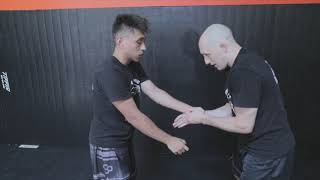
Ming shows a wrist lock and control with clothing vs a resisting attacker. Core JKD Group Leader from Denton, Texas, Brian Gibson joins him for training and for the demo. Brian is an artist and member of CJKDMember.com To contact him or see a tiny bit of what he does, check out him on Facebook: https://www.facebook.com/Brian-Gibson-Arts-275360859553051/ Our Self-Defense Training and Curriculum Videos can be found here: https://gumroad.com/corejkd Interested in becoming a Certified Core JKD Group Leader or Instructor via Distance Learning? Find out more at COREJKD.INFO to start on your path to learning and teaching the Core JKD, Rebel Wing Chun or CJKD Weapons curricula. Core JKD’s Instagram: https://www.instagram.com/corejkd/ Be sure to go to Corejkd.com for our other videos and sign up for our Core JKD newsletter. For more information about our European Headquarters in Germany, check out Core JKD.de If you are interested in hosting a seminar or becoming an affiliate school or study group in Core JKD, please contact Ming via the Core JKD website at CoreJKD.com Get Free Updates And Current Blog Articles On Self Defense And Training From The Core JKD website: http://corejkd.com =================================== Social Media Links: Core JKD’s Facebook: https://www.facebook.com/corejkd/ Core JKD’s Twitter: https://twitter.com/corejkd
Related Techniques
Frequently Asked Questions
What does this video teach about wrist control clinch?
This video covers attachment points and line breaking, low-line wrist lock setup, sensory disruption strategy. It provides detailed instruction from corejkd.
How long does it take to learn wrist control clinch?
The basic mechanics can be understood in a single session, but developing reliable execution requires consistent drilling over weeks of practice. This 7-part breakdown helps structure your training by isolating each phase of the technique.
What are the key details for finishing wrist control clinch?
Once the wrist lock is established, the practitioner turns inward and presses forward along the line of tendons and muscles. Small controlled movements generate significant pressure without requiring muscular force. This position enables continued striking while maintaining secure control over the opponent's limb.