Establishing Grip: Collar and Sleeve Control
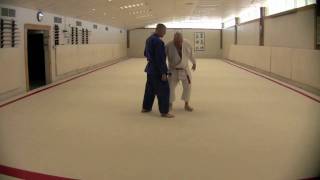
The instructor demonstrates proper grip placement for right-side-versus-right-side judo. The collar hand should position high on the lapel near the opponent's ear rather than low near the chin, as a low grip allows the opponent to slip underneath. The sleeve hand grabs the bicep to maximize control of the opponent's power arm, pinning the elbow toward the hips to severely limit their postural defense.
Grip Variations and Hand Positioning
Multiple grip options exist along the sleeve, from the bicep to the wrist material. Grabbing the sleeve material and turning creates tension across the wrist, allowing the instructor to control the opponent's posture and handle. These variations provide different mechanical advantages depending on the situation and preferred attacking strategy.
Right-Side-Versus-Right-Side Fundamentals
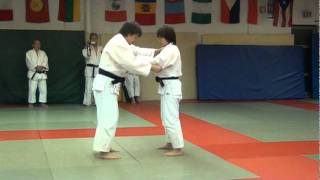
In right-versus-right positioning, the dominant hand controls posture from the collar while the right leg leads forward. This stance enables both backward attacks such as O Uchi Gari and Ashi Dashi, as well as forward turning techniques like Harai Tsurikomi Ashi. The symmetrical mirror positioning of both practitioners defines this fundamental configuration.
Right-Side-Versus-Left-Side Configuration
When opponents adopt opposing stances, the collar grip can be positioned on either the inside or outside of the opponent's lapel. The first practitioner to establish grip typically dictates the configuration. Both inside and outside positions offer distinct tactical advantages in controlling the opponent's posture.
Attacking Patterns in Mixed Stances
Right-versus-left judo creates unique dynamics because both practitioners turn in the same direction. Available attacks include turning techniques to the back, across-the-body sweeps, O Uchi Gari moving in one direction, and Shumata moving in the opposite direction. Constant pressure and direction changes create multiple throwing opportunities.
Natural Dominance and Bilateral Training
While practitioners can learn to throw from both sides, they naturally develop a stronger preference for one dominant direction, much like a golfer's swing. Extensive training in one direction creates neurological adaptation that makes reversing stances significantly more difficult. Practitioners should maintain and strengthen their dominant side rather than attempting to develop equal proficiency on both sides.
Dominant Side Strategy and Grip Priority
The instructor emphasizes fighting for position on one's preferred side, which in their case means attacking with a right-leg lead and turning leftward. When encountering left-sided opponents, securing the inside grip first allows control of the positioning battle. This strategic priority on the dominant side leads to stronger execution of techniques like O Soto Gari, Sasai, and O Uchi Dashi.
Integrated Attack Sequences
From the dominant right-side position, the instructor chains multiple throwing techniques including O Soto Gari, Sasai, and O Uchi Dashi. When facing left-sided opponents, the grip battle becomes critical—securing preferred hand placement determines whether inside or outside positioning is established. This foundational control enables consistent execution of the complete technical arsenal.
Basic Judo throws and concepts
Key Takeaways
- •Establishing Grip: Collar and Sleeve Control
- •Grip Variations and Hand Positioning
- •Right-Side-Versus-Right-Side Fundamentals
- •Right-Side-Versus-Left-Side Configuration
Judo Basics. Here we cover the basic Judo positions and some basic throws and combinations. Osoto 1:24 Taio 1:30 Kenkayotsu 2:00 uchimata 3:00 Combinations 4:15 Combinations 4:39 Ai Yotsu, or RvR and LvL Secure dominant position: Stay high on your dominant hand lapel. Control your partner's sleeve. This will be their power hand and controlling it will limit their turn throws thus ensuring a positional advantage for you. Backwards techniques: o uchi to o soto Turning techniques: tai otoshi etc... Kenka Yotsu, or RvL Choose inside or outside lapel position and make your partner settle for the one you didn't choose. Fight for dominant sleeve control to turn your partner's shoulders. Bombard attacks in both directions. Use backwards throws and turning throws. Frequently asked question: Can I learn both sides? You can learn to throw both ways, but there will always be a preference to one side. Once you train your body to turn in one direction, you're going to want to turn in that direction. O uchi - o soto - de ashiMy youtube membership https://www.youtube.com/channel/UC70qwffU7qQvTVm26wziD8A/join 1. 🔥 My JudoFanatics Instruction🔥 http://bit.ly/ShintaroJudoinstruction 2. 🎉 Ever wanted pockets on your Gi pants? Here it is! 🎉 http://bit.ly/2RLl13Z 3. 🐶 This Non-profit helps fund Local Judo athletes. Give today! 🐶 https://paypal.me/AthletesFund 4. 💪Follow me on social💪 https://www.instagram.com/judoshintaronyc/ https://www.facebook.com/JudoShintaroNYC/ https://www.instagram.com/kokushibudoinstitute/ https://www.facebook.com/kokushibudo/ https://www.instagram.com/kanomartialarts/ 5. 🥋 My favorite apparel🥋 Best apparel company http://bit.ly/2lKJwAE Favorite gi: http://bit.ly/2Ch3uYl BEST VALUE: My everyday affordable gi http://bit.ly/2C7JUOt To wear under the gi: http://bit.ly/2mHlWVI 6. Randoms The ONLY Athletic Tape I use: https://amzn.to/2oiuDHl
Frequently Asked Questions
What does this video teach about standard harai tsurikomi ashi?
This video covers establishing grip: collar and sleeve control, grip variations and hand positioning, right-side-versus-right-side fundamentals. It provides detailed instruction from Shintaro Higashi.
How long does it take to learn standard harai tsurikomi ashi?
The basic mechanics can be understood in a single session, but developing reliable execution requires consistent drilling over weeks of practice. This 8-part breakdown helps structure your training by isolating each phase of the technique.
What are the key details for finishing standard harai tsurikomi ashi?
The instructor emphasizes fighting for position on one's preferred side, which in their case means attacking with a right-leg lead and turning leftward. When encountering left-sided opponents, securing the inside grip first allows control of the positioning battle. This strategic priority on the dominant side leads to stronger execution of techniques like O Soto Gari, Sasai, and O Uchi Dashi.