Uke Techniques: Defensive and Offensive Applications
Uke techniques encompass a range of blocks and covers designed to intercept opponent attacks. When executed with sufficient force, these defensive techniques can also prevent follow-up attacks and serve as covert strikes, blurring the line between defense and offense.
Age Uke: Rising Block Mechanics
Age Uke is performed by moving the arm upward and forward in a curved path, striking the attacker's arm with the forearm. The final position places the arm within one fist of the forehead with the elbow held at 90 degrees or greater. This technique can also be applied to break an opponent's elbow when executed with proper force.
Developing Uke Striking Surfaces
Specialized partner drills are essential for strengthening the striking surfaces used in uke techniques. Progressive conditioning of the forearm contact points builds the resilience necessary for effective block execution.
Gedan Barai: Downward Block Execution
Gedan Barai begins with the fist resting on the shoulder at the pinky side, then slides downward in an arc with accompanying hip movement. The pinky-side forearm deflects lower-level attacks, with blocking efficiency directly dependent on forearm conditioning.
Uchi Uke: Inward Pulling Block
Uchi Uke is initiated with the fist positioned thumb-side on the opposite hip, then moves forward and outward through forearm rotation. The technique is enhanced by simultaneous hip movement in the opposite direction of the block.
Soto Uke: Side Pulling Block for Head and Body Defense
Soto Uke employs the pinky edge of the forearm to deflect attacks directed at the body or head. The motion begins at head level next to the body with a bent elbow, then executes a forward arc with forearm rotation to position the forearm behind the body's axis.
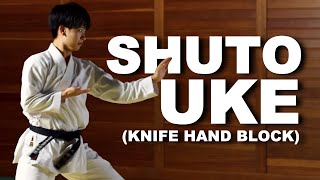
Shuto Uke: Knife Hand Block Technique
Shuto Uke is a knife-hand block performed as a chop using the pinky-edged forearm. Starting from an open-hand position on the shoulder with palm facing the head, the technique employs a forward arcing motion and forearm rotation around a stationary 90-degree flexed elbow, functioning as both defensive block and counter-attack.
Nakashi Uke: Inside Forearm Defense
Nakashi Uke uses the inside of the forearm to deflect upper or lower limb attacks toward the face and can also be performed with the outside forearm. This technique gains efficiency when executed while moving backward, and its simplicity and effectiveness make it a staple in sport karate and kumite applications.
Juji Uke: X Block for Multiple Attack Angles
Juji Uke is a versatile defensive technique performed by crossing both forearms in an X formation across the front of the body. This configuration effectively intercepts both high and low attacks from opponents.
KARATE - block techniques (UKE waza)
Key Takeaways
- •Uke Techniques: Defensive and Offensive Applications
- •Age Uke: Rising Block Mechanics
- •Developing Uke Striking Surfaces
- •Gedan Barai: Downward Block Execution
Video describes the basic block - defence techniques occurring in SHOTOKAN KARATE style, some of which are also used in sport karate competition kumite (Olympic karate). Engish version - instruction video was created at the Department of Technical and Combat Sports - Faculty of Physical Education and Sport - Charles University 2021 Participants: @radimpavelka , Adam Zdobinský
Frequently Asked Questions
What does this video teach about uchi uke?
This video covers uke techniques: defensive and offensive applications, age uke: rising block mechanics, developing uke striking surfaces. It provides detailed instruction from Radim Pavelka.
How long does it take to learn uchi uke?
The basic mechanics can be understood in a single session, but developing reliable execution requires consistent drilling over weeks of practice. This 9-part breakdown helps structure your training by isolating each phase of the technique.
What are the key details for finishing uchi uke?
Nakashi Uke uses the inside of the forearm to deflect upper or lower limb attacks toward the face and can also be performed with the outside forearm. This technique gains efficiency when executed while moving backward, and its simplicity and effectiveness make it a staple in sport karate and kumite applications.
Related videos
Can You Master This Karate Move? | Girl Power Uchi Uke Tutorial
Fitness Karate Academy
Karate For You :: Outside block - Soto uke tutorial
Karate For You
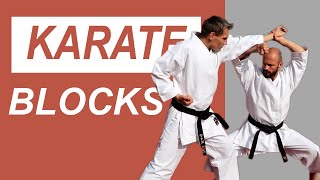
KARATE - block techniques (UKE waza)
Radim Pavelka
outside block martial arts for beginners part 1
Fitness Karate Academy
Japanese Karate Sensei's Tips On Shuto Uke (Knife Hand Block)
Karate Dojo waKu