Can You Master This Karate Move? | Girl Power Uchi Uke Tutorial
0
Uchi Uke·Fitness Karate Academy
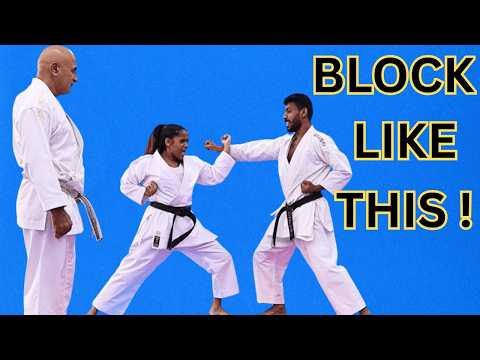
Can You Master This Karate Move? In this Girl Power Uchi Uke Tutorial, we break down one of the most important karate bl…
Translation: inside block
Uchi Uke (inside-to-outside block) is a traditional karate middle block where the forearm sweeps from inside the body outward, intercepting an incoming strike and deflecting it to the outside. [1] The block starts with the arm chambered across the body at the opposite hip, then sweeps outward in an arc, using the inner forearm surface to redirect the attack. [1],[2] Uchi uke creates an opening on the inside line for counter-attacks and is particularly effective against hooks and circular attacks to the body. [2],[3]
Uchi uke (inside forearm block) is effective for deflecting straight and mid-level attacks by sweeping the forearm outward from the centre of the body. [1] Like other traditional karate blocks, its classical form with full chamber is less practical in fast-paced full-contact fighting, but the underlying principle of forearm interception remains valid. [2]
Uchi uke (inside block) is a standard karate block. [1]
No images yet for this technique.
Sign in to suggest an image.
Can You Master This Karate Move? In this Girl Power Uchi Uke Tutorial, we break down one of the most important karate bl…
Video describes the basic block - defence techniques occurring in SHOTOKAN KARATE style, some of which are also used in …
Uchi Uke, also known as an inward pulling block, is a defensive technique executed by moving the forearm inward across the body to intercept and deflect an opponent's attack. According to Radim Pavelka's comprehensive instruction on uke techniques, Uchi Uke is initiated with the fist positioned with the thumb side on the opposite hip. The hand then moves forward and outward through simultaneous rotation of the forearm, with the thumb pointed outward at the conclusion of the movement. The block is performed using the thumb side of the forearm as the striking surface. Pavelka emphasizes that correct application of the technique requires accompanying hip movement in the opposite direction of the block, which generates power and efficiency. Like other uke techniques, Uchi Uke functions not merely as a defensive barrier but can also be employed as a covert strike when applied with sufficient force, potentially deterring the opponent from executing follow-up attacks. The technique demonstrates simplicity and effectiveness, making it a practical choice for both traditional kata practice and sport karate applications. Radim Pavelka's instruction provides the only substantive technical detail available from the approved video sources.
Synthesized from 1 instructor
No instructional courses yet for this technique.
Sign in to suggest a course.
Risk of injury to the person this technique is applied to
Blocking and parrying absorb strike force; hand/forearm injury from repeated blocking
Skill level needed to execute this technique reliably
Whether this technique is allowed under major competition rule sets
Karate-Do Kyohan: The Master Text (Gichin Funakoshi, 1935)
Alias sources — [1] Karate-Do Kyohan (Funakoshi, 1935) [2] The Kyokushin Way (Oyama, 1979) [3] Dynamic Karate (Nakayama, 1966)
Effectiveness sources — [1] Karate-Do Kyohan (Funakoshi, 1935) [2] Dynamic Karate (Nakayama, 1966)
Official karate technique names (和語/漢語)
Established Japanese martial arts naming convention — native Japanese term (和語/漢語)
Alias sources — [1] Karate-Do Kyohan (Funakoshi, 1935) [2] The Kyokushin Way (Oyama, 1979) [3] Dynamic Karate (Nakayama, 1966)
Effectiveness sources — [1] Karate-Do Kyohan (Funakoshi, 1935) [2] Dynamic Karate (Nakayama, 1966)
forearm conditioning, reaction speed, structural stability
dense bone structure, strong forearms
forearm flexors/extensors, deltoids, biceps, core (absorbing impact)
Uchi uke is a rising or head block performed by moving the arm upward and forward in a curved path so that the forearm strikes the attacker's arm, with the final arm position within one fist of the head. As with all blocking maneuvers, it's important to realize that any block can also be a covert strike.
Yes, uchi uke can function as a form of counter-attack, allowing the defender to simultaneously block an incoming strike while delivering their own technique.
Uchi Uke (inside-to-outside block) is a traditional karate middle block where the forearm sweeps from inside the body outward, intercepting an incoming strike and deflecting it to the outside. The block starts with the arm chambered across the body at the opposite hip, then sweeps outward in an arc, using the inner forearm surface to redirect the attack.
Uchi uke is one of karate's fundamental blocks, appearing in the earliest training sequences and kata of Okinawan and Japanese karate. It is typically taught alongside soto uke as a complementary blocking technique covering the opposite directional sweep.
Unified MMA: legal — Legal defensive technique; WBC/Boxing: legal — Legal — blocking and evasion are core boxing skills; WKF: legal — Legal — blocking is a fundamental karate skill; Kyokushin: legal — Legal; WT: legal — Legal; WAKO: legal — Legal; K: legal — 1/GLORY — Legal; IFMA: legal — Legal
Danger rating 3/10. Moderate — blocking and parrying absorb strike force; hand/forearm injury from repeated blocking
The standard setup chain: Anticipate the Attack → Execute Defence → Recover Stance → Counter or Disengage.
Standard counters include: Timing — attack when the defence is recovering or between movements / Feint — use deception to create openings in the defensive structure / Angle Change — attack from an unexpected angle that the defence does not cover.
Common variants: High block (forearm raised above the head to protect against overhead…); Low block (forearm driven downward to deflect kicks or body strikes); Cross block (forearm crosses the body to protect the opposite side); Double forearm block (both forearms together for maximum coverage).
Uchi uke (inside block) is a standard karate block.
Top errors to watch for: Sweeping too far outward — the block stops when the forearm is aligned with the outside of the shoulder / Starting from too far inside — the arm should cross the centreline from the opposite hip for maximum sweeping force / Using the outside of the forearm — uchi uke contacts with the inside (radius bone side) / Not maintaining the 90° elbow angle — the compact arm position is essential for structural blocking.
The Uchi Uke is also known as Uchi Uke, Inside Block, Inward Block, Inside Forearm Block.