KARATE - block techniques (UKE waza)
0
Shuto Uke·Radim Pavelka
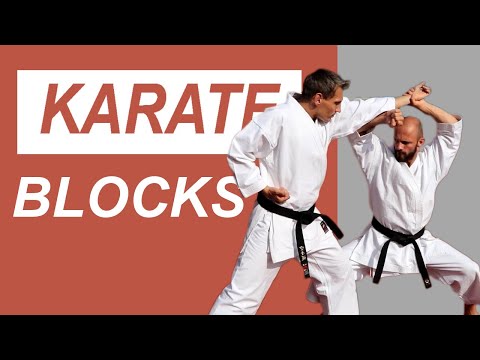
Video describes the basic block - defence techniques occurring in SHOTOKAN KARATE style, some of which are also used in …
Translation: knife-hand block
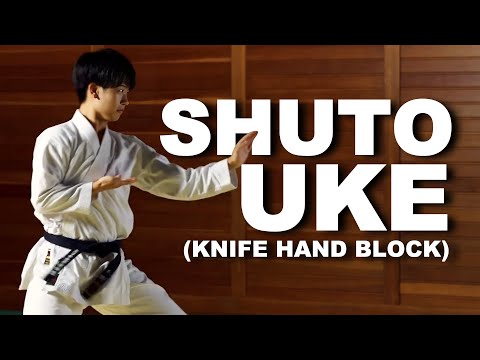
Shuto Uke (knife-hand block) is a traditional karate middle block that uses the outer edge of the open hand (the knife-hand or shuto) to deflect incoming strikes to the midsection. [1] The block is executed with an open hand, striking surface along the little-finger edge, sweeping from the opposite ear across the body to the outside. [1],[2] Shuto uke is distinctive because the open-hand position allows the blocking hand to immediately transition to grabbing (hikite) the attacker's limb for counter-attacks. [2],[3]
Shuto uke (knife-hand block) is effective for deflecting mid-level attacks using the edge of the open hand, simultaneously redirecting the attack and positioning the hand for a grab or counter-strike. [1] The open-hand position allows for quicker transitions to trapping, grabbing, or counter-striking compared to a closed-fist block. [2]
Shuto uke (knife-hand block) is a standard karate block. [1]
No images yet for this technique.
Sign in to suggest an image.
Video describes the basic block - defence techniques occurring in SHOTOKAN KARATE style, some of which are also used in …
🎓More Karate Secrets On My Video Course 🎓 https://courses.thekarateuniversity.org/courses/hidden-karate-principles-the…
You will learn Martial arts techniques outside block for beginners, outside block step by step on natural pose, part 1 …
Shuto Uke, or knife-hand block, is a middle-level defensive technique performed with the knife edge (pinky side) of the forearm, classified as one of karate's fundamental uke (blocking) techniques. Radim Pavelka describes it as a block executed with the pinky-edged forearm in a forward arcing motion, with simultaneous forearm rotation and a stationary elbow flexed at 90 degrees, starting from an open-hand position resting on the shoulder. Karate Dojo waKu's Yusuke emphasizes critical biomechanical details often overlooked by practitioners: the elbow must remain close to the body (not extended outward) to maintain structural strength, and the execution occurs in two sequential phases—first, the elbow slides into position, generating initial momentum; second, the forearm flicks outward explosively. Pavelka notes that shuto uke functions both defensively and as a form of counter-attack due to its striking quality. All instructors stress that proper hip rotation accompanies the technique for efficiency. While Fitness Karate Academy's coverage focuses on Soto Uke (outside block), a related technique using the outside forearm, the underlying mechanics of stance integration and coordinated hikite (pulling hand) apply across these blocking families. Conditioning drills to strengthen the striking surfaces are emphasized as essential for technique development.
Synthesized from 3 instructors
No instructional courses yet for this technique.
Sign in to suggest a course.
Risk of injury to the person this technique is applied to
Blocking and parrying absorb strike force; hand/forearm injury from repeated blocking
Skill level needed to execute this technique reliably
Whether this technique is allowed under major competition rule sets
Karate-Do Kyohan: The Master Text (Gichin Funakoshi, 1935)
Alias sources — [1] Karate-Do Kyohan (Funakoshi, 1935) [2] The Kyokushin Way (Oyama, 1979) [3] Dynamic Karate (Nakayama, 1966)
Effectiveness sources — [1] Karate-Do Kyohan (Funakoshi, 1935) [2] Dynamic Karate (Nakayama, 1966)
Official karate technique names (和語/漢語)
Established Japanese martial arts naming convention — native Japanese term (和語/漢語)
Alias sources — [1] Karate-Do Kyohan (Funakoshi, 1935) [2] The Kyokushin Way (Oyama, 1979) [3] Dynamic Karate (Nakayama, 1966)
Effectiveness sources — [1] Karate-Do Kyohan (Funakoshi, 1935) [2] Dynamic Karate (Nakayama, 1966)
forearm conditioning, reaction speed, structural stability
dense bone structure, strong forearms
forearm flexors/extensors, deltoids, biceps, core (absorbing impact)
Keep your elbow relatively close to your body rather than flared out. According to Karate Dojo waKu, picture a small squishy balance ball between your elbow and your torso to maintain the correct distance—this ensures the position stays strong and doesn't become loose.
Karate Dojo waKu breaks shuto uke into two distinct steps: first, move your elbow to its designated position, and second, flick your forearm outward. Many students make the mistake of skipping the first step and only performing the forearm flick.
Start by sliding your elbow out to gain initial momentum, then flick your hand out in a two-part sequence rather than one continuous motion. This staged approach allows you to build momentum before extending the strike.
Shuto Uke (knife-hand block) is a traditional karate middle block that uses the outer edge of the open hand (the knife-hand or shuto) to deflect incoming strikes to the midsection. The block is executed with an open hand, striking surface along the little-finger edge, sweeping from the opposite ear across the body to the outside.
Shuto uke is a fundamental karate technique appearing in numerous kata across all major styles. The knife-hand block is particularly associated with the kata Heian Yondan (Shotokan) and Pinan Yondan (Shito-ryu), where it features prominently.
Unified MMA: legal — Legal defensive technique; WBC/Boxing: legal — Legal — blocking and evasion are core boxing skills; WKF: legal — Legal — blocking is a fundamental karate skill; Kyokushin: legal — Legal; WT: legal — Legal; WAKO: legal — Legal; K: legal — 1/GLORY — Legal; IFMA: legal — Legal
Danger rating 3/10. Moderate — blocking and parrying absorb strike force; hand/forearm injury from repeated blocking
The standard setup chain: Anticipate the Attack → Execute Defence → Recover Stance → Counter or Disengage.
Standard counters include: Timing — attack when the defence is recovering or between movements / Feint — use deception to create openings in the defensive structure / Angle Change — attack from an unexpected angle that the defence does not cover.
Common variants: High block (forearm raised above the head to protect against overhead…); Low block (forearm driven downward to deflect kicks or body strikes); Cross block (forearm crosses the body to protect the opposite side); Double forearm block (both forearms together for maximum coverage).
Shuto uke (knife-hand block) is a standard karate block.
Top errors to watch for: Keeping the fingers loose — the hand must be firm with fingers tightly together / Striking with the palm instead of the knife edge — the outer edge of the hand is the contact surface / Bending the wrist during the block — the wrist must be straight and aligned with the forearm / Sweeping too wide and exposing the centreline — the block stays within the body's defensive perimeter.
The Shuto Uke is also known as Shutō Uke, Knife-Hand Block, Sword-Hand Block, Knifehand Receive.