Triangle Choke Fundamentals
The triangle choke is one of jiu-jitsu's most effective submissions regardless of size differential, as it leverages leg strength against an opponent's neck. Success requires understanding the fundamental positioning: one of the opponent's arms must be positioned inside the practitioner's legs while the other remains outside. This basic recipe—one arm in, one arm out—is the prerequisite for all triangle variations.
Initial Positioning and the Diamond
From closed guard, the practitioner initiates the triangle by pulling one wrist inward while pushing the opposite arm outward, then jumping the legs over the opponent's shoulder. The intermediate position, called the diamond due to the leg shape, represents halfway through the setup. The knee pit (the area beneath the knee) should ideally contact the opponent's carotid artery during this initial jump to maximize choking pressure.
The Shake and Bake Technique
Once in the diamond position, the practitioner must prevent the opponent from creating space by placing their elbow on the floor. The shake and bake maneuver involves grasping the opponent's wrist and forcefully shaking it across their body to the opposite side. Immediately after securing this position, the practitioner grabs the opponent's head to prevent them from posturing upward.
Locking the Figure Four
The practitioner grabs their own inside ankle and positions the non-locking foot against the opponent's hip to maintain a closed triangle configuration. The locking foot then rotates over the opponent's shoulder—not down the back—with toes pointed backward. This positioning ensures maximum pressure through the knee pit against the carotid artery.
Final Compression and Submission
The submission is completed by simultaneously squeezing the knees together, pulling the opponent's head downward with both hands, and raising the hips upward. This creates a closed box effect: the legs form the walls, the hips form the floor, and the hands form the ceiling. Steady, continuous pressure applied to all three vectors results in blood flow restriction and submission.
Common Mistakes and Corrections
Four primary errors prevent triangle submission: inadequate knee pit contact with the neck, failure to lock the ankle into the knee pit groove, positioning the leg down the back instead of over the shoulder, and relying on muscle squeezing rather than coordinated knee compression. Each mistake must be systematically corrected during setup and execution to ensure effective pressure application.
The Shotgun Setup
When an opponent plays defensively low, the practitioner can use the shotgun method by grasping both wrists and pulling one arm outward while pushing the opposite arm toward the opponent's chest. After clearing the elbow by opening the legs, the practitioner throws themselves over to achieve the one-in-one-out configuration. This setup is particularly effective against low-guard players.
Overhook Setup and Finishing
The overhook provides an alternative entry point, keeping the opponent compressed while preventing postural escape. From this position, the practitioner shrimps toward the overhook to create enough space to free the knee using a palm press. Once knee position is established, the practitioner positions the foot to the opponent's bicep and executes the standard triangle finish sequence.
How to do the Triangle In Jiu Jitsu | Everything You Need to Know!
Key Takeaways
- •Triangle Choke Fundamentals
- •Initial Positioning and the Diamond
- •The Shake and Bake Technique
- •Locking the Figure Four
Get my New Course the GUARD ATTACK BLUEPRINT and learn to DOMINATE from the closed guard! https://guardattackblueprint.com Join My Online Academy to Improve Your Jiu Jitsu FAST!!! https://www.skool.com/mattarroyojiujitsu/about ___________________________________________________________________________ Learn how to execute the Triangle Choke, one of the most versatile and effective submissions in Brazilian Jiu Jitsu (BJJ)! This step-by-step tutorial breaks down the mechanics of the triangle, including setup, control, and finishing details to help you lock it in smoothly and effectively. Whether you’re a beginner looking to master the basics or an experienced grappler refining your technique, this video will help you dominate on the mats. 🔑 What’s in this video: • How to set up the triangle from closed guard • Proper leg positioning for maximum pressure • Key details to avoid counters and escapes • Tips for finishing the choke with precision 🎥 Who this video is for: • Beginners learning foundational BJJ submissions • Grapplers looking to improve their guard attacks • Competitors preparing for tournaments or live sparring ___________________________________________________________________________ 🔥 Boost Your Jiu Jitsu Skills: Subscribe to the channel for more in-depth tutorials, tips, and drills to help you take your BJJ game to the next level. Don’t forget to like, comment, and share this video with your training partners!
Frequently Asked Questions
What does this video teach about triangle choke?
This video covers triangle choke fundamentals, initial positioning and the diamond, the shake and bake technique. It provides detailed instruction from Matt Arroyo Jiu Jitsu .
How long does it take to learn triangle choke?
The basic mechanics can be understood in a single session, but developing reliable execution requires consistent drilling over weeks of practice. This 8-part breakdown helps structure your training by isolating each phase of the technique.
What are the key details for finishing triangle choke?
When an opponent plays defensively low, the practitioner can use the shotgun method by grasping both wrists and pulling one arm outward while pushing the opposite arm toward the opponent's chest. After clearing the elbow by opening the legs, the practitioner throws themselves over to achieve the one-in-one-out configuration. This setup is particularly effective against low-guard players.
Related videos
No Gi Triangle Choke From Closed Guard
Chewjitsu
Instantly Make Your Triangle Choke Better | Ethan Crelinsten B-Team Technique
The B-Team
Flying Triangle
Gracie Jiu-jitsu Academy
How To Do A Reverse Triangle From The Back
Wim Deputter BJJ
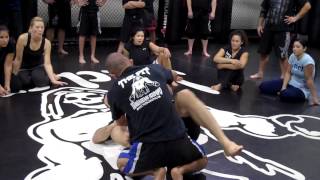
Brazilian Jiu-Jitsu: Open Guard Triangle Choke Submission
PitBlackBelt