Strategic Match Preparation
Jones recognized that Kyle Boehm would pull guard early and identified him as a physically strong competitor. Rather than immediately pursuing a guard pass, Jones elected to keep his opponent in transitional positions to induce fatigue and force poor decision-making. This strategy exploited the distinction between defending established positions versus defending the gray areas between them.
Exploiting Transition Vulnerabilities
While Boehm demonstrated excellent submission defense from settled positions, Jones identified the intermediate phases of guard retention as the critical window for applying pressure. By maintaining outside passing sequences and avoiding commitment to full passes, Jones forced Boehm to expend maximum effort in defense. This tactical approach gradually depleted his opponent's energy reserves without entering positions where Boehm's defensive mastery could be applied.
Reading Fatigue Through Biomechanics
Jones observed multiple indicators that Boehm was becoming exhausted, including his breathing patterns and his attempt to stand up from the bottom position. When a fatigued opponent stands up to escape bottom pressure, it signals desperation and declining decision-making capacity. Jones also noted Boehm's repeated attention to his legs and predicted a last-second takedown attempt before overtime.
Capitalizing on Unsecured Takedown Attempts
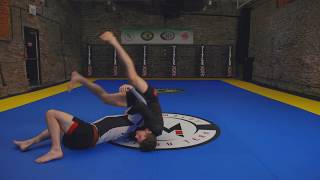
Boehm's double-leg takedown was launched without proper setup, initiated from an open position with excessive extension. This extended posture created the precise vulnerability needed for the arm-in guillotine, as Jones achieved optimal neck and arm positioning before impact. The undefended nature of the shot provided Jones the timing window necessary to lock the submission before ground contact.
Grip Mechanics and Neck Positioning
Jones establishes the guillotine grip by first securing a chin strap control, then connecting both hands over the opponent's head. The critical execution detail involves scooping the hands upward to collapse the neck before ground contact occurs. Early neck collapse during the takedown significantly deepens the submission hold compared to attempting the finish after the opponent has established postural stability on the ground.
Body Positioning for Submission Security
Upon landing, Jones maintains his shoulder at the base of Boehm's spine rather than falling flat on his back, keeping all pressure directed forward rather than allowing archback escape lanes. This forward-oriented positioning prevents the opponent's head from slipping free during the submission. Jones then secures closed guard to eliminate lateral rolling and escape opportunities, creating a position with minimal defensive options.
Controlled Pressure and Finishing Mechanics
From the secured position, Jones pulls to the side while maintaining forward pressure and collapsing all slack from the submission. This synchronized tightening of neck control and guard position eliminates the opponent's ability to relieve pressure through positional adjustment. The arm-in guillotine finish requires simultaneous tension maintenance across multiple pressure points to prevent escape.
Application to High-Level Competition
Jones successfully applied this identical arm-in guillotine setup at ADCC 2019 against Mason Fowler, demonstrating the technique's effectiveness against elite wrestling-level opponents. Both submissions emerged from wrestling exchanges where extended positioning created vulnerability. The technique's proven success at the highest competitive level confirms its technical soundness and practical applicability.
ADCC-Tested Guillotine Choke | Craig Jones B-Team Technique
Key Takeaways
- •Strategic Match Preparation
- •Exploiting Transition Vulnerabilities
- •Reading Fatigue Through Biomechanics
- •Capitalizing on Unsecured Takedown Attempts
Craig Jones shows the guillotine choke he used to submit Kyle Boehm at ADCC 2022. Instructionals: https://bjjfanatics.com/collections/craig-jones Website: https://bteamjj.com/ Instagram: https://instagram.com/bteamjj Merch: https://www.ma1combat.com/ #BTeamJiuJitsu #BJJ #JiuJitsu #NoGi
Frequently Asked Questions
What does this video teach about guillotine choke?
This video covers strategic match preparation, exploiting transition vulnerabilities, reading fatigue through biomechanics. It provides detailed instruction from The B-Team.
How long does it take to learn guillotine choke?
The basic mechanics can be understood in a single session, but developing reliable execution requires consistent drilling over weeks of practice. This 8-part breakdown helps structure your training by isolating each phase of the technique.
What are the key details for finishing guillotine choke?
From the secured position, Jones pulls to the side while maintaining forward pressure and collapsing all slack from the submission. This synchronized tightening of neck control and guard position eliminates the opponent's ability to relieve pressure through positional adjustment. The arm-in guillotine finish requires simultaneous tension maintenance across multiple pressure points to prevent escape.
Related videos
How To Do The Guillotine Choke | The Jiu Jitsu Class
ROYDEAN
How to do the Guillotine in Jiu Jitsu | Everything You Need to Know!
Matt Arroyo Jiu Jitsu
Power Guillotine
Stealth BJJ Madrid
High Elbow Guillotine from the Front Headlock
Rich Castro
Front Headlock Choke Series: Sweep to Arm In Guillotine
Robby Malof