K-Guard Fundamentals
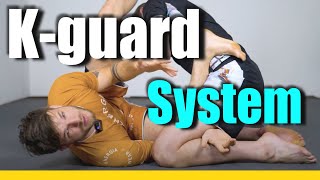
The K-Guard is a versatile attacking position that enables the practitioner to execute sweeps, submissions, and expose the opponent's back. This guard provides multiple offensive opportunities while maintaining control against a resisting opponent.
Establishing the Basic Position
To enter the K-Guard, the practitioner secures a deep grip on the opponent's leg, places the inside foot against the opponent's hip, points the outside knee upward, and uses the free hand to create distance. This configuration provides optimal control for launching attacks.
Creating Distance with the Outside Foot
The practitioner places the outside foot on the opponent's armpit and body to push them away and track their movement. This additional point of control presents more attacking opportunities and prevents the opponent from collapsing into the guard.
Lifting the Hips to Create Entry Space
Many practitioners struggle to reach under the opponent's leg when the opponent sits heavily on their base. The solution is to pull the opponent in with the legs to lift their hips off their heels, creating the necessary space to enter the K-Guard efficiently.
Grip Depth and Control
A common mistake is gripping the opponent's leg too shallow, which allows them to sprawl or slip free easily. An elbow-deep grip provides substantially more control and prevents the opponent from escaping the leg.
One-Arm vs. Two-Arm Grip Strategy
When the opponent is low and close, a single elbow-deep arm grip suffices to control the leg while the other hand manages the opponent's body position. When the opponent stands with their leg further away, both arms should be used to achieve adequate reach and attachment.
Inside Foot Connection
The inside foot must remain tightly connected to the opponent's hip to prevent them from manipulating and removing it during a passing attempt. A loose inside foot significantly undermines the structural integrity of the entire position.
Outside Knee Positioning
The outside knee must point upward rather than inward, as an inward angle collapses the leg structure and enables the opponent to apply downward passing pressure. An upward knee orientation maintains mobility and prevents pressure-based attacks.
Tracking Movement with the Outside Leg
The practitioner must actively track the opponent away by placing the outside foot on their body, preventing them from turning in and applying pressure. This offensive use of the outside leg is fundamental to the K-Guard's attacking nature.
Control Point: Knee Pit vs. Calf
Controlling the opponent's leg at the knee pit provides superior control compared to gripping the calf, which allows easier leg slip escapes. Deep control at the knee pit significantly increases the difficulty for the opponent to free their leg.
Entry from Closed Guard
From the closed guard, the practitioner reaches underneath the opponent's leg, shifts their body angle, and transitions into the K-Guard. If the opponent leans back or stands, additional space becomes available to execute a clean entry.
Entry from Open and Tripod Guards
The K-Guard entry from open guard requires reaching under the leg and pushing the opponent away. The tripod guard position provides excellent foundational connections to shift the body circularly and establish the K-Guard smoothly.
Entry from Sitting Guard
From sitting guard, the practitioner grips the opponent's arm, pulls them close, and spins around to transition into the K-Guard as the opponent steps forward. This entry leverages the opponent's natural response to create positioning opportunity.
63 K-Guard Techniques In Just 18 Minutes by Jason Scully (BJJ / Grappling)
Key Takeaways
- •K-Guard Fundamentals
- •Establishing the Basic Position
- •Creating Distance with the Outside Foot
- •Lifting the Hips to Create Entry Space
The K-Guard Is A Versatile Attacking Guard That Allows You To Be Offensive Against Your Opponent With Sweeps, Submissions and Back Exposure. This Guard Will Provide You With Many Offensive Opportunities! 0:00 - Introduction 0:13 - Positional Concepts 4:36 - Closed Guard Entries 5:02 - Open Guard Entries 6:42 - Entries From Basic Submissions 7:37 - Switching To Other Positions 9:00 - Sweeps 10:42 - Leg Locks 14:12 - Arm Locks 14:52 - Triangle Chokes and Omoplatas 15:53 - Back Exposure and Back Takes JOIN THE GRAPPLERS GUIDE: https://grapplersguide.com JOIN THE GRAPPLERS GUIDE FB GROUP: https://www.facebook.com/groups/grapplersguidemembers GRAPPLERS GUIDE CHANNEL: https://www.youtube.com/jasculs SUPPORT OUR OTHER GUIDE SITES Strikers Guide: https://thestrikersguide.com Weapons Guide: https://theweapsongudie.com Combat Business Guide: https://combatbusinessguide.com FOLLOW OUR SOCIALS: GRAPPLERS GUIDE IG: https://instagram.com/the_grapplers_guide FB Group: https://www.facebook.com/groups/grapplersguidemembers FB Page: https://www.facebook.com/thegrapplersguide STRIKERS GUIDE IG: https://instagram.com/the_strikers_guide FB Group: https://www.facebook.com/groups/strikersguide FB Page: https://www.facebook.com/strikersguide WEAPONS GUIDE IG: https://instagram.com/the_weapons_guide FB Group: https://www.facebook.com/groups/weaponsguide FB Page: https://www.facebook.com/theweaponsguide Combat Business Guide IG: https://www.instagram.com/combat_business_guide FB Group: https://www.facebook.com/groups/combatbusinessguide FB Page: https://www.facebook.com/combatbusinessguide/
Frequently Asked Questions
What does this video teach about standard z-guard?
This video covers k-guard fundamentals, establishing the basic position, creating distance with the outside foot. It provides detailed instruction from Jiu Jitsu In Minutes by Jason Scully.
How long does it take to learn standard z-guard?
The basic mechanics can be understood in a single session, but developing reliable execution requires consistent drilling over weeks of practice. This 13-part breakdown helps structure your training by isolating each phase of the technique.
What are the key details for finishing standard z-guard?
The K-Guard entry from open guard requires reaching under the leg and pushing the opponent away. The tripod guard position provides excellent foundational connections to shift the body circularly and establish the K-Guard smoothly.