Distance Butterfly Guard Overview
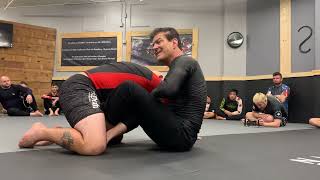
The instructor introduces the distance butterfly guard position, where the practitioner maintains space from their opponent rather than establishing close contact. This approach addresses the practical challenge of defending against an opponent who actively resists close-range butterfly guard entries through hand positioning and pass attempts.
Defensive Foot Positioning
The practitioner maintains one foot extended to control the opponent's forward advance while keeping the other foot positioned for mobility and escape. Establishing both hooks simultaneously from distance is ineffective and places the practitioner in a compromised position vulnerable to pass attempts.
Reactive Attack Selection
The instructor outlines three primary attack patterns based on opponent hand positioning: arm drag when the opponent reaches toward the legs, two-on-one grip when the opponent engages the upper body, and forward drive attacks when hands remain disengaged. Each response directly counters the opponent's defensive strategy.
Arm Drag Mechanics and Grip
The practitioner controls the same-side wrist and reaches to the opponent's shoulder rather than the elbow, as shoulder control better exposes the opponent's body orientation. The grip utilizes combined push-pull mechanics to generate sufficient momentum for transitioning around the opponent.
Leg Work During Arm Drag
The grounded foot provides stability while the other foot kicks to rotate the opponent and expose their back. The practitioner then pulls their heel toward their buttocks to create turning momentum and prevent the opponent from maintaining connection.
Arm Control Before Back Take
The critical error to avoid is pursuing the back position immediately, which allows the opponent to escape the controlled arm and establish an underhook. Instead, the practitioner secures the arm across their own chest first, trapping it before transitioning to the back position.
Positional Requirements for Arm Drag
The arm drag only functions effectively from distance butterfly guard when the practitioner retains significant leg mobility. Once both hooks are established, the practitioner's leg positioning severely restricts lateral movement necessary to complete the transition around the opponent.
Two-On-One Grip Setup
When the opponent blocks shoulder pressure with active hands, the two-on-one grip becomes the more practical control option. The practitioner secures a cross grip on the wrist and controls the elbow, immediately breaking connection before establishing full control.
Two-On-One Hip Control
Rather than maintaining extended arms, the practitioner locks both elbows to their hips, allowing them to scoot hips in when the opponent pulls backward. This positioning traps the opponent's arm across their body, severely limiting guard pass options while creating positional control.
Strategic Advantages of Two-On-One
The two-on-one grip control immobilizes the opponent's arm across the practitioner's body, making conventional guard passes extremely difficult. While this position doesn't provide immediate back access like the arm drag, it substantially reduces the opponent's tactical options and creates sustainable control.
Distance butterfly guard (Lachlan Giles)
Key Takeaways
- •Distance Butterfly Guard Overview
- •Defensive Foot Positioning
- •Reactive Attack Selection
- •Arm Drag Mechanics and Grip
Check out http://lachlangiles.net for more instructionals and seminars
Frequently Asked Questions
What does this video teach about standard single butterfly?
This video covers distance butterfly guard overview, defensive foot positioning, reactive attack selection. It provides detailed instruction from Absolute MMA St Kilda - Melbourne.
How long does it take to learn standard single butterfly?
The basic mechanics can be understood in a single session, but developing reliable execution requires consistent drilling over weeks of practice. This 10-part breakdown helps structure your training by isolating each phase of the technique.
What are the key details for finishing standard single butterfly?
Rather than maintaining extended arms, the practitioner locks both elbows to their hips, allowing them to scoot hips in when the opponent pulls backward. This positioning traps the opponent's arm across their body, severely limiting guard pass options while creating positional control.
Related videos
Butterfly Ashi and Single Leg to Aoki Lock!
Still Rolling
Butterfly Kick/Tricker Aerial Tutorial (First Ever Tutorial!)
Zenix Tricking
Use your Butterfly Hook from Half Guard
Eduardo Fraga BJJ
Double Leg from Seated Butterfly Guard (No Gi BJJ)
Brian Glick
Basics of the no-gi butterfly guard
JeanJacquesMachado