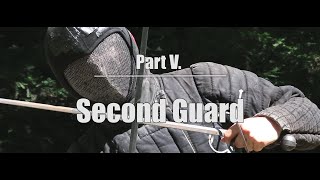
Introduction to the Stoccata
The stoccata is the principal attack in Capoferro's early 17th-century Italian rapier system. While the system includes cuts and other specialized thrusts, the stoccata serves as the foundational offensive technique, with cuts reserved primarily for ripostes and target-of-opportunity attacks.
Two Variations: Range and Footwork
The stoccata has two tactical variations determined by distance: nisura larga (wide measure) for long-range attacks requiring a forward step, and nisura stretta (narrow measure) for close-range attacks performed without footwork. The core body mechanics remain identical between both versions, differing only in the presence or absence of the supporting step.
Hand Positions and Guard Stances
The stoccata can be executed from multiple hand positions—terza, quarta, or seconda—depending on the tactical situation. The choice of guard position (guardia) determines which hand position supports the attack, though the fundamental body mechanics apply consistently across all variations.
Core Body Mechanics and Muscle Engagement
The stoccata is a whole-body movement requiring coordinated engagement of leg, torso, and back musculature to control the heavy blade (typically over 1.3 kilograms) with accuracy and efficiency. The attack begins by pushing with the rear thigh while simultaneously advancing the sword hand and expanding the torso forward in a unified motion called push-advance-expand.
Maintaining Level Trajectory and Weight Control
The attack should maintain a level forward drive rather than an upward arc, keeping weight low and close to horizontal. The rear leg should not push upward; instead, the entire body drives forward in a controlled, level plane toward the target.
Narrow Measure Execution (Pié Firmo)
The narrow measure stoccata is performed as a firm-footed attack (pié firmo) with no footwork, relying on forward torso lean and vita advancement while the feet maintain their grip on the ground. Recovery is accomplished by reversing the forward motion.
Wide Measure Execution with Forward Step
For wide measure attacks, the forward foot advances approximately one foot-length while the body executes the stoccata mechanics. The foot is raised slightly, moved forward, and landed on the heel before rolling onto the rest of the foot to safely absorb impact through the ankle and knee joints.
Progressive Training Method
Practitioners should initially train the stoccata without a weapon, executing the movement slowly to establish proper posture and body mechanics. Once mechanics are confident, speed is gradually increased before adding the sword to the practice.
Defensive Application and Guard Coverage
The stoccata provides inherent defensive benefit through the guard, quillons, and hilt position, which shield the sword arm, lead shoulder, and head when the body leans forward. This protective arrangement functions similarly to a small shield attached to the weapon.
Counter-Time Defense and Sword Interception
The stoccata serves a defensive function in contra-tempo exchanges, where the fencer interrupts an opponent's attack by launching a quick stoccata while angling the quillons and blade edge toward the opponent's weapon. This counter-time stoccata can also interrupt an opponent's cavazione (sword-freeing action) if the opponent's execution is slow or imprecise.
Capoferro Rapier 4: The Stoccata Thrust
Key Takeaways
- •Introduction to the Stoccata
- •Two Variations: Range and Footwork
- •Hand Positions and Guard Stances
- •Core Body Mechanics and Muscle Engagement
In this fourth video in our series on Capoferro's Italian rapier system I examine the main attack form, the stoccata thrust. Although it seems like a simple technique, performing it with the correct body mechanics is, as always, vitally important. Intro music - ERFA Jingle by Rossi Cariello
Related Techniques
Frequently Asked Questions
What does this video teach about rapier thrust?
This video covers introduction to the stoccata, two variations: range and footwork, hand positions and guard stances. It provides detailed instruction from Edinburgh Renaissance Fencing Academy.
How long does it take to learn rapier thrust?
The basic mechanics can be understood in a single session, but developing reliable execution requires consistent drilling over weeks of practice. This 10-part breakdown helps structure your training by isolating each phase of the technique.
What are the key details for finishing rapier thrust?
The stoccata provides inherent defensive benefit through the guard, quillons, and hilt position, which shield the sword arm, lead shoulder, and head when the body leans forward. This protective arrangement functions similarly to a small shield attached to the weapon.