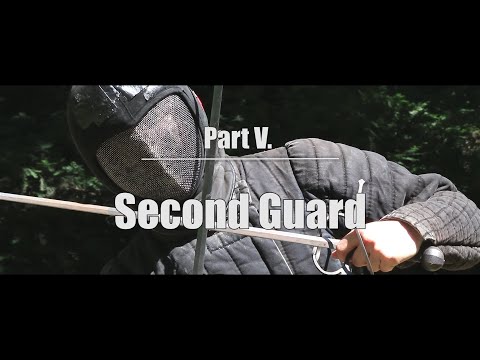
Learn Rapier V. - Second Guard
0
Rapier Guard·Martin Fabian
Part V. of my new video series about fencing with the symbol of the renaissance - the rapier, according to the teachings…
Translation: rapier guard
The Rapier Guard subfamily covers the four primary guard positions of Italian rapier fencing — Prima, Seconda, Terza, and Quarta — each named for the hand position (first through fourth) and corresponding to the four classical fencing invitations. [1] Each guard protects specific lines while threatening thrusts to others, and the system of four guards creates a comprehensive framework for controlling the engagement. [1],[2] Salvator Fabris and Capoferro both describe these four guards as the foundation of rapier defence, with the choice of guard dictating available offensive and defensive options. [2],[3]
Rapier guards were systematised by Renaissance Italian masters, with Agrippa's four primary guards forming the foundation adopted across Europe. [1]
Rapier guards are actively used in HEMA rapier tournaments worldwide. [1]
No images yet for this technique.
Sign in to suggest an image.
Part V. of my new video series about fencing with the symbol of the renaissance - the rapier, according to the teachings…
Part IV. of my new video series about fencing with the symbol of the renaissance - the rapier, according to the teaching…
No instructional courses yet for this technique.
Sign in to suggest a course.
Risk of injury to the person this technique is applied to
Edged weapons cause fatal lacerations; historical battlefield mortality rates >30% (Amberger 1999)
Skill level needed to execute this technique reliably
Whether this technique is allowed under major competition rule sets
The Art of Fencing (Luigi Barbasetti, 1932)
Alias sources — [1] The Sword and the Centuries (Castle, 1901) [2] Classical Fencing (Rogers, 2014) [3] Old Sword-Play (Hutton, 1892)
Effectiveness sources — [1] The Martial Arts of Renaissance Europe (Anglo, 2000) [2] The Swordsman's Companion (Windsor, 2004)
Mixed Japanese-Western terminology — combines traditional Japanese terms with katakana loanwords
Alias sources — [1] The Sword and the Centuries (Castle, 1901) [2] Classical Fencing (Rogers, 2014) [3] Old Sword-Play (Hutton, 1892)
Effectiveness sources — [1] The Martial Arts of Renaissance Europe (Anglo, 2000) [2] The Swordsman's Companion (Windsor, 2004)
wrist control for edge alignment, grip endurance, footwork precision
quick wrists, strong forearms, good posture
forearm extensors/flexors, deltoids, core, calves
Every move, in any martial art, shares a few universal traits. Mix and match below to pinpoint the right tool — or compare equivalents across styles.
Quarta (fourth guard) positions the hand with the palm facing upward (supinated), the blade angled across the body to protect the inside low line and threaten a thrust to the opponent's flank or abdomen. [1] Quarta is the guard most commonly used for parrying thrusts to the inside line and is the foundation of the modern fencing parry of quarte. [1,2] From Quarta, the fencer can deliver a riposte thrust along the inside line with minimal blade movement. [2,3]
Seconda (second guard) positions the hand with the palm facing outward (pronated), the blade angled to protect the outside low line and threaten a thrust beneath the opponent's arm. [1] Seconda is a powerful guard for controlling the outside line and is particularly effective in combination with a forward step (passata) to deliver a thrust under the opponent's weapon. [1,2] This guard is the basis of the modern fencing parry of seconde. [2,3]
Terza (third guard) positions the hand with the palm facing to the right (half-supinated), the blade extended along the centreline to threaten the opponent's chest or face. [1] Terza is the most neutral and commonly adopted guard in Italian rapier, providing balanced protection of both high and low lines while maintaining a direct threat. [1,2] Capoferro's preferred fighting stance places the sword arm in Terza, making it the default position for initiating attacks. [2,3]
Sekonda is suited even more to parry a cut than First Guard. According to Martin Fabian, you can provoke a cut by pushing the opponent's sword to the side, then parry their strike with your extended sword and thrust into their chest.
Martin Fabian emphasizes leaning away with your head and body when executing techniques in First Guard, so that if your technique fails, you can still evade the opponent's blade through body movement alone.
Push your opponent's blade out of the line to call for a calazione (tempo), forcing them to return to the center line where you can execute a combined parry and thrust against their cut from either side while keeping your arm extended.
The Rapier Guard subfamily covers the four primary guard positions of Italian rapier fencing — Prima, Seconda, Terza, and Quarta — each named for the hand position (first through fourth) and corresponding to the four classical fencing invitations. Each guard protects specific lines while threatening thrusts to others, and the system of four guards creates a comprehensive framework for controlling the engagement.
The four-guard system of Italian rapier fencing was codified by Salvator Fabris in Lo Schermo (1606) and refined by subsequent masters. This four-guard framework directly influenced the development of modern fencing's parry system (parry of prime through quarte).
FIE: legal — Legal fencing technique — governed by FIE rules for foil, épée, and sabre; HEMA: legal — Legal in historical fencing competition
Danger rating 9/10. Extreme — edged weapons cause fatal lacerations; historical battlefield mortality rates >30% (Amberger 1999)
The standard setup chain: En Garde → Advance/Lunge Preparation → Attack → Recovery.
Standard counters include: Beat Parry — deflect the blade with a sharp lateral beat before it reaches target / Displacement — move the body off the line while threatening with the point / Counter-Thrust — extend into the attacker's line during their advance.
Common variants: Standard cut (primary cutting angle from the ready stance); Thrust (tsuki) (straight thrust targeting the throat, chest, or face); Rising cut (kiri-age) (upward diagonal cut from low to high); Diagonal cut (kesa-giri) (downward diagonal cut following the kimono line).
Rapier guards are actively used in HEMA rapier tournaments worldwide.
Top errors to watch for: Holding the guard with a retracted arm — the arm should be extended or semi-extended to minimize thrust distance / Not directing the point at the opponent — every guard must threaten with the point / Using the same guard for all situations — different guards protect different lines; adapt to the opponent's actions / Holding the guard with excessive tension — the hand must be relaxed enough for quick changes.
The Rapier Guard is also known as Reipia Kamae, Guardia, Rapier Guard Position, Ward.