Defensive Goals in Knife Use
The primary objective of knife deployment in self-defense is to stop an active threat. This can be accomplished through pain compliance causing an attacker to withdraw, or through functional impairment via blood loss or structural damage. A knife is not a less-lethal tool, meaning any deployment carries lethal force implications, though non-fatal injury sufficient to halt a threat satisfies the defensive objective.
Advantages of Slashing Technique
Slashing requires less precision than thrusting, as the cutting arc can intercept a moving target even with modest accuracy. Deep slashes have superior capacity to completely transect blood vessels, tendons, ligaments, and muscle tissue, causing significant structural damage and functional impairment of the targeted limb.
Advantages of Thrusting Technique
Thrusts penetrate deeper into the body, allowing access to vital organs protected by bone structure—including the heart, aorta, and major blood vessels—that surface slashes cannot reliably reach. Thrusts are more economical in motion, traveling in a straight path with minimal structural openings for an opponent to exploit, and translate effectively to improvised weapons like screwdrivers or pens.
Limitations of Slashing
Slashing motions degrade under adrenaline stress into wide, inefficient arcs that expose the defender's structure and reduce effectiveness. The technique also fails when applied to improvised weapons lacking blade geometry designed for cutting, requiring the practitioner to rely on thrusting instead.
Blade Design for Thrusting
Thin, pointed blades minimize friction and penetrate tissue more efficiently than wider designs. Specialized thrusting blades like the TDI knife or karambit feature inward-curved edges and pronounced points that excel at straight thrusting and ripping motions but sacrifice cutting surface area and require awkward angles for slashing.
Blade Design for Slashing
Blades with large belly profiles and substantial edge length excel at slashing due to greater surface area contact during the cutting motion. Trailing-tip and similar curved designs maximize cutting efficiency for arc-based techniques.
General-Purpose Blade Selection
Clip-point and drop-point blade designs offer balanced capability for both thrusting and slashing, making them practical general-purpose options. Practitioners should handle various blade geometries to understand how each design influences technique and application.
Knife Fighting: Thrust vs Slash
Key Takeaways
- •Defensive Goals in Knife Use
- •Advantages of Slashing Technique
- •Advantages of Thrusting Technique
- •Limitations of Slashing
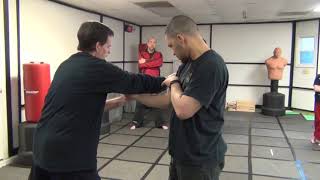
In this video, we look at the advantages and disadvantages of thrusting versus slashing. Each has it's pro's and con's. We have to understand when and where each has it's place. For exclusive, full length, instructional videos, go to: http://warriorfocus.org/ For information on training courses from Warrior Tactical Systems, go to: http://www.wartacsystems.com/ Get emails with videos tips and exclusive offers at: http://forms.aweber.com/form/63/2126511263.htm Please subscribe to this channel and share with your network. Connect with me on: Facebook: https://www.facebook.com/WarTacSystems Google +: https://plus.google.com/+WarriorTacticalSystems Linkedin: https://www.linkedin.com/in/paul-clark-2b518567?trk=nav_responsive_tab_profile_pic
Related Techniques
Frequently Asked Questions
What does this video teach about knife thrust?
This video covers defensive goals in knife use, advantages of slashing technique, advantages of thrusting technique. It provides detailed instruction from Warrior Tactical Systems LLC.
How long does it take to learn knife thrust?
The basic mechanics can be understood in a single session, but developing reliable execution requires consistent drilling over weeks of practice. This 7-part breakdown helps structure your training by isolating each phase of the technique.
What are the key details for finishing knife thrust?
Blades with large belly profiles and substantial edge length excel at slashing due to greater surface area contact during the cutting motion. Trailing-tip and similar curved designs maximize cutting efficiency for arc-based techniques.