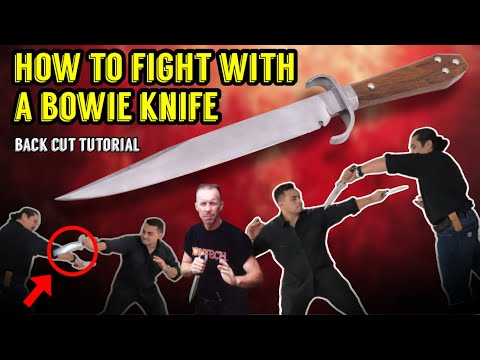
How to FIGHT with a Bowie Knife – Keating’s Back Cut System EXPLAINED
0
Knife Cut·Tactical Tavern Tomas
Unlock the secrets of the Bowie Knife’s deadliest techniques with this exclusive episode breaking down 2 brutal back cut…
Translation: knife cut
The Knife Cut subfamily covers all cutting and slashing actions performed with a knife, as distinct from thrusting techniques. [1] Knife cuts employ the edge of the blade in sweeping, arcing, or hooking motions to target the opponent's limbs, neck, and torso. [1],[2] Filipino martial arts organise knife cuts around numbered angles of attack (typically five or twelve angles), ensuring that all lines of cutting are systematically trained. [2],[3]
Knife cutting techniques have been practised in blade-centric cultures worldwide, with Filipino martial arts developing the most systematic angle-based frameworks for classifying and drilling cuts. [1] Modern knife-fighting systems such as Sayoc Kali and Pekiti-Tirsia Kali organise cuts into numbered sequences that practitioners drill thousands of repetitions to achieve fluency. [2],[3]
Knife cuts use slashing motions to inflict damage across a wide area, effective for targeting the hands, arms, and face at close range. [1]
Knife cutting techniques are competed in FMA dagger divisions using padded or training knives. [1]
No images yet for this technique.
Sign in to suggest an image.
Unlock the secrets of the Bowie Knife’s deadliest techniques with this exclusive episode breaking down 2 brutal back cut…
No instructional courses yet for this technique.
Sign in to suggest a course.
Risk of injury to the person this technique is applied to
Knives and short blades are the most common weapon in real-world assaults; high lethality
Skill level needed to execute this technique reliably
Whether this technique is allowed under major competition rule sets
Bubishi: The Classic Manual of Combat (Patrick McCarthy, 2008)
Alias sources — [1] Filipino Martial Arts (Wiley, 1994) [2] Hoplology (Burton, 1884) [3] Comprehensive Asian Fighting Arts (Draeger & Smith, 1969)
Effectiveness sources — [1] Filipino Martial Arts (Wiley, 1997)
Mixed Japanese-Western terminology — combines traditional Japanese terms with katakana loanwords
Alias sources — [1] Filipino Martial Arts (Wiley, 1994) [2] Hoplology (Burton, 1884) [3] Comprehensive Asian Fighting Arts (Draeger & Smith, 1969)
Effectiveness sources — [1] Filipino Martial Arts (Wiley, 1997)
wrist control for edge alignment, grip endurance, footwork precision
quick wrists, strong forearms, good posture
forearm extensors/flexors, deltoids, core, calves
Every move, in any martial art, shares a few universal traits. Mix and match below to pinpoint the right tool — or compare equivalents across styles.
The Backhand Cut is a knife cutting action delivered from the outside inward using the back of the hand to drive the blade edge across the target. [1] In Filipino martial arts this corresponds to the even-numbered angles of attack (angles 2, 4, 6 in many systems), travelling from the practitioner's non-dominant side. [1,2] The backhand cut is often used as a follow-up to a forehand cut, creating a continuous figure-eight cutting pattern. [2,3]
The Slash Cut is a broad, sweeping knife action that draws the blade edge across the target in a horizontal or diagonal arc, maximising the length of the cutting surface in contact with the target. [1] Unlike a chop, which relies on impact force, the slash uses a pulling or pushing motion to let the blade's edge do the work, making it effective even with moderate force. [1,2] In Filipino martial arts the slash is a primary offensive tool, often targeting the forearm, hand, or neck. [2,3]
The Upward Cut is a knife cutting action that travels vertically from low to high, typically targeting the underside of the opponent's forearm, the inside of the wrist, or the abdomen. [1] In Filipino martial arts this motion corresponds to angle 9 or angle 12 in various numbering systems and is often delivered from a concealed low position. [1,2] The upward cut is tactically valuable because it attacks from below the opponent's line of sight and is difficult to parry with a downward block. [2,3]
Using an ipsilateral (same-side) stance allows you to create distance by retracting one shoulder while protruding the other, which keeps your opponent in your line while you move off theirs. This positioning is fundamental to Keating's Back Cut System.
When you execute the back cut and step back, you move completely off your opponent's line while keeping them on yours, so even if they attempt a counter, you're already out of range and have the tactical advantage.
You cannot simply flick your wrist on a contralateral cut as this creates a mutual kill situation; instead, pop your elbow up and turn your hip over (similar to throwing a hook) to safely clear the line and deliver the cut across to the target.
The Knife Cut subfamily covers all cutting and slashing actions performed with a knife, as distinct from thrusting techniques. Knife cuts employ the edge of the blade in sweeping, arcing, or hooking motions to target the opponent's limbs, neck, and torso.
Knife cutting techniques have been practised in blade-centric cultures worldwide, with Filipino martial arts developing the most systematic angle-based frameworks for classifying and drilling cuts. Modern knife-fighting systems such as Sayoc Kali and Pekiti-Tirsia Kali organise cuts into numbered sequences that practitioners drill thousands of repetitions to achieve fluency.
WEKAF: legal — Legal in padded stick competition; HEMA: legal — Legal in applicable weapon categories
Danger rating 9/10. Extreme — knives and short blades are the most common weapon in real-world assaults; high lethality
The standard setup chain: Ready Position → Distance Control → Execute Technique → Return to Guard.
Standard counters include: Parry (Absetzen) — deflect the incoming blade with a counter-displacement / Void (Step Back) — withdraw from measure to avoid the cutting arc / Counter-Cut (Nachreisen) — strike into the opponent's opening during their attack.
Common variants: Standard cut (primary cutting angle from the ready stance); Thrust (tsuki) (straight thrust targeting the throat, chest, or face); Rising cut (kiri-age) (upward diagonal cut from low to high); Diagonal cut (kesa-giri) (downward diagonal cut following the kimono line).
Knife cutting techniques are competed in FMA dagger divisions using padded or training knives.
Top errors to watch for: Slapping with the flat of the blade — proper edge alignment is critical; the edge must contact the target / Using excessive force — knife cuts rely on edge sharpness and drawing motion, not blunt force / Cutting with only the tip — use the full length of the edge for maximum cutting effect / Not varying cutting angles — predictable cuts from the same angle are easily defended.
The Knife Cut is also known as Naifu Kiri, Taga, Knife Slash, Blade Cut.