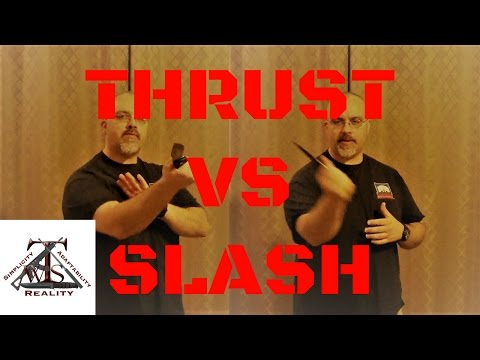
Knife Fighting: Thrust vs Slash
0
Knife Thrust·Warrior Tactical Systems LLC
In this video, we look at the advantages and disadvantages of thrusting versus slashing. Each has it's pro's and con's. …
Translation: knife thrust
The Knife Thrust subfamily covers all stabbing and piercing actions performed with a knife, where the point of the blade is driven directly into the target. [1] Thrusting is biomechanically the most efficient knife action for penetrating force, requiring less space and travel distance than a cut. [1],[2] Military combatives systems emphasise the thrust as the primary lethal knife technique due to its speed, directness, and difficulty to detect and parry. [2],[3]
Knife thrusting has been the preferred military knife technique since at least World War I, when trench fighting demonstrated the thrust's superiority in confined spaces. [1] William Fairbairn's World War II combatives manual emphasised the forward thrust as the most reliable knife attack, a doctrine that continues to influence military knife training today. [2],[3]
Knife thrusting technique exists in all blade-fighting traditions, with FMA, HEMA dagger, and military combatives all emphasising the thrust as the primary lethal action. [1]
Knife thrusts are the primary scoring action in FMA dagger competition divisions. [1]
No images yet for this technique.
Sign in to suggest an image.
In this video, we look at the advantages and disadvantages of thrusting versus slashing. Each has it's pro's and con's. …
Cut and Thrust in Knife Combatives This is a bit of an insight in the Bundok Eskrima method of knife training. #sel…
No instructional courses yet for this technique.
Sign in to suggest a course.
Risk of injury to the person this technique is applied to
Knives and short blades are the most common weapon in real-world assaults; high lethality
Skill level needed to execute this technique reliably
Whether this technique is allowed under major competition rule sets
Bubishi: The Classic Manual of Combat (Patrick McCarthy, 2008)
Alias sources — [1] Filipino Martial Arts (Wiley, 1994) [2] Hoplology (Burton, 1884) [3] Comprehensive Asian Fighting Arts (Draeger & Smith, 1969)
Effectiveness sources — [1] Filipino Martial Arts (Wiley, 1997) [2] Classical Fighting Arts of Japan (Mol, 2001)
Mixed Japanese-Western terminology — combines traditional Japanese terms with katakana loanwords
Alias sources — [1] Filipino Martial Arts (Wiley, 1994) [2] Hoplology (Burton, 1884) [3] Comprehensive Asian Fighting Arts (Draeger & Smith, 1969)
Effectiveness sources — [1] Filipino Martial Arts (Wiley, 1997) [2] Classical Fighting Arts of Japan (Mol, 2001)
wrist control for edge alignment, grip endurance, footwork precision
quick wrists, strong forearms, good posture
forearm extensors/flexors, deltoids, core, calves
Every move, in any martial art, shares a few universal traits. Mix and match below to pinpoint the right tool — or compare equivalents across styles.
The primary goal is to stop the threat by either causing pain compliance or affecting the attacker's function through blood loss or structural damage—especially important when dealing with someone on drugs or highly motivated. Warrior Tactical Systems LLC emphasizes not relying on pain alone.
Unlike slashes, thrusts don't make your weapon stick in your opponent, which is critical when facing multiple attackers in melee combat. The Bladed Bludgeoner notes this is why the rapier became the civilian dueling weapon of choice over slashing swords.
Compression is critical to cutting effectiveness—simply slashing across a target without pressing into it will cut far less effectively. The Bladed Bludgeoner emphasizes that proper compression technique must be trained alongside all other aspects of knife work.
The larger your knife, the more important and effective cutting becomes relative to thrusting. The Bladed Bludgeoner advises not disregarding slashes and cuts as important aspects of knife combatives, especially with larger folder or daily carry knives.
The Knife Thrust subfamily covers all stabbing and piercing actions performed with a knife, where the point of the blade is driven directly into the target. Thrusting is biomechanically the most efficient knife action for penetrating force, requiring less space and travel distance than a cut.
Knife thrusting has been the preferred military knife technique since at least World War I, when trench fighting demonstrated the thrust's superiority in confined spaces. William Fairbairn's World War II combatives manual emphasised the forward thrust as the most reliable knife attack, a doctrine that continues to influence military knife training today.
WEKAF: legal — Legal in padded stick competition; HEMA: legal — Legal in applicable weapon categories
Danger rating 9/10. Extreme — knives and short blades are the most common weapon in real-world assaults; high lethality
The standard setup chain: Ready Position → Distance Control → Execute Technique → Return to Guard.
Standard counters include: Parry (Absetzen) — deflect the incoming blade with a counter-displacement / Void (Step Back) — withdraw from measure to avoid the cutting arc / Counter-Cut (Nachreisen) — strike into the opponent's opening during their attack.
Common variants: Standard cut (primary cutting angle from the ready stance); Thrust (tsuki) (straight thrust targeting the throat, chest, or face); Rising cut (kiri-age) (upward diagonal cut from low to high); Diagonal cut (kesa-giri) (downward diagonal cut following the kimono line).
Knife thrusts are the primary scoring action in FMA dagger competition divisions.
Top errors to watch for: Pushing rather than thrusting — the thrust must be a sharp, explosive extension, not a gradual push / Over-extending and losing balance — the body must stay centred; leaning forward past the base of support creates vuln… / Not retracting immediately — the extended arm is vulnerable to grabs and counter-cuts; snap the blade back / Telegraphing with the shoulder — the thrust should be initiated from the arm without a visible shoulder wind-up.
The Knife Thrust is also known as Naifu Tsuki, Saksak, Knife Stab, Blade Thrust.