You Can't Disarm a Knife Like That!
0
Knife Defence-Disarm·Rantoni
Missed the stream? Click the link below to watch the next one! 🔴 TWITCH ►► SUNDAY, MONDAY, WEDNESDAY, THURSDAY 10pm CET…
Translation: knife defence-disarm
The Knife Defence-Disarm subfamily covers techniques for defending against a knife attack and stripping the weapon from the attacker's hand. [1] Disarm techniques typically combine a parry or redirect of the attacking arm with a joint lock, wrist manipulation, or leveraged strip that forces the knife free. [1],[2] Filipino martial arts, Krav Maga, and Hapkido all include extensive knife-disarm curricula, though the tactical philosophies differ significantly between systems. [2],[3]
Knife disarm techniques appear in Filipino martial arts as a core training component (often called 'disarms' or 'strips'), in Japanese jujutsu as tantō-dori (knife-taking), and in modern military close-quarters combat programs. [1] Krav Maga formalised a set of knife defences for the Israel Defense Forces in the 1960s that remain among the most widely taught civilian self-defence knife techniques today. [2],[3]
Knife defence and disarming techniques use redirection, joint locks, and striking to neutralise a knife-wielding attacker, though all knife defences carry significant risk. [1]
Knife disarming is a specialty of FMA, which developed the most comprehensive disarming curriculum of any martial art. [1]
Knife disarming is demonstrated at FMA events and self-defence seminars worldwide. [1]
No images yet for this technique.
Sign in to suggest an image.
Missed the stream? Click the link below to watch the next one! 🔴 TWITCH ►► SUNDAY, MONDAY, WEDNESDAY, THURSDAY 10pm CET…
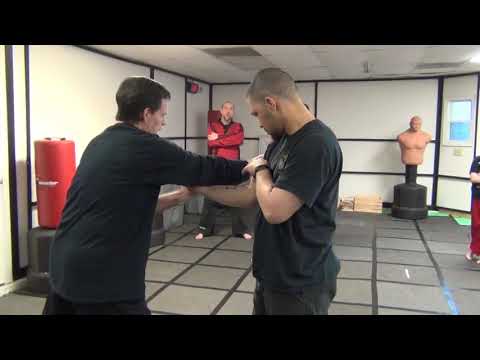
From a knife workshop http://www.dynamicfightingart.com
No instructional courses yet for this technique.
Sign in to suggest a course.
Risk of injury to the person this technique is applied to
Knives and short blades are the most common weapon in real-world assaults; high lethality
Skill level needed to execute this technique reliably
Whether this technique is allowed under major competition rule sets
Bubishi: The Classic Manual of Combat (Patrick McCarthy, 2008)
Alias sources — [1] Filipino Martial Arts (Wiley, 1994) [2] Hoplology (Burton, 1884) [3] Comprehensive Asian Fighting Arts (Draeger & Smith, 1969)
Effectiveness sources — [1] Filipino Martial Arts (Wiley, 1997)
Mixed Japanese-Western terminology — combines traditional Japanese terms with katakana loanwords
Alias sources — [1] Filipino Martial Arts (Wiley, 1994) [2] Hoplology (Burton, 1884) [3] Comprehensive Asian Fighting Arts (Draeger & Smith, 1969)
Effectiveness sources — [1] Filipino Martial Arts (Wiley, 1997)
wrist control for edge alignment, grip endurance, footwork precision
quick wrists, strong forearms, good posture
forearm extensors/flexors, deltoids, core, calves
Every move, in any martial art, shares a few universal traits. Mix and match below to pinpoint the right tool — or compare equivalents across styles.
The most important thing is to get a hold of the knife itself. Knife attacks are chaotic situations where both you and the attacker are likely to get hurt, so controlling the weapon is critical.
No, kicks are never recommended in real self-defense knife situations. They are very risky because you can slip and fall, and falling during a serious fight is extremely dangerous. Stick to punches and throws instead.
The disarm works best on larger fixed blades or machetes, but you would never be able to use this technique on a pocket knife. The key is to control the hand by targeting where the fingers bend and meet the hand to force them open.
The Knife Defence-Disarm subfamily covers techniques for defending against a knife attack and stripping the weapon from the attacker's hand. Disarm techniques typically combine a parry or redirect of the attacking arm with a joint lock, wrist manipulation, or leveraged strip that forces the knife free.
Knife disarm techniques appear in Filipino martial arts as a core training component (often called 'disarms' or 'strips'), in Japanese jujutsu as tantō-dori (knife-taking), and in modern military close-quarters combat programs. Krav Maga formalised a set of knife defences for the Israel Defense Forces in the 1960s that remain among the most widely taught civilian self-defence knife techniques today.
FIE: legal — Legal fencing technique — governed by FIE rules for foil, épée, and sabre; HEMA: legal — Legal in historical fencing competition
Danger rating 9/10. Extreme — knives and short blades are the most common weapon in real-world assaults; high lethality
The standard setup chain: En Garde → Advance/Lunge Preparation → Attack → Recovery.
Standard counters include: Guard Position — return to a defensive ready stance / Distance Management — control the measure to avoid being in range / Counter-Attack — strike during the opponent's recovery or between movements.
Common variants: Standard cut (primary cutting angle from the ready stance); Thrust (tsuki) (straight thrust targeting the throat, chest, or face); Rising cut (kiri-age) (upward diagonal cut from low to high); Diagonal cut (kesa-giri) (downward diagonal cut following the kimono line).
Knife disarming is demonstrated at FMA events and self-defence seminars worldwide.
Top errors to watch for: Assuming you won't get cut — in most knife encounters, even successful defenders receive cuts; train with this reality / Grabbing for the blade — control the arm, not the weapon; grabbing the blade causes severe hand injuries / Using fine motor techniques under stress — adrenaline degrades fine motor control; use gross motor movements for defence / Not training at realistic speed — slow, cooperative knife defence creates false confidence.
The Knife Defence-Disarm is also known as Naifu Bōgyo / Buki-tori, Knife Disarm, Blade Defence, Knife Takeaway.