Introduction to Tail Guard
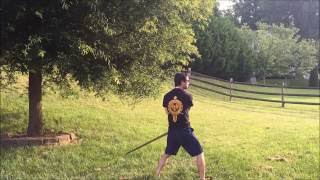
Tail (Nebenhut) is the final secondary guard in this series and is considered by many practitioners to be one of the most practical. The guard is executed by rotating a fool guard 180 degrees so the sword point aims directly behind the body. This positioning creates unique offensive and defensive characteristics distinct from other guards.
Grip Requirements
A loose grip on the pommel is essential for executing tail effectively on either side. The practitioner should nearly palm the pommel, especially when arms cross in the guard position. With heavy gloves, maintaining contact primarily through thumb placement allows the necessary flexibility for smooth transitions.
Transfer Overview: Unter-How
The three primary transfers from tail follow the sequence: unter-how, middle-how, and over-how. The unter-how begins by dropping the tip downward, which rises diagonally into an ox position before returning to tail on the opposite side. This transfer requires relaxed fingers and should be practiced equally on both sides.
Transfer Overview: Middle-How
The middle-how employs the false edge as the primary cutting surface, distinguishing it from the unter-how. This sweep motion requires knuckles to face downward during execution before returning to tail. The false edge's availability in tail makes this transfer particularly useful for unconventional cutting angles.
Transfer Overview: Over-How
The over-how concludes the transfer sequence and utilizes the false edge in an unconventional upward angle. The point rises and descends at an angle that mirrors the true edge unter-how but with inverted hand position—knuckles toward ceiling and thumb toward the rear. This seemingly awkward motion proves highly efficient when attacking from the same side as the opponent.
Bilateral Transfer Sequence
The complete transfer cycle executes identically from both right and left positions: unter-how, middle-how with false edge, and over-how with false edge. This sequence should be practiced both forward and backward to develop fluid transitions. Maintaining proper body positioning ensures the sword remains perpendicular to the body rather than angled outward or behind.
Sword Positioning and Alignment
The sword must be maintained at a perpendicular angle relative to the body, neither angled outward nor extended rearward. This solid lateral positioning provides stability and allows efficient transitions between guards. Proper alignment ensures the weapon remains ready for immediate offense while maintaining structural integrity.
Offensive and Defensive Considerations
The tail guard positions the sword point directly behind the body as an active threat to the opponent, particularly effective against long point stances. However, this same positioning makes thrust deflections challenging, requiring the blade to traverse significant distance from rear to defensive position. The guard excels when the practitioner can press initiative and maintain offensive momentum.
Practical Applications and Advantages
Tail guard is exceptional for executing a wide variety of cutting angles and trajectories that prove difficult for opponents to anticipate or counter. The guard's unusual geometry makes it particularly effective against grills and other defensive positions. This versatility, combined with its offensive capability, makes tail a favorite positioning for skilled practitioners seeking to control combat through deception and initiative.
Tail/Nebenhut guard
Key Takeaways
- •Introduction to Tail Guard
- •Grip Requirements
- •Transfer Overview: Unter-How
- •Transfer Overview: Middle-How
Here we discuss the 3 transfers for the tail guard and how to drill all 3. The official channel of the HEMA Club @ VCU. Our videos are: Produced by: Mick Murphy, Dan Thomas Presented by: Nick Allen, Tom Wagamon Edited by: Dan Thomas
Related Techniques
Frequently Asked Questions
What does this video teach about schrankhut?
This video covers introduction to tail guard, grip requirements, transfer overview: unter-how. It provides detailed instruction from VCU HEMA.
How long does it take to learn schrankhut?
The basic mechanics can be understood in a single session, but developing reliable execution requires consistent drilling over weeks of practice. This 9-part breakdown helps structure your training by isolating each phase of the technique.
What are the key details for finishing schrankhut?
The tail guard positions the sword point directly behind the body as an active threat to the opponent, particularly effective against long point stances. However, this same positioning makes thrust deflections challenging, requiring the blade to traverse significant distance from rear to defensive position. The guard excels when the practitioner can press initiative and maintain offensive momentum.