Technique Classification
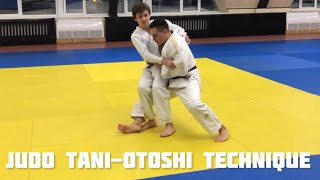
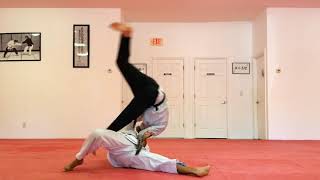
Tani Otoshi is classified as a Yoko Tsutemi Waza (side sacrifice throw), where the thrower's body lies on its side rather than the back. The technique is part of the sacrifice throw category in judo and requires precise positioning and balance disruption to execute effectively.
Initial Grip and Balance Breaking
The technique begins with a standard komikata grip. Before executing the throw, the thrower must control the opponent's upper body and break their balance through circular hand actions. Both hands work in unison, with the throwing hand lifting and rotating the opponent's arm and shoulder in a circular motion.
Three-Phase Balance Disruption
Balance breaking occurs in three sequential actions: first, bringing the opponent's foot forward with a slight break; second, elevating the hip onto the opponent's toes; and third, directing pressure slightly to the left, primarily through the right hand. This sequence renders the opponent vulnerable on their right leg.
Leg Placement and Trap
The throwing leg extends forward and drops between the opponent's legs, trapping the rear heel rather than contacting the left leg directly. Full extension of this leg is critical—the leg must pass beyond the opponent's left leg to maximize throwing power through gravitational force.
Weight Distribution and Hip Leverage
During execution, the thrower maintains contact with the mat through toe positioning on both feet. Hip extension and leverage are applied in conjunction with hand and arm action to amplify the throw's power. The closer the thrower's body to the opponent, the more effective the technique becomes.
Synchronized Body Mechanics
Tani Otoshi requires coordinated action of the hands, feet, hips, and shoulders working in unified sequence. The left leg's toe maintains contact with the mat while extending, and both legs function together to generate maximum efficiency with minimal effort—a core principle of judo technique.
Practice Requirements
Mastering Tani Otoshi demands extensive repetition, practice on both sides, and commitment to detail work. Practitioners should focus on developing the hand actions, dropping mechanics, and hip positioning gradually before applying full speed and power.
How to do Tani Otoshi
Key Takeaways
- •Technique Classification
- •Initial Grip and Balance Breaking
- •Three-Phase Balance Disruption
- •Leg Placement and Trap
In this tutorial I am showing you how to do Tani Otoshi. Learning this technique provides an excellent foundation for future counter throws. It is essential that you fully commit yourself, and fully extend your leg behind uke, making strong use of kuzuhi to execute this powerful throw. Be sure to like, comment and share the video! Like us on Facebook at: www.Facebook.com/SampsonJudo www.sobelljudoclub.com www.judoforall.org.uk Finger tape: https://amzn.to/2zbqvyh Mizuno Judogi: https://amzn.to/3gasbZz Pre-washed soft black belt: https://amzn.to/2XpNIEK My ultimate technique reference book: https://amzn.to/2LT46Zk Mind over muscle by Jigoro Kano: https://amzn.to/2zeDTSi
Related Techniques
Frequently Asked Questions
What does this video teach about tani otoshi?
This video covers technique classification, initial grip and balance breaking, three-phase balance disruption. It provides detailed instruction from Sampson Judo.
How long does it take to learn tani otoshi?
The basic mechanics can be understood in a single session, but developing reliable execution requires consistent drilling over weeks of practice. This 7-part breakdown helps structure your training by isolating each phase of the technique.
What are the key details for finishing tani otoshi?
Tani Otoshi requires coordinated action of the hands, feet, hips, and shoulders working in unified sequence. The left leg's toe maintains contact with the mat while extending, and both legs function together to generate maximum efficiency with minimal effort—a core principle of judo technique.